Focus
Your Present Location: HOME> Focus-
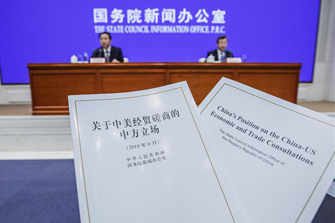
Yang Fanxin: Chinese white paper exposes flaws in Trump's 'America First' policy
"China's Position on the China-U.S. Economic and Trade Consultations" represents the authentic voice of the Chinese on their concerns over the trade restrictions launched by the United States some 15 months ago.
2019-06-10 -
William Jones: China grows weary of the U.S. moving the goal posts on trade
The publication by China's Ministry of Commerce of the policy white paper “China's Position on the China-U.S. Economic and Trade Consultations” last week, coupled with China's Ministry of Commerce's research report on U.S. gains from bilateral trade cooperation on Thursday, are really China drawing a line in the sand, noting that their patience was running out with the continual shifts in U.S. policy in resolving the contentious trade negotiations. How many times have we seen the two sides approaching some type of agreement when suddenly President Donald Trump, or one of his advisers, makes some remarks about issues that remain unresolved and throws everything into turmoil?
2019-06-10 -
Han Hua: Duan Wu continues to bring people together
Duan Wu, literally the "double fifth" lunar day and month, or Dragon Boat Festival, brings people closer every year. Why? Unlike many other traditional holidays that honor gods or Mother Nature, Duan Wu was created by the people to commemorate a real person.
2019-06-10 -
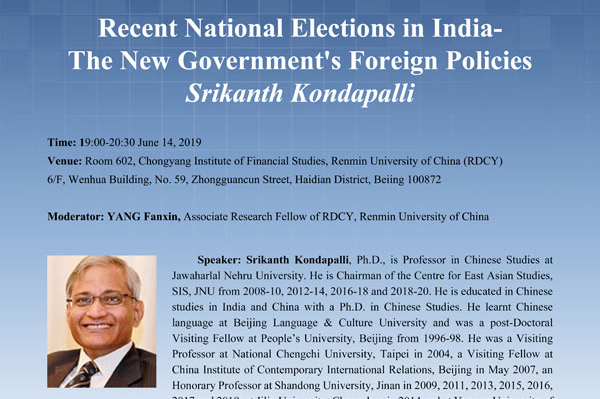
Srikanth Kondapalli: Recent National Elections in India- The New Government's Foreign Policies
Srikanth Kondapalli, Professor in Chinese Studies at Jawaharlal Nehru University, will give a lecture with the theme of “Recent National Elections in India- The New Government's Foreign Policies” on June 14, 2019.
2019-06-10 -
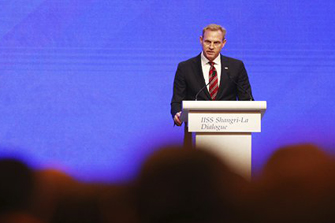
Zhao Minghao: With stepped-up plan, US takes aim at China
The Pentagon released its first Indo-Pacific Strategy Report (IPSR) on June 1. On the same day, US Acting Defense Secretary Patrick Shanahan explained the main points of this report when he spoke at the 18th Shangri-La Dialogue in Singapore which was held between May 31 and June 2. Amid an escalating trade conflict between China and the US, US President Donald Trump's administration is determined to invest more resources in implementing the Indo-Pacific Strategy, especially in the field of security, which has not only alarmed Beijing, but also unsettled most countries in the region.
2019-06-10 -
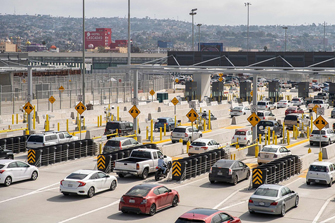
William Jones: Despite a trade agreement, Trump threatens Mexico with new tariffs
U.S. President Trump seems almost obsessed with his newfound ability to get his way using tariffs as a weapon. Concerned with the continued flow of migrants on the U.S. border with Mexico, which he blames on Mexico's rather limited ability to prevent migrants from coming through their country to the U.S. border, he is now threatening Mexico with a five percent tariff starting on June 10.
2019-06-06 -

Ding Gang: Nepal not a pawn in US’ China strategy
Over 200 years ago, British colonists began to march into Nepal, with China's Tibet their next target. But the era of Western expansion starting from 500 years ago is gone forever. China's policy of creating an amicable and prosperous neighborhood will offer people of Nepal and other South Asian countries more opportunities to improve their living standards.
2019-06-06 -
He Weiwen: How Trump's Extreme Pressure on China is Backfiring
US President Donald Trump said recently on Twitter that Huawei could be part of a potential trade deal. In other words, America’s recent outright ban on Huawei was not truly done for national security reasons — there was no evidence supporting the allegations — but rather as a bargaining chip to help get “a great deal” with China.
2019-06-04 -
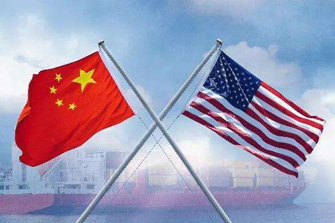
Zhao Minghao: US has shot itself in the foot by escalating trade war
As the US has recently tightened the screws on tariffs and as talk of a "tech cold war" looms, the prospect of an agreement between China and the US appears gloomier.
2019-05-31 -
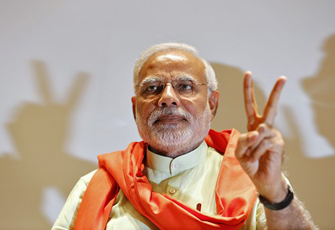
Ding Gang: Pros and cons of Modi as a strong politician
Indian Prime Minister Narendra Modi's thumping victory on May 23 reflects the power of nationalism in an ascendant nation. Such a sentiment led voters to re-elect Modi and vest their future in him.
2019-05-30 -

FTZ could be impetus for China-Russia trade, cooperation in new areas
Russia and China could establish a free trade zone (FTZ) of a limited size in the initial phase, as an answer to a rising tide of protectionism around the world, Chinese analysts said on Wednesday.
2019-05-30 -

Ding Gang: Pros and cons of Modi as a strong politician
Indian Prime Minister Narendra Modi's thumping victory on May 23 reflects the power of nationalism in an ascendant nation. Such a sentiment led voters to re-elect Modi and vest their future in him.
2019-05-30 -

He Weiwen: Trade conflict suggests hard times ahead
The escalating China-US trade friction is unprecedented in the history of bilateral relations. True, when trade begins, trade friction begins, too. And the history of China-US relations since the establishment of diplomatic relations in 1979 has been a history of bilateral trade frictions. But the trade frictions in the 1980s were relatively small and less damaging.
2019-05-30 -

FTZ could be impetus for China-Russia trade, cooperation in new areas
Russia and China could establish a free trade zone (FTZ) of a limited size in the initial phase, as an answer to a rising tide of protectionism around the world, Chinese analysts said on Wednesday.
2019-05-30 -

Huawei Threat Artificially Inflated by Radical US Politicians
The United States, while urging other countries to join sanctions against Huawei, is dividing the global community. As a result, the rest of the world unwittingly has become a hostage to the situation, and many American partners find themselves in an uncomfortable position.
2019-05-29 -

Vietnam advised to stimulate domestic consumption
The escalating US-China trade war has affected many other countries, including Vietnam, said Prof. Liu Ying of the Chongyang Institute for Financial Studies under the Renmin University of China.
2019-05-29 -

The "May 4" Spirit: Why China Refuses to Surrender on Trade
With China-US trade negotiations suffering a new setback, international public opinion is increasingly pessimistic about the prospect of the two countries reaching an agreement and concluding the trade war. The Trump administration has not only decided to raise tariffs on about $200 billion worth of Chinese exports from 10 percent to 25 percent, but is also preparing to impose a 25-percent tariff on another $320 billion worth of goods. The Chinese side has announced it will take necessary retaliatory measures in response. Chinese official media outlets, such as the People's Daily, have published a series of articles, emphasizing that China is not afraid of US pressure, and will fight till the end if the US wants to continue the trade war. Beijing's rseponse was tougher than expected.
2019-05-28 -

Projects agreed to boost ties as Chinese VP visits Pakistan
China-Pakistan cooperation in the next phase will focus more on benefiting people through local projects that improve livelihood along the China-Pakistan Economic Corridor (CPEC), Chinese experts said on Monday as Chinese Vice President Wang Qishan was visiting Pakistan and the two countries boosted their cooperation on multiple projects.
2019-05-28 -

Zhao Minghao: Why China Refuses to Surrender on Trade
With China-US trade negotiations suffering a new setback, international public opinion is increasingly pessimistic about the prospect of the two countries reaching an agreement and concluding the trade war. The Trump administration has not only decided to raise tariffs on about $200 billion worth of Chinese exports from 10 percent to 25 percent, but is also preparing to impose a 25-percent tariff on another $320 billion worth of goods. The Chinese side has announced it will take necessary retaliatory measures in response. Chinese official media outlets, such as the People's Daily, have published a series of articles, emphasizing that China is not afraid of US pressure, and will fight till the end if the US wants to continue the trade war. Beijing's rseponse was tougher than expected.
2019-05-27





























































 京公网安备 11010802037854号


