发布时间:2026-08-16 作者: 王文 洛塔兹
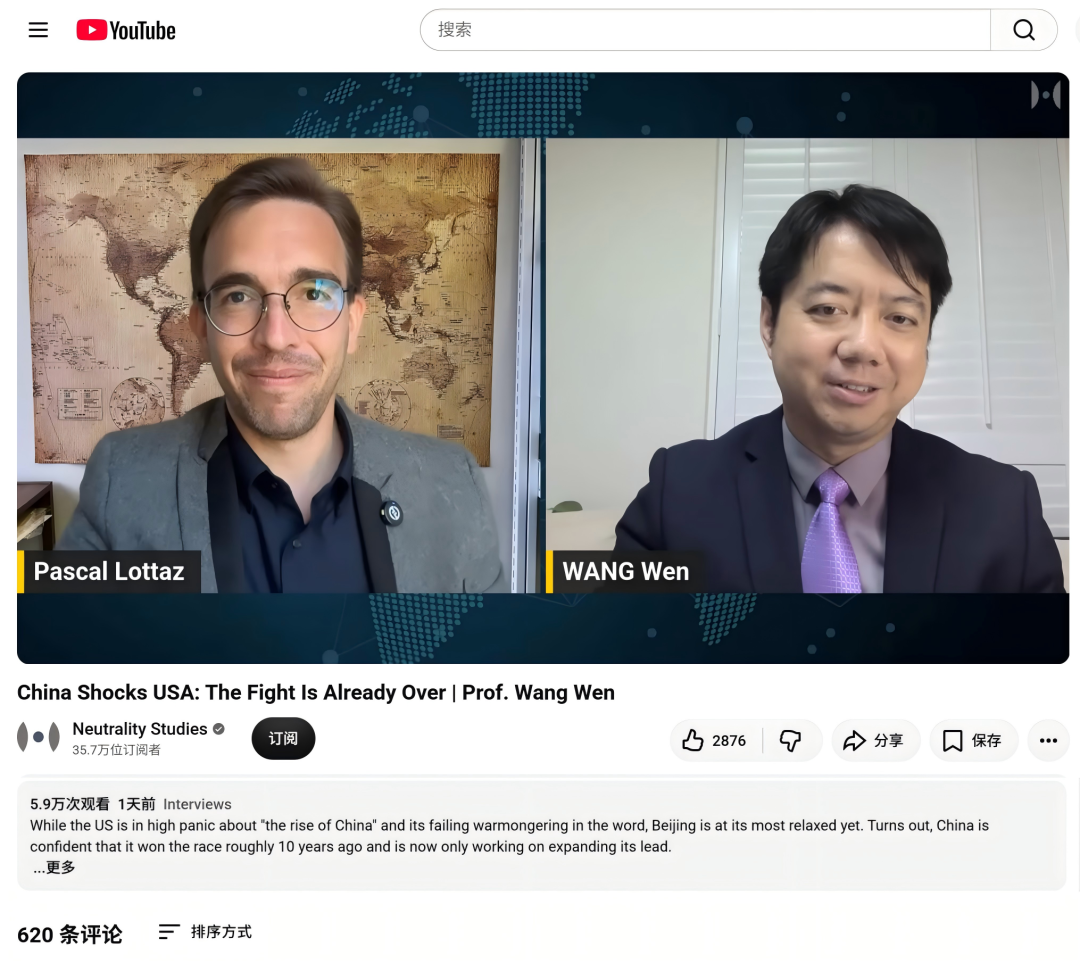
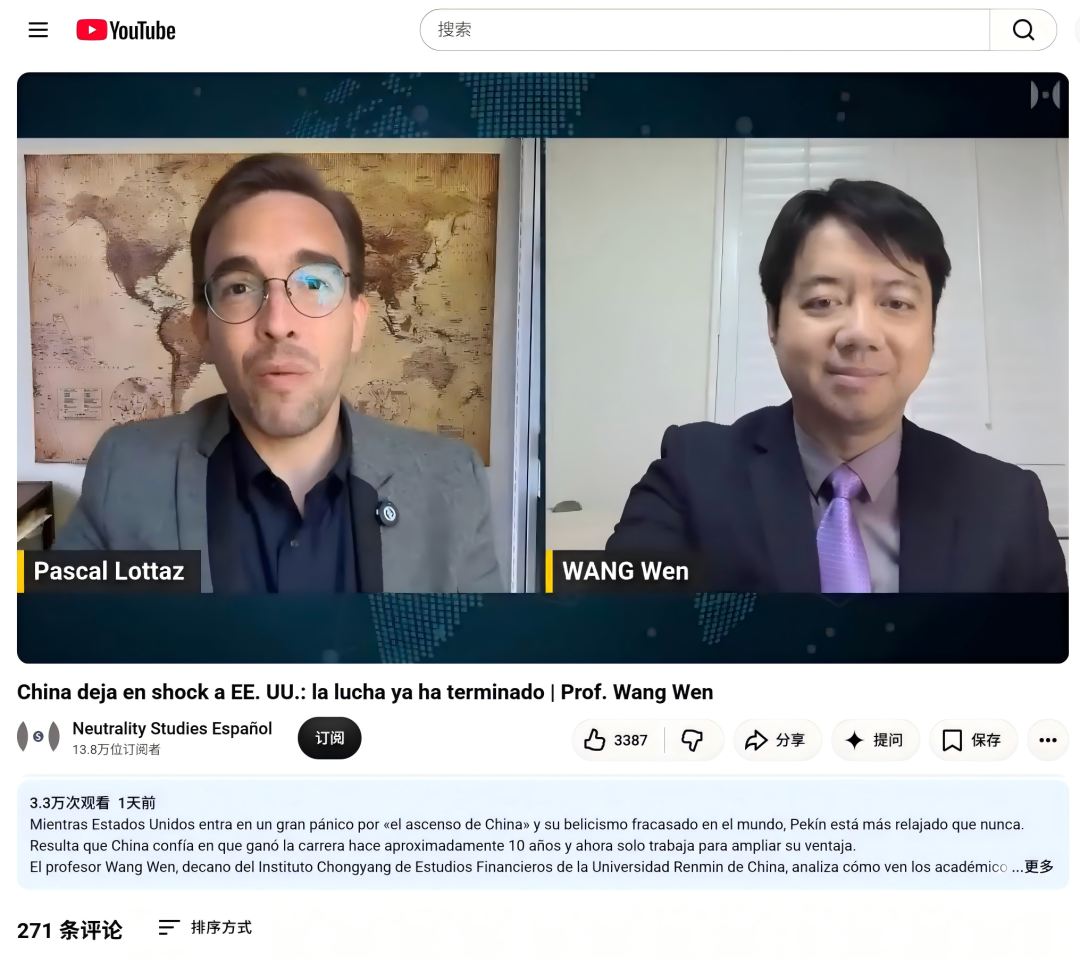
近日,一条标题为“中国震慑美国:斗争已结束”主题的英语、西班牙语对话在油管引发10万+播放量和近1000条评论。
编者按:近日,一条标题为“中国震慑美国:斗争已结束”主题的英语、西班牙语对话在油管引发10万+播放量和近1000条评论。这是欧洲学者、YouTube“中立研究”(Neutrality Studies)频道主创帕斯卡尔·洛塔兹(Pascal Lottaz)博士对中国人民大学重阳金融研究院院长、全球领导力学院院长王文长达50多分钟的专访。对话分析中国的战略抱负以及应对特朗普2.0的自信,强调中美恶性竞争的时代正在成为过去。现将对话视频及中英文实录发布如下:(中文实录约10000字,预计阅读时间27分钟)
帕斯卡尔·洛塔兹:欢迎大家再次来到“中立研究”频道。今天,我们有幸首次邀请到中国人民大学重阳金融研究院院长王文教授。王教授,欢迎您!
王文:谢谢,非常感谢您给我这次对话交流的机会。
帕斯卡尔·洛塔兹:非常荣幸能有一位中国学者做客本节目。事实上,您一直密切关注并深耕国际关系研究。因此,今天我想主要请教您关于当今中美关系的问题。或许我们可以从唐纳德·特朗普谈起,毕竟很难绕开他。您认为,中国社会究竟是如何看待特朗普第二任期的?
王文:是的,这是一个非常核心的问题。众所周知,特朗普名气很大,在中国也是家喻户晓,几乎人尽皆知。但关键在于,与八年前或是两年前他重返执政舞台时相比,我认为如今中国民众对特朗普2.0已经形成了许多共识。让我为您列举几点中国社会的主要看法。
首先,特朗普2.0是美国体制内部固有矛盾的集中爆发,其带有交易色彩的“美国优先”政策正在迅速削弱美国的全球领导力。与2017年上台的特朗普1.0相比,特朗普2.0不再仅仅是对华盛顿建制派的冲击,而是对美国治理规则的系统性重构——清洗联邦公职体系、无限扩张行政权力、对盟国不分青红皂白地征收不对等关税,并大幅削减对全球公共产品的投入。因此,从中国民众,特别是中国学者的角度来看,绝大多数中国学术界人士都认为特朗普的所有政策完全是由短期选举利益和商业利益驱动的,缺乏任何中长期的全球治理规划。这种功利主义霸权正在主动瓦解二战后由美国亲自建立的全球秩序框架,客观上加速了多极化进程。所以我认为,在许多中国人尤其是中国学者看来,如今特朗普总统正在亲自瓦解美国的霸权。这是关于特朗普2.0一个非常核心的共识。
帕斯卡尔·洛塔兹:你知道,在我的圈子里,比如YouTube上的讨论圈里,有人分析美国霸权,认为特朗普总体上并没有那么特殊,因为特朗普政府依然延续了这种霸权行径——对抗伊朗、对俄罗斯打代理人战争,以及破坏不再有利于美国的全球秩序,这在某种程度上依然是美国扩张主义的延续,同时也加剧了对华的好战言论。海外美军基地并未撤走,而能源冲击也给中国经济带来了麻烦。您和中国学者如何看待这类观点?您认为这只是美国长期战略的最新版本,还是说唐纳德·特朗普领导的这届政府行事极为怪异,对美国自身利益实际上是弊大于利?
王文:是的,我认同你的看法。要知道,大多数中国学者认为,与中国展开竞争是美国两党长期存在的战略共识。但问题在于,特朗普2.0那种商人式的交易思维,在中美博弈中反而提供了更具可控性的谈判空间。无论是拜登还是特朗普,美国将中国视为主要战略竞争对手,这一底层逻辑并未改变。然而,与拜登时代最大的不同在于,特朗普并不执拗于意识形态对抗,所有的谈判都是以经济利益和对等交换来衡量的。比如在2025年,也就是去年,美国将对华商品关税提高到了145%,然而许多美国本土企业纷纷抗议并施加压力,最终迫使美方主动寻求与中国展开多轮贸易谈判。因此,我认为有很多实际案例印证了我们共同的判断——特朗普的终极目标无非是获取经济利益,对中国的关税立场是达到目的的手段,这就为中美关系管控分歧、并在特定领域开展务实合作留下了一个窗口期。
此外我还想补充一点,刚才你提到了遏制政策还有特朗普的竞争战略,但就中方而言,我们认为外部的全面施压并没有阻碍中国的发展,反而它倒逼我们构建一个更安全、更多元、更自主的发展体系,把外部压力转化为长期的增长韧性,这正是让我们越来越自信的底气所在。看看过去八年来发生的变化就清楚了。我举个例子,2018年特朗普首次发起贸易战时,中国社会舆论曾普遍感到相当焦虑;但到了2026年,也就是今年,外部封锁反而激发出强大的自主创新能力,中国在半导体、造船、新能源汽车、光伏、机器人、大语言模型等领域全面崛起。不知道您是否读过我去年写的一篇很有意思的文章,当时被包括《经济学人》在内的全球20多个国家的媒体所引用。我去年文章的核心观点就是“感谢”特朗普让中国再次伟大。这篇文章指出,极端的外部压力无法阻碍中国式现代化的进程,相反,它促使我们补齐了产业链短板,拓展了全球合作圈,并实现了战略韧性上的质的飞跃。
帕斯卡尔·洛塔兹:这确实是一个非常吸引人的标题,是一篇好文章。这不禁让我很好奇,您和其他中国学者心里是不是真的觉得“感谢特朗普,他虽无意为师,却成了最好的老师”?这种心态目前在中国普遍存在吗?也就是“好吧,我们能从大洋彼岸发生的事情中学到很多,并让我们化挑战为机遇”?
王文:是的,我赞同你的看法。如今面对特朗普2.0,越来越多的中国人表现得愈发自信。我必须指出一个事实:中国在应对美国方面,可能比美国应对中国更加游刃有余。中国并不害怕特朗普2.0,相反,中国已经成功应对了特朗普发动的贸易战、科技战以及各种遏制打压手段。因此,我认为这种自信是一种在应对外部博弈时的“主动自信”。八年前特朗普1.0上台并突然发起贸易战时,中国主要是被动应对、顺势而为;而进入特朗普2.0时期后,中国已经学会了如何主动塑造中美关系。
我举几个例子。在经贸层面,我们精准实施了稀土出口管制、对能源产品关税的反制措施,并对“不可靠实体清单”实施对等反制,我们不再被动忍受单边壁垒。在全球治理层面,我们依托金砖国家、上海合作组织、共建“一带一路”倡议以及全球南方合作,共同抵御美国的单边主义。更重要且有意思的是,中国的经验表明,在与美方的沟通层面,我们主动开展分层对话,区分不同议题——例如经贸、气候变化、人文交流、安全等——主动设定合作议程,管控风险,避免与美国的冲突升级。因此,正如你所提到的,过去八年间中国民众的心态发生了非常明显的变化。过去我们被动适应美国制定的规则,而现在我们不仅有能力平衡分歧,还能主动创造双边合作的机遇,不再被美方政策牵着鼻子走。这就是中国式自信的一种体现。
帕斯卡尔·洛塔兹:这非常有意思,因为我从你的话中听到的是,您对中国应对美国的能力其实相当积极和乐观。那么,这是否也影响到了当前对中美关系的未来规划?也就是说,中国不再只是被动见招拆招,而是开始制定长期规划,思考如何主动与美国打交道并维持平衡?这是否正是当前中国的主流想法?
王文:刚才你提到了中国在应对美国时为什么越来越有底气,我认为信心的根本在于中国始终坚定走在属于自己的发展道路上。请允许我向你解释一下,因为我认为许多西方舆论落入了一个认知误区,他们以为中美关系是一场零和博弈,认为中国的发展目标就是超越并击败美国。在我看来,这恰恰是对中国发展逻辑最大的误读。让我明确地告诉你,中国的发展目标从来不是去打败哪个国家,而是改善民生福祉、实现全体人民共同富裕、实现中华民族伟大复兴。因此,即便长期处于与欧洲、日本或美国等大国的竞争环境中,中国的政策重心始终建立在自身国内需求之上。
今年是中国的“十五五”规划开局之年。“十五五”规划聚焦于扩大内需、推动科技创新、促进城乡协调发展和生态保护,确保每年创造数以千万计的就业岗位,完善养老和医疗保障体系,并持续推进乡村振兴。所有的战略出发点都是为了满足14亿中国人民对美好生活的向往。但反观特朗普的执政,看看美国社会,贫富分化极其严重,底层民众的社会福利遭到了严重忽视。因此,我们的底气在于,我们的目标从来不是为了追赶美国,而是坚定不移地把自己的事情做好。我们越来越有信心,正是因为我们把自己的事情做得越来越好,远胜过以往。所以,中国变得比过去强大得多、优秀得多,我们也因此更有信心去应对与美国的关系。
帕斯卡尔·洛塔兹:这非常有意思,因为您的意思是中国的发展目标是自我提升而非伤害他国,这才是根本的内生动力。但您知道,当我们听到华盛顿政界乃至许多智库的论调时,他们现在的目标却是干扰和阻挠中国推进“一带一路”倡议,他们甚至对此颇为得意,比如自诩撬动了委内瑞拉,又比如哥伦比亚即将迎来右翼政府,从而脱离所谓的“中国影响圈”。西方总是陷在“谁掌控了谁”这种零和思维里。但您的意思是,这根本不是核心所在,也不是我们追求的目标。所以从这个角度看,中国或许并不太担心委内瑞拉或哥伦比亚的局势变动,因为它们各行其是,而中国自会按自己的节奏布局,对吗?
王文:是的,我认为未来中美竞争的终极赛场既不是关税,也不是技术壁垒或对其他国家的控制,而是国内治理能力的较量。正因如此,我们坚信从长远来看,时间站在中国这一边,站在保持稳定且连贯发展政策的一方。这也解释了为什么媒体经常报道美国社会撕裂,美国的政策是反复无常的,每一届政府都在推翻前任的政策。
相比之下,在过去四十年里,中国始终如一地执行其中长期战略规划,在精准扶贫、共同富裕、新质生产力和绿色转型等领域持续发力。我认为日积月累之下,从长远来看,中国的政策连续性、超大规模市场、完备的工业体系以及统筹发展与安全的制度优势将持续彰显,进而不断缩小中美之间的综合国力差距。这就是我们保持长期自信的根本基石。反观美国,它与外部世界存在如此多的摩擦冲突,长远来看必将阻碍其自身的可持续发展。两者一对比,就不难明白为什么中国人的自信心越来越强。
帕斯卡尔·洛塔兹:但是,当您看到美国如何在世界舞台上积极打击其他大国时,比如与俄罗斯的冲突、北约对俄罗斯的代理人战争,尤其是眼下与伊朗的对抗,难道像您这样的中国战略学者不会感到担忧吗?比如思考,我们会不会是下一个目标?他们会不会试图把台湾地区或菲律宾变成翻版的乌克兰,以消耗我们的资源?这类讨论难道不存在吗?
王文:我想在去年或更早以前,我们确实曾为此担忧,担心中国会不会成为下一个被打压的目标,或是卷入美国发起的战争。但到了现在,尤其是今年,我们变得更加笃定了。我不确定你是否关注到,今年五月,中美两国领导人之间达成了一项全新的共识——两国领导人达成了“建设性战略稳定关系”的中美关系新共识。这一关系的精髓在于,以合作为主轴,开展有序竞争、有效管控分歧、共创和平前景。这是极其关键的,所以我觉得今年极其重要,但这一点被西方许多媒体误读或忽略了。
在我看来,中美两国今年正在走出“修昔底德陷阱”,双方都展现出了高度的理性。或许你也清楚,尽管日本、菲律宾甚至欧洲某些势力可能希望看到中美爆发战争,但至少在战略层面,中美两国领导人都是非常理性的。在我看来,虽然特朗普总统是一位争议极大的人物,但在华盛顿政治圈里,特朗普在对华政策上反而是最理性的那一位。今年,中美两国领导人将举行一次全面的面对面会晤,这是非常罕见的。正因我前面所说的“建设性战略稳定关系”,这是一项极其重大的新共识。
更重要的是,在特朗普2.0任内,我们正步入大国互动的新时代,比如中美俄三国之间的关系。我大胆推测,在今年11月于中国深圳举行的APEC峰会上,我们或许会看到习近平主席、特朗普总统和普京总统三人的历史性合影,一种新型的大国关系正在浮现。当然,我并不是说这是某种“G3”,我想强调的是,这标志着一个由三大国引领的“后后冷战时代”的开启,就像二战后美、苏、英三国奠定雅尔塔体系一样。这也充分表明,过去几年中国应对特朗普2.0乃至过去20多年应对美国遏制战略的反制措施是极其成功的,因为美方认同了“建设性战略稳定关系”这一新共识。在我看来,中美之间恶性竞争的时代正在成为过去。这就是为什么,正如你所见,我对中美关系持非常乐观的态度。
帕斯卡尔·洛塔兹:您这个观点非常有意思,因为在我看来,局势似乎正在朝相反的方向发展——美国似乎正在积蓄力量准备更大的动作,不仅仅是竞争,而是真正的对抗,也许不是与中国发生直接的军事热战,但至少会通过贸易战来打击中国利益。但您却乐观得多。我想请教,您刚才描绘的情景,究竟是您对未来局势发展的预判,还是您对中国战略走向的评估?中国希望将两国关系引向何方?
王文:是的,正如我刚才讲的,中国的发展战略绝非去征服其他国家,而是专注于自身修炼,顺应全球大势。因此,如果我们放眼世界,从全球大趋势这一更为关键的视角来审视中美两国的未来,就会发现中国已经在关系全球未来的前沿阵地完成了系统性、前瞻性的战略布局。如果回顾几十年前的中美竞争,那时的格局是“美领中追”;而现在,在决定未来30年全球格局的尖端新兴领域,中国已经完成了前瞻布局,在多条核心未来赛道上具备了争夺主导权并保持高速推进的能力。
让我为您详细解释。例如,在低碳和绿色发展赛道上,中国是全球唯一建立起全产业链、超大规模、工业化绿色能源体系的国家,发展速度远超美国。看看全球四大低碳核心产业——风电、光伏、锂蓄电池和新能源汽车——中国的产能、产量和出口量均占到了全球的一半以上。所以展望未来,可以说未来全球绿色转型的标准、产业链和落地模式,基本上都是由中国来定义、供给和主导的。这是第一条未来赛道。
第二条赛道则是关于现代社会治理。在现代社会治理领域,中国在本土构建了一套全球独一无二且高效的治理体系,成功将制度优势转化为长期的发展优势。所以如果你来到中国,就会看到依托数字治理、基层治理和应急响应的系统化举措,中国打造了全球最大的数字治理体系,实现了公共服务、社会管理和应急响应的精准高效落地。无论是中国的常态化疫情防控、灾害应急响应,还是乡村振兴、共同富裕,亦或是智慧城市、智慧社区的全方位建设,中国都已经建立起稳定、精准、包容、可持续的现代化治理模式。这就是我们所说的国内治理能力,这种治理能力兼顾了效率与公平,平衡了发展与安全,统筹了短期民生与长远发展。我认为这是一种极为强大的治理效能,这是美式体制无法复制的核心优势,也是中国实现长期稳定发展、持续蓄势赋能的底层支撑。
还有一条非常关键,您可能也非常感兴趣的赛道,那就是当前竞争白热化的领域——人工智能与未来算力。对比中美两国,中国如今已在应用场景落地、空间算力以及产业生态等多维度取得了显著进展。是的,我不否认美国在基础领域拥有很多优势,例如底层算法、高端GPU芯片等。但关键在于,中国在决定未来发展方向的总体布局上占据了先机,比如总电力供应保障、AI产业化落地、丰富应用场景,以及天基智能算力部署等。
我想说的是,现在中国聚焦于国内建设,我们的最高领导人99%的精力都集中在国内建设上,让我们更加健康、更加强大。只要我们的国家能够富强,比以前更加强大,任何外部势力都无法征服我们、占领我们、打败我们。所以我认为这非常重要。这是一种不同的战略路径——对美国来说,他们的领导人聚焦于外部扩张、与其他国家发生外部冲突;但对中国领导人来说,我们聚焦于国内发展。这是非常大的不同。所以我认为,未来属于中国。
帕斯卡尔·洛塔兹:这真的非常有趣,因为您也并没有把这件事概念化为中国要成为世界第一,因为那不是重点。中国想要继续发展,不管其他国家怎么做,中国都不在乎。感觉就像“我们要继续向月球和更远的地方发展”。但确实存在这种危险——美国或其他西方国家,包括欧洲,可能开始使用暴力手段。我的意思是,比如在伊朗发生的事情,美国通过侵略性攻击发动了战争,这似乎又是违反联合国宪章的行为。这是否构成威胁?还有,从我的角度来看,美国持续撒谎,试图用外交手段假装一切正常,然后在方便的时候进行军事打击,这是否对中国构成威胁?或者说这场战争如何影响中国对美国能力的评估?
王文:我认为,首先我承认美伊冲突是一场巨大的悲剧,这场战争已经越过了此前默认共识的红线,风险正在升级。特别是自七月敌对行动恢复以来,双方已经从单纯打击军事目标转向攻击对方的能源基础设施,甚至打破了此前不针对民用设施的共识。所以我认为中东地区正在滑入更深的对抗漩涡,中东局势非常危险。很明显,美国现在被以色列绑架了。
但事实上,你问我中国人是否感受到来自美国的威胁?没有。我认为从伊朗与美国的冲突中可以看出,美国仍然是一只“纸老虎”,缺乏打持久战的能力。因为我们都知道,许多美国学者和分析人士认为,在这场战争中美国已经输了——美国什么也没有改变,它未能推动伊朗的政权更迭,未能控制霍尔木兹海峡,未能控制全球油价,未能保护海湾国家的利益。美国在这场战争中是彻底的输家。所以我预测,由于美国国内政治两极分化,加上中期选举临近,白宫无法承受长期高强度战争的代价,而且现在美国的海湾盟友也普遍不愿意直接卷入长期冲突。
这就是为什么我认为,正如毛泽东主席多年前所说的,美国是一只“纸老虎”。在我看来,美伊之间的这场战争,美国会输得比越南战争和阿富汗战争惨得多。
从历史上看,我们可以观察美国与其他国家的战争史——美国从未能够征服或击败一个人口超过三千万的国家。那伊朗呢?伊朗有八千万人口,它是一个地区性的中等强国和大国。还有越南,二十世纪六十年代越南有五千万人口,也超过三千万。所以说实话,我认为美国尤其需要尊重那些地区大国,美国需要尊重那些有文明传统的国家,包括伊朗。对中国来说,美国当然也需要尊重我们这样有悠久文明传统的国家。当然,中国的人口要多得多。所以这就是为什么我认为,中国人观察美伊战争会比以前更有信心,因为美国连伊朗都征服不了,它怎么敢征服中国?这就是我们的观察。
有时我们只是觉得,这是一个非常大的悲剧,对那些在战争中死去的人来说是巨大的悲剧,特别是那些伊朗人民,特别是那些伊朗的小学生。这就是我的观察和观点。
帕斯卡尔·洛塔兹:也许最后我想请教您的最后一个复杂问题,是关于中国与金砖国家的合作,以及中国与俄罗斯、伊朗的区域合作,还有扩展到南非、巴西等国的合作,以及共建“一带一路”倡议。我们是否应该按照您之前描述的方式,来理解中国与其他大国的互动——即这只是改善中国自身的一部分?在这种背景下,是试图改善与他国的关系和贸易吗?还是背后有更多地缘政治考量,比如试图建立一个网络来抵抗西方在银行网络或贸易网络方面的压力?我们应该如何理解中国更宏大的外交政策方针?
王文:我认为你提出了一个关于中国未来的非常重要的问题。如果我可以这样理解的话,作为智库学者,我们为国家思考——因为当今中国的国内实力已经比以前强大得多,我们发展得非常快,我们的经济规模比以前大得多。那么我们应该做什么?我们想给世界带来什么?这对我们来说是一个新问题,我们每天都在思考。同时,我们也在为政府提供咨询,而且我们的政府也在逐渐形成中国新的战略抱负。中国的外交政策抱负是什么?我认为至少有五点可以和你分享。
第一,我们追求各国共享的和平发展环境。中国希望维护普遍和平,反对霸权主义、强权政治和各种阵营对抗,为全人类创造稳定的发展环境。所以,正如你所看到的,在过去许多年里,中国提出了全球安全倡议,防止世界陷入新的动荡和分裂,让所有国家都能安心谋发展。这是第一个抱负。
第二个抱负是,我们希望促进全球共同繁荣。中国想要打破少数国家垄断发展红利的不公平格局,让发展成果更广泛更公平地惠及世界各国人民。因此,通过你提到的平台——共建“一带一路”倡议和全球发展倡议——中国正在帮助“全球南方”国家,特别是非洲国家,解决基础设施短板,培育自主发展能力,促进全球经济增长来源的多元化。
中国未来外交政策的第三个战略抱负是,我们想要建设一个更加公正合理的全球治理体系。所以这就是为什么我认为中国希望改变由西方主导的旧治理规则和旧治理体系,推动国际秩序朝着共商共建共享的方向改革。因此,中国倡导多边主义,支持联合国发挥核心作用,通过亚投行、金砖合作机制、上合组织等机制,提升发展中国家在国际事务中的话语权,确保全球事务通过各国共同协商来处理。
我认为中国外交政策的第四个抱负是,我们想要维护人类文明多样性和包容性的生态系统。因为中国希望——如你所知,中国有着悠久的文明历史——世界上不同的文明和发展道路都能得到尊重。所以我们不同意很多年前塞缪尔·亨廷顿提出的所谓“文明冲突论”。
最后一个战略外交政策抱负,当然是中国与各国共同努力,应对人类生存和发展的共同挑战。因为我们都知道,当今我们面临许多共同威胁,比如气候变化、数字治理和公共卫生。所以中国只是希望鼓励世界各国超越分歧,共同解决全人类面临的共同问题。这就是为什么中国在推动世界上最大规模的低碳革命,中国希望与各国一道守护我们共同的家园——地球。
所以我的结论是,当我们观察中国、思考中国的崛起时,我们需要跳出传统的国际关系理论,即现实主义国际关系理论。因为如果你用国际关系研究中的现实主义理论来思考中国,你可能会得出一个结论:“哦,是的,中国崛起了,然后中国会成为下一个霸权。”不,如果你跳出西方国际关系的现实主义理论,你可以看到,中国想要的从来不是主宰世界,而是与各国一道构建人类命运共同体,让世界摆脱霸权压迫和发展鸿沟,实现全人类的共同进步。从这个角度出发,你可以解释中国在过去几十年里所做的一切。例如,我们与菲律宾有冲突分歧,我们有充分的军事力量可以推动对台湾地区的军事统一,但我们没有,我们没有那样做,我们只是保持耐心,一步步解决。这是新型大国战略的韧性和耐心。所以我认为这非常有趣。那么如何评判中国这个新崛起的大国呢?我认为我们需要推动思维创新。作为一个来自中国的智库学者,我们只想尽我们所能,向外国民众解释中国崛起的逻辑。这就是我的观点。
帕斯卡尔·洛塔兹:这太有意思了。我其实正想问您关于西方现实主义的问题,还有最后一点。因为我认为约翰·米尔斯海默在中国也是一位著名的学者,而他让我难以认同的一个主要观点是,他把整个现实主义思想都建立在安全竞争不可避免这一前提之上。如果我对您的理解正确的话,您可能会不同意,并说“安全竞争不是我们做的事,我们竞争,但我们是争发展,不是争安全”。因此,我会理解为您是在说“不,在这一点上,米尔斯海默先生并没有正确评估中国真正想要什么”,是这样吗?
王文:是的,实际上约翰·米尔斯海默教授是我的老朋友,我曾邀请他到我们大学做了两次讲座。我认为是的,我们有很多辩论,但我们彼此非常尊重,我们经常通过电子邮件联系。这就是新型风格,就像未来中美之间新型关系一样。我认为我们不拒绝与美国的公平竞争,我们不断寻求相互尊重和和平共处的模式。我认为从长远来看,中美注定要共存,竞争将成为常态,但冲突和对抗绝不是不可避免的。因为正如我所说,中国谋求发展的初心没有改变,它所有前瞻性的规划、产业升级、治理改革、技术突破,其终极目标从来不是击败或超越美国,而是解决自身的发展短板,提高人民的生活质量,实现国家的可持续发展。
所以我认为,与过去被动应对美国相比,中国的能力提升非常快。过去中国遵循规则,适应现有格局;但现在,我们主动规划自己的道路,塑造新规则,引领新趋势。因为我们越来越确信,时间站在长期主义一边,时间站在稳定发展一边,时间站在包容共赢的合作一边。这是我们的思考,我们的信念,我们的理念。
帕斯卡尔·洛塔兹:王教授,听到这些我非常高兴,因为通常我的讨论到最后都会变成对人类未来等等非常悲观的话题,但您给了我一个非常积极的展望,我对此非常感激。那些想找到您的著作、想关注您或您所在机构的人,应该去哪里呢?
王文:是的,他们可以访问我们的网站人大重阳网rdcy.ruc.edu.cn。欢迎任何朋友联系我,我们可以辩论,可以讨论,可以交朋友。我认为现在我们需要越来越多的思维创新。过去,我们相信西方的国际关系理论,但现在我认为,仅靠那些西方国际关系理论不足以理解新世界。对中国来说,我们觉醒了,我们崛起了。但问题是,在我们变得比以前更加强大之后,我们每天都在学习美国的成功经验,但与此同时,我们也从美国身上吸取负面教训。我们总是告诫、总是建议我们的政策制定者不要学习美国那些负面的东西。我们的抱负是成为一个更好的大国,一个更文明的大国,构建一个更美好的世界。这是我们的长期战略抱负。
帕斯卡尔·洛塔兹:好的,我会鼓励大家参与进来,实际加入到构建全球发展合作框架的行动中。我觉得这是一个非常非常好的想法。我们一定会再邀请您来到这个频道,王教授。我希望将来也能邀请来自俄罗斯和其他地方的学者一起探讨这些问题。王文教授,非常感谢您今天抽出时间。
王文:谢谢。
英文版对话内容
Pascal Lottaz: Welcome back everybody to Neutrality Studies. Today for the first time with Professor Wang Wen, the Dean of the Chongyang Institute for Financial Studies at the Renmin University of China. Professor Wang, welcome.
Wang Wen: Thank you, thank you for your opportunity to give me.
Pascal Lottaz: It's fantastic to have a Chinese scholar here and you've been, actually you are one of the very attentive people who try to analyze also international relations and that's why I would like to ask you, you know, a little bit mainly about the China's relationship today with the United States and maybe let's start with Donald Trump because it's hard to get past him. How do you think, how do Chinese people actually view the second Trump administration?
Wang Wen: Yeah, well, this is a very important question, you know, Trump is so famous, also is very famous in China, every Chinese people know him. But the problem is that gradually, you know, compared to eight years ago or two years ago when he got the office again, I think the Chinese people now have found many consensus about Trump 2.0. Let me show you a few consensus of Chinese viewpoint on Trump 2.0.
First is that Trump 2.0 is a concentrated outbreak of inherent contradictions within the American system. The transactional American first policy is rapidly eroding American global leadership. As I said, compared to Trump 1.0, who took office in 2017, Trump 2.0 is no longer merely about impacting the Washington establishment, but a systematic transformation of U.S. governance rules, purging the federal public office system, unlimited expansion of executive power, indiscriminate imposition of non-reciprocal tariff on allies, and significant reduction in global public goods investment.
So now we can see from the Chinese people, I mean, especially Chinese scholars, most of the Chinese academics agree that all of Trump's policies are driven by short-term electoral and commercial interests, lacking any medium or long-term global governance planning. This utilitarian hegemony is actively undermining the global order framework built by the U.S. after World War II, objectively accelerating the multipolarization process. So I think for Chinese people, especially for Chinese scholars nowadays President Trump destroyed the American hegemony. That's, I think, a very important consensus on Trump 2.0.
Pascal Lottaz: You know, there are people in my world, of this YouTube bubble that try to analyze U.S. hegemony, that argue that overall Trump is not that exceptional, because overall the Trump administration continues with this hegemonic approach, the war on Iran, the proxy war on Russia, the undermining of the global order that doesn't benefit the United States anymore. So it's still kind of the continuation of U.S. expansionism, and also it's ratcheting up of war rhetoric with China, and the U.S. bases are not going away, and the energy shock is rather also causing problems for the Chinese economy. What do you and Chinese scholars make out of such arguments? Do you think this is, you know, just the latest version of a long-term strategy, or is this, you know, Donald Trump as a kind of a very bizarre administration that's actually harming U.S. interests more than it helps?
Wang Wen: Yeah, I agree with you. You know, for most of the Chinese scholars, they think that competing with China is a long-standing strategic consensus between the two U.S. parties. But the problem is that Trump 2.0, businessman-like transaction thinking, allows more controllable negotiation space in the China and U.S. games. Whether it's Biden or Trump, the underlying logic of the U.S. position in China as it's a primarily strategic competitor remains unchanged as you mentioned right now. However, the biggest difference from the Biden era is that Trump is not fixated on ideological confrontation. All negotiations are measured by economic gains and reciprocal exchanges.
In 2025, I mean, last year, the U.S. raised the tariffs on Chinese goods to 145 percent. However, many U.S. domestic businesses protested and infliction of pressure, forced the U.S. to actively seek multiple rounds of trade negotiations with China. So I think there were a lot of cases confirming our shared judgment. Trump's tariff stands on China is a means to an end, the real goal is to gain economic benefits. So this leaves a window for China-U.S. relations to manage the differences and engaging in pragmatic cooperation in certain areas.
And another point I want to share with you is that, because you mentioned the containment or Trump's competitive strategy, but nowadays for China side, we think the comprehensive external pressure has not hindered China's development. Instead, it has forced us to build a safer, more diversified and independent development system, transforming pressure into long-term growth resilience. So that's what will make us more and more confident.
Look at the conditions happened in the past eight years. I give you an example. When Trump launched his first trade war in 2018, there was considerable anxiety in Chinese public opinion. But what was the result by 2026, I mean this year, the blockade spurred independent innovation. China is rising in semiconductors, ships, new energy vehicle, photovoltaics, robotic, larger language model and more. So I don't know whether you read my very interesting article written last year, which was cited by media outlet in over 20 countries, including The Economist. My articles last year is that, thanks to Trump for making China great again. This article stated the extreme external pressure cannot hurt Chinese style modernization. Instead, it has allowed us to fill gaps in our industrial chain, expand our global cooperation and achieve a qualitative leap in our strategic resilience.
Pascal Lottaz: So yeah, that is a very good title for a very good article. It actually made me wonder whether you and other Chinese scholars actually kind of think like, thank you, Trump, for being a teacher without wanting to be one. Is that kind of a sentiment that is currently around in China that, okay, we can learn a lot from what's going on over there, let's make the best out of it?
Wang Wen: Well, yes, I agree with you. Nowadays, more and more Chinese people, when they face Trump 2.0, the Chinese are becoming more and more confident. I must tell you a fact, China may be better at dealing with the U.S. than the U.S. dealing with China. China is not afraid of Trump 2.0. On the contrary, China has successfully responded to Trump's trade war, high-tech war, and other containment and suppression efforts. So I think this self-confidence is the proactive self-confidence in dealing with external games.
As I said, eight years ago, when Trump 1.0 came to power, when faced with the sudden trade war, China responded more passively and took advantage of the situation. However, after the Trump 2.0 cycle, China has learned to proactively shape U.S.-China relationship. Let me give a few examples.
At the economic and trade level, we have accurately implemented rare earth export controls, energy product tariff counter measures, and unreliable entity list reciprocity constraints. And we no longer passively endure unilateral barriers. At the global governance level, we rely on BRICS, Shanghai Cooperation Organization, Belt and Road Initiative Expansion, and cooperation in Global South to pigeon against the U.S. unilateralism. And more importantly, very interesting is that China's experience is that at the communication level with the U.S., we take the initiative to conduct hierarchy dialogues, distinct different topics such as economic, trade, climate change, humanities, and security, to set cooperation agendas, proactively manage risks, and avoid escalation of conflicts with the U.S.
So now, it's very obvious that, as you mentioned, in the past eight years, the mentality of Chinese people has changed very clearly. In the past, we passively adopted to the rules set by the United States. But now, we have the ability to balance the differences, proactively create opportunity for bilateral cooperation, and no longer dictated by the reins of the U.S. policy. That's one kind of Chinese self-confidence.
Pascal Lottaz: That is very interesting, because what I hear from your words is that you are actually rather positive, rather optimistic about China's ability to deal with the United States. So, does that influence now the future planning of the U.S.-China relationship, that China doesn't feel that they just need to deal with anything being thrown at them, but that they can also now start long-term planning of how to proactively approach the U.S. and balance things? Is that the thinking in Beijing these days?
Wang Wen: Oh, well, I think you mentioned why China has more and more self-confidence deal with the United States. I think the fundamental confidence is that China is in China's own development path. So, because, let me explain to you, because I think many Western public opinions have fallen into a cognitive misunderstanding. They think that China-U.S. relations are a zero-sum competition, and they believe that China's development goal is to surpass and defeat the United States. I think this is precisely the biggest misunderstanding of Chinese development logic.
Let me tell you that the development goal of China has never been to defeat any country, but to improve the people's livelihood, achieve common prosperity for all people, and complete national rejuvenation. So now, I think, even though it has been in a competitive environment among the major powers for a long time, from Europe, from Japan, or from the U.S., China's policy focus has always been based on the domestic demand.
I don't know whether you know, this year is the first year of our 15th Five-Year Plan. I don't know whether you know of 15th Five-Year Plan. 15th Five-Year Plan focuses on boosting domestic demand, technological innovation, urban-rural balance, and ecological protection, ensuring tens of millions of jobs every year, improving the pension and medical system, and continue to revitalize the countryside. All strategic starting points are the needs of a better life for the 1.4 billion Chinese people.
But look at Trump's rule, look at American society. There are so many polarizations between rich and poor in the United States. There are so many that the welfare of the people at the bottom has shut. So I think our confidence is that our track has never been to catch up with the United States, but to continue to do our own things well. So we become more and more confident because we do very well, much better than before. So China become much more better than before. And we think that we can have more confidence to deal with the U.S..
Pascal Lottaz: This is very interesting, you know, because what you're saying is the goal of China is self-improvement and not to hurt the other one. And that's the motivating factor. But you know, when we listen to a lot of the rhetoric that comes out of Washington or even among the think tanks and so on, they now have a goal of disturbing or preventing China from building the Belt and Road Initiative. And they're very proud, you know, that they picked off Venezuela. And now, you know, Colombia is going to get a right wing government and they're going to leave the Chinese orbit. The West keeps thinking about who do we control and who does China control. But you're saying that's not the point. That's not what we are after. So in this sense, China is probably not very worried about Venezuela and Colombia because it's like they do what they do and then China will do something different, right?
Wang Wen: Yeah, I think in the future, the ultimate area of U.S.-China competition is not tariffs or technological barriers or occupation to the other countries, but a contest of domestic governance capability. That's why we believe that time is on China's side in the long term, in the long run, favoring stable and continuous development policy.
So that's why in media, we often report the American society is divided, American policy is volatile, and each administration overturns many of its predecessors' policy. So in contrast, over the past four decades, China has consistently implemented its medium and long term plan with strategic such as targeted poverty alleviation, common prosperity, new style productivity, and green transformation continues taking efforts. So I think gradually and gradually, in the long term, China's policy continuity, massive market, complete industrial system, and institutional advantages that coordinate development and security will continue and to narrow the gap in comprehensive national strength between China and the U.S..
So that's our fundamental basis for our long term confidence. But look at the United States, the U.S. has so many conflicts with the outside world, that will stop and prevent the U.S.'s sustainable development in the long term. So we compare it, you can find why Chinese people have more and more confidence.
Pascal Lottaz: But does it not worry you when you see how the United States is trying to actively hurt its other powers on the world stage, like the war with Russia, NATO's war with Russia, and especially now the war with Iran, doesn't it worry Chinese strategic thinkers like you that you think like, okay, we might be next, they might try to transform Taiwan or the Philippines into Ukraine for China in order to drain our resources? Is this not being discussed?
Wang Wen: I think maybe last year or in the past, we often worry about it. We worry about that, maybe whether China will be the next one who will be conquered or the war launched by the U.S.. But nowadays, I mean, especially this year, we become more confident because I don't know whether this year, this May, the two leaders of U.S. and China, we cognize a new consensus. The two leaders reached a new consensus, the constructive, strategic, and stable relationship. The core of this relationship is cooperation as a primary focus, orderly competition, manageable differences, and prospect of peace.
So this is extremely important. So I think this year is very, very important, which was misunderstood or ignored by a lot of public opinion in the West. This year, in my opinion, the U.S. and China are escaping the Hucydides’s trap. Both countries are very rational. Maybe as you may know, although some countries such as Japan or the Philippines and even Europe hope for a war between the U.S. and China, the leaders of China and the U.S. are very rational, at least at the strategic level.
In my opinion, even President Trump is a very controversial person, but Trump is the most rational person in Washington political circles regarding China policy. This year, the two leaders between China and the U.S., will have a full face-to-face meeting. This is very, very rare. And because of the, as I said, the constructive, strategic, stability relationship, this is a very important new consensus.
And more importantly is that we are experiencing a new era of interaction between major powers in President Trump's 2.0 administration. For example, the U.S.-China-Russia relationship. Perhaps, I guess, at the APEC summit this November in Shenzhen, China we will see a photo of President Xi Jinping, President Trump, and President Putin together. A new type of a big power relationship. Of course, I don't see this as a G3 level action. I just want to say that I see it as a beginning of a post-post-Cold War era, led by three major powers, just as the United States, Soviet Union, and the United Kingdom led the establishment of the Yalta system after World War II.
So that also demonstrates that China's response and China's countermeasure to Trump's 2.0 over the past few years, and even to the U.S. containment policies over the past 20 years or so, has been very, very successful. Because the U.S. agrees with China as a new consensus, the constructive strategic stability. So the era, in my opinion, the era of vicious competition between China and the U.S. is passing. So that's why, as you mentioned, I'm very, very optimistic about China and U.S. relations.
Pascal Lottaz: It's so interesting that you're saying that, because to me, it seems it's going the other way. It seems to me that the United States is gearing up for more, not just competition, but actual fight. Maybe not direct kinetic fight with China, but at least the trade war to try to hurt Chinese interests. But you're much more optimistic. And I just want to ask, what you just portrayed, is this your expectation of what will happen? Or is it your assessment of what China's strategy is probably going to be? Where China wants to push the relationship?
Wang Wen: Yes, as I said, China's strategy of development is not to conquer other countries. China just focus on ourselves and focus on the broader global trends. So if we observe the world, as well as China and the U.S. future from a more crucial perspective of broader global trends, China has achieved a systematic and forward-looking strategic layout in the forefront of global future.
If we observe U.S.-China competition decades ago, that condition was characterized by the U.S. leading and China catch up. Now, in the cutting-edge emerging fields that will determine the global landscape for the next 30 years, China has already completed a forward-looking and systematic layout, achieving a struggle for leadership and a pace of advancement in multiple core future track.
Let me explain to you. For example, in the track of low-carbon and green development, China is the only country in the world to have built a full-chain large-scale and industrialized green energy system with a pace of development far existing that of the U.S.. You look at four cores of low-carbon industrial globally, Wind power, photovoltaics, lithium battery, and the new energy vehicle, China production capacity, output, and export account for more than half of a global total. So look at the future. It can be said that the standards, industrial chain and implementation model for global green transformation in the future are basically defined, supplied, and lead by China. That's one future track.
The second track is about the modern social governance. In the field of modern social governance, China has formed a global unique and highly efficient governance system domestically, transforming its institutional advantage into long-term development advantage. So if you come to China, you can see that rely on a systematic approach to digital governance, grassroots governance, and emergent response, China has built the world's largest digital governance system, enabling a precise and efficient implementation of public service, social control, and emergent response. If you look at China's routine pandemic prevention and control, if you look at the disaster emergent response, if you look at China's rural revitalization, if you look at China's common prosperity, if you look at China's full-scale construction of smart city, smart community, China has achieved a stable, precise, inclusive, sustainable, modern governance model. So I think this is what we call its domestic governance capability.
So these domestic governance capability balance efficiency and affairs, balance development and security, balance short-term livelihood and long-term development. So I think this is a very powerful domestic governance capacity. That is a core advantage that American-style system cannot replicate. So it's also the underlying support for China's long-term stable development and continuous accumulation of momentum.
And another very important, and you might be very interested in another track, that is now competitive very seriously. That is AI and future computing power. We can compare China and the U.S.. China now has achieved multi-dimensional advisement in application implementation, space computing power, and industrial ecosystem. Yes, I agree. So U.S. advantage, I cannot deny, U.S. advantage still has a lot of advantages in fundamental areas, such as underlying algorithms and high-end GPU chips. But the problem is that China's overall layout leads in the future direction, such as total electricity, AI industrialization, scenario implementation, and space-based intelligence computing power.
So what I want to say is that now China focuses on our domestic construction. Our top leader, focus 99% energy on the domestic construction, you know, push and promote our body healthy and healthy, stronger and stronger. As long as our body, our national body is strengthened, become much stronger than before, no any external strengthens can conquer us, can occupy us, can beat us. So I think that's very, very important. That's a different strategic method. For United States, their leaders focus on the external expansion, external conflict with other countries. But for Chinese leaders, we focus on the domestic development. That's very, very different. So in the future, I think time belongs to China.
Pascal Lottaz: This is really very interesting because you're not conceptualizing it as China becoming number one because that's not the point. China wants to continue to develop whatever the other ones do, I don't care. Like “we just continue developing to the moon and beyond”. But there is this danger that the United States or others and the Western countries including Europe might start using violent means. I mean, it doesn't, what happened to Iran and the war that was started by the United States by an aggressive attack again, like a breach of the UN charter and whatnot. Isn't that a threat or how does this war and also, you know, the continuous from my view lies by the United States when trying to use diplomacy as a way to pretend that everything is fine but then strike militarily when it's convenient for them. Doesn't that create kind of, isn't that a threat to China or how does this war impact China's assessment of U.S. capabilities?
Wang Wen: I think, first of all, I admit that the U.S.-Iran conflict is a huge tragedy. The war now has crossed the red line of the earlier tacit understanding and the risks are escalating now especially since July, the resumption of the hostility. Both sides have shifted from simply striking military targets to attacking each other's energy infrastructure even breaking the previous consensus of not touching civilian facility. So now I think the Middle East, the area is sliding into a deeper vortex of confrontation. So that's a very, very dangerous conditions in Middle East. It's very obvious U.S. now is hijacked by the Israel.
But in reality, you ask me, Chinese people, whether Chinese feel the threat from U.S.? No. I think from the Iran conflict with U.S., it shows that U.S. is still a paper tiger lacking the capacity for a protracted war. Because we all know that many American scholars and analysts believe that this war, United States has already lost. The U.S. has changed nothing. It failed to push for regime change in Iran. It failed to gain control of Strait of Hormuz. It failed to control global oil prices. And it failed to protect the interest of Gulf states. The U.S. is a complete loser in this war.
So I predict, because of the domestic political polarization in the U.S., coupled with approaching the midterm elections making the White House unable to bear the cost of the prolonged, high-intensity war. And now U.S. Gulf allies are also generally unwilling to be directly involved in the long-term conflicts. So that's why I think as Chairman Mao Zedong said many, many years ago that the U.S. is a paper tiger. And this war between U.S. and Iran, U.S. would lose this war far worse than the Vietnam War and Afghanistan War, in my opinion.
And historically, we can observe the U.S. war history with the other country. The U.S. has never been able to conquer or defeat a country with a population exceeding 30 million. And how about Iran? Iran has 80 million. It's a middle and a big power regionally. And also Vietnam. Vietnam that time in the 1960s, 50 million or over exceeding 30 million.
So I think the U.S. especially need to respect those regional power. The U.S. need to respect those countries with civilized tradition, including Iran, to be honest. For China, of course, U.S. need to respect us with a long-term civilized tradition. Of course, China's population is much bigger. So that's why I think for Chinese people, we observe the war between U.S. and Iran. It could promote us more confidence than before because the U.S. cannot conquer Iran, how dare he conquer China?
So this is our observation. Sometimes we just feel it is a very, very big tragedy, big tragedy for those people who died in the war, especially for those Iranian people, especially for those primary school students in Iran. So that's my observation and opinion.
Pascal Lottaz: Maybe the very last kind of complex that I just would like to ask your opinion about, it's like China's cooperation with the BRICS states and these regional corporations with Russia, Iran, but extending on South Africa, Brazil, and so on and The Belt and Road Initiative. Should we understand China's interaction with other powers the way that you described earlier, just as part and parcel of trying to improve China? And in that context try to improve relations and try to improve trade with others? Or are there more geopolitical aspects behind it like trying to build a network to resist, for instance, Western pressure when it comes to the banking network or to trade networks? How should we understand China's larger foreign policy approach?
Wang Wen: Well, I think you launched a very important question about China's future. If I can understand it like this, now, as a think tank scholar, we think for our country, because nowadays China's national domestic strength has become much more powerful than before. We grew up very quickly. Our economy value has become much bigger than before. So what should we do? What do we want to the world? This is a new question to us. Every day we think about it. And also then we're consulting for our government. And also our government, you know, gradually China has our new strategic ambition, this ambition.
What about China's foreign policy ambition? I think at least five points, if I can share with you:
First, we want to pursue a peaceful development environment shared by all countries. China hopes to maintain universal peace, oppose hegemonism, power politics, and various camp confrontations and create a stable development environment for all humanity. So therefore, as you can see in the past many years, China has launched a Global Security Initiative to prevent the world from falling into new turmoil and division, allowing all countries to pursue development with peace of mind. That's one ambition.
Second ambition is that we want to promote common prosperity globally. China wants to break the unfair pattern of a few countries monopolizing the dividends of development so that the fruits of development can benefit people all over the world more widely and equitably. So therefore, through the platform, as you mentioned, Belt and Road Initiative and Global Development Initiative, China is helping countries in Global South especially in Africa to address infrastructure shortcomings, cultivate independent development capability and promote a more diversified source of global economic growth.
And third strategic ambition for China's foreign policy in the future is that we want to build a more just and reasonable global governance system. So that's why I think China hopes to change the old governance rule and the old governance system domestic by the West and promote the reform of the international order towards consultation, joint construction, and shared benefits. So therefore, China advocates the genius of multilateralism and support the UN in planning a central role and enhance the voice of a developing country in the international affairs through the mechanisms such as AIIB, BRICS Cooperation you mentioned and the Shanghai Cooperation Organization, you mentioned, ensuring that global affairs are handled through joint consultation among all countries.
And I think the fourth foreign policy ambition of China is that we want to safeguard diverse and inclusive ecosystem of human civilization. Because China hopes, as you know, China has a long civilization history, China hopes that different civilizations and different development paths in the world can be respected. So we disagree so-called crash of civilization launched by Samuel Huntington many, many years ago.
And the final strategic foreign policy ambition of course is China working together to address a common challenge to human survival and development. Because we all know nowadays we have so many common threats such as climate change, digital governance, and public health. So China just hopes to encourage countries around the world to transcend differences and jointly solve common problems facing all humanity. So that's why China is promoting the world's largest low-carbon revolution. China hopes to work with all countries to safeguard our shared home earth.
So my conclusion is that we should, when we observe China, when we think about China's rise, we need to jump from the traditional international relations theory, the Realistic International Relations Theory. Because if you think about China in terms of the realism theory of international study, you can find that, maybe you can got a conclusion that, oh yes, China rise up, then China will become the next hegemony. No, if you jump from the Western international relation, realistic theory, you can see that what China wants has never been to dominate the world, but to work with all countries to build a community with a shared future for mankind, so that the world is free from the hegemonic oppression and development gaps and achieve common progress for all mankind.
So from this point, you can explain everything China did in the past many decades. For example, we have even a neighbor conflict, neighbor differences between Philippines. We have full military strength to maybe can push the military reunification with Taiwan, but we didn't. We didn't do that. We just keep patience and solve it step by step. This is resilience and patience of new big power strategy. So I think this is very interesting.
So how to judge the new style of big power's rising, China? I think we need to push our thinking innovation. So as a think tank scholar from China, we just try our best to explain China's rising up logic to the foreigners. That's my opinion.
Pascal Lottaz: This is fascinating. I actually wanted to ask you exactly about that, about Western realism. And just the very last point, because I think John Mearsheimer is also a famous scholar in China, and one of his main points that I struggle with is that he builds the entire thinking of realism around the inevitability of security competition. And if I understand you correctly, then you would probably disagree and say like, security competition is not what we do. We compete, but we compete for development, not for security. And hence, I would understand you as saying like, no, in this point, Mr. Mearsheimer doesn't correctly assess what China actually wants. Is that the case?
Wang Wen: Yeah, actually Professor John Mearsheimer, he's my long-term friend. I invited him to deliver a lecture in our university twice. I think that, yes, we have a lot of debate, but we respect each other very well. We often contact by email. That's the new style, like the new style relationship between the U.S. and China in the future.
I think we do not reject the fair competition with the United States and we continuously seek a model of mutual respect and a peaceful coexistence. I think in the long run, China and the U.S. are destined to coexist and competition will be the norm. But conflict and confrontation are by no meaning inevitable. Because as I said, China's original aspiration for development remains unchanged. All its forward-looking plans, industrial upgrading, governance reforms, the technological breakthrough have never had the ultimate goal of defeating or surpassing the United States, but rather of addressing its own development shortcomings, improving the quality of life for its people, and achieving sustainable national development.
So I think, compared to passively responding to the United States in the past, China's capacity rises up very quickly. In the past, China followed the rules and adopted to the existing landscape. But now, we proactively plan our own path, shake the new rules, and lead the new trends. Because we are increasingly convinced that time is on the side of long-termism, time is on the side of stable development, and time is on the side of inclusive and win-win cooperation. That's our thinking, our trust, and our idea.
Pascal Lottaz: Professor Wang, that makes me very happy to hear that, because quite often, my discussions in the end, they become very gloomy about the future of humanity and whatnot, but you're giving me a very positive outlook. I'm very grateful for that. People who want to find your work and who would like to follow you or your institute, where should they go?
Wang Wen: Yes, they can click our website, the rdcy.ruc.edu.cn. So welcome, any friends, contact me. We can debate, we can discuss, we can make friends. And I think that now, we need more and more thinking innovation. In the past, we trusted the Western theory of international relations, but now I think only those Western international relations theories are not enough to understand the new world.
For China, we wake up, we rise up. But the problem is that after we become much more powerful and stronger than before, every day, we learn from the U.S. successful experience. But simultaneously, we learn from the U.S. the negative lessons. We always caution, we always suggest our policy makers that, No, don't learn from the U.S. those negative issues. Our ambition is to become a much better big power, much more civilized big power, much more beautiful world. That's our long-term strategic ambition.
Pascal Lottaz: Well, and I would encourage everybody to engage and actually to join in building a cooperative framework for global development. I find that a very, very good idea. We will certainly have you back here on this channel, Professor Wang. I hope in the future also with other scholars, maybe from Russia and other places in order to chart that out. Professor Wang Wen, thank you so much for your time today.
Wang Wen: Thank you.
















 京公网安备 11010802037854号