编者按:8月24日,中国人民大学重阳金融研究院院长、全球领导力学院院长王文在《南华早报》发表英文评论文章表示,中国人对特朗普第二任期的看法已经从2017年的真切警觉,转变为如今的近乎于不以为意。文章一经发布,即被包括卡塔尔半岛电视台,美国《科技时代》(Tech Times)、Eastern Herald,印度News 18,印度尼西亚《罗盘报》(Kompas)、IDN Times在内的多家外媒转引报道。现将中文译文及英文原文发布如下:(中文译文约2800字,预计阅读时间8分钟)
报道情况
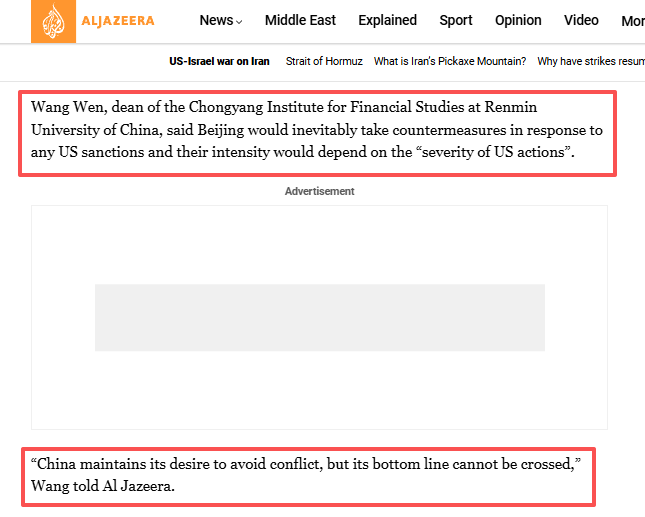
▲报道截图如上
8月24日,卡塔尔半岛电视台转引王文观点:如果美国实施制裁,中国政府必将采取报复措施,其影响将是严重的。“中国始终努力避免冲突。然而,凡事都有底线。”
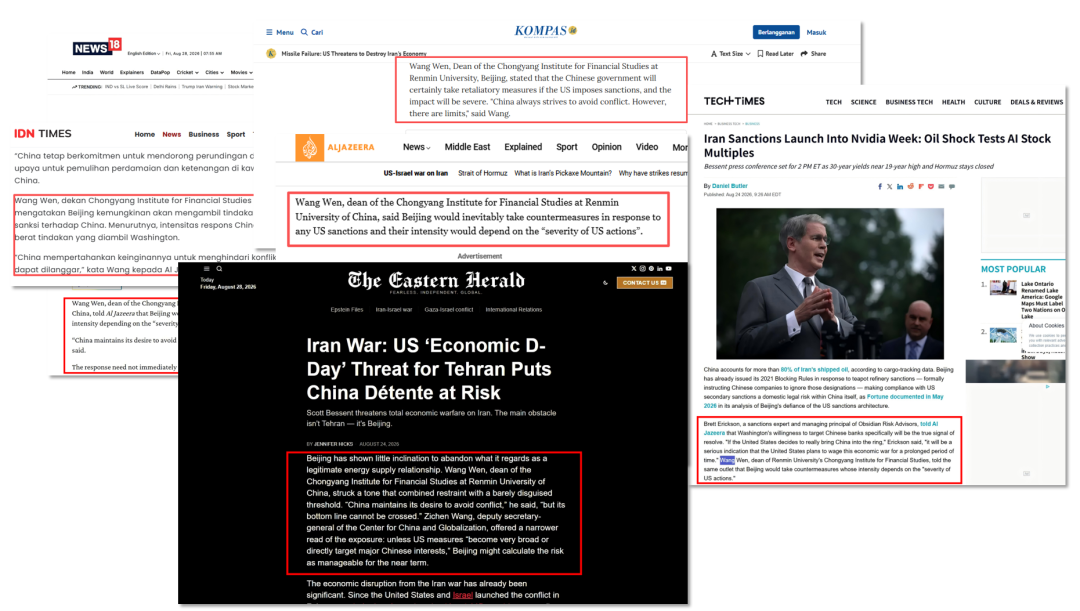
▲美国《科技时代》(Tech Times)、Eastern Herald,印度News 18,印尼《罗盘报》(Kompas)、IDN Times报道
随后,该观点被美国《科技时代》(Tech Times)、Eastern Herald,印度News 18,印尼《罗盘报》(Kompas)、IDN Times接连转引。
以下为正文:
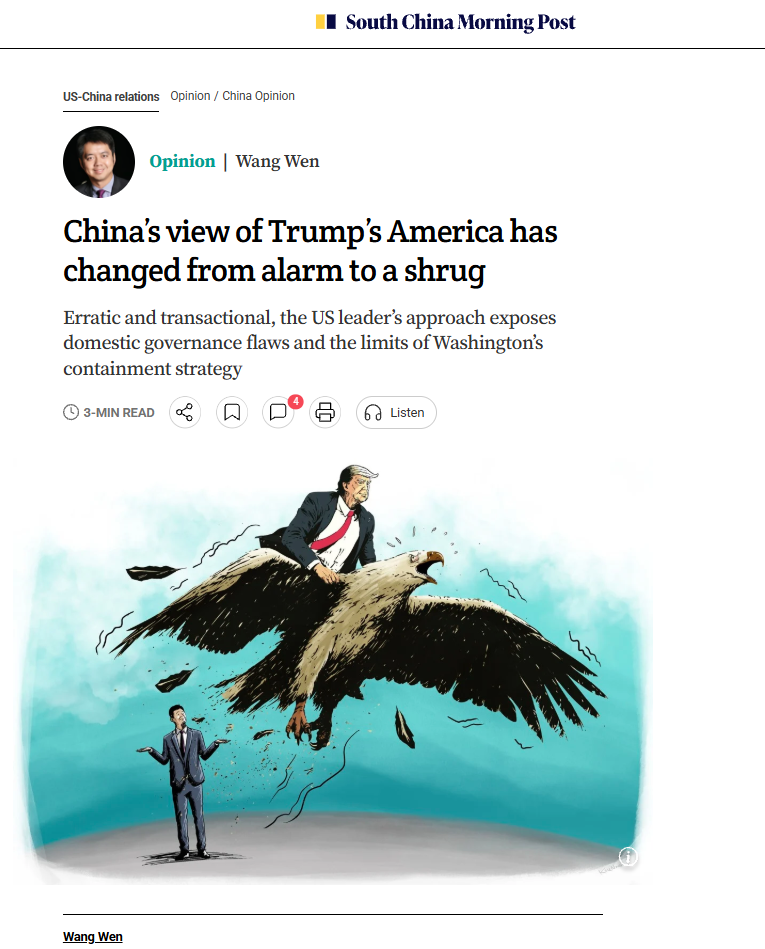
▲报道截图如上
关于美国总统唐纳德·特朗普第二任期,西方的评论并不算少。实际缺少的是一个能反映14亿中国人真实看法的声音——至少缺乏中国学者的见解。过去十年,我目睹了这种看法的演变:从2017年的真切警觉,到如今近乎于耸耸肩、不以为意。
如今,中国学者间大体达成了四点共识。第一,特朗普政府正在削弱美国的同盟体系。他的第一个任期使华盛顿的根基动摇,第二个任期则彻底摧毁了这一基础。还包括清洗文官系统,扩大行政权力,对盟友和敌人均加征税款,并严重削减了美国对全球公共品的贡献。
特朗普第二任期的执政似乎只为下一次选举,而非下一代人——而这正在加速多极化世界的到来。
第二,在华盛顿,对华敌意是两党共识,但特朗普版本的敌意附带代价,这反倒让我们感到“莫名安心”。去年,当对中国商品加征145%的关税时,美国零售商、农民和制造商怨声载道,通货膨胀加剧,白宫最终不得不退让,达成停战协议。我们从中得出的教训是:他的强硬是一种谈判策略,而非一场圣战。这为管理两国关系留出了空间。
第三,施压远不能替代真正的遏制。2018年的贸易战曾让中国企业感到不安。但到了2026年,局势已经逆转。事实证明,制裁反而很好地促进了美国本欲阻止的事物的成长。中国芯片制造商已扩大成熟28纳米工艺的生产规模;国产芯片设计软件现已占据国内市场的四分之一;太阳能电池板和电动汽车在东南亚、中东和拉丁美洲找到了新的买家;美国在中国贸易中的份额也在下降。
第四,真正的较量在于治理,而时间站在中国一边。美国的政策随着每次选举而摇摆不定,而中国的五年计划往往能够经受住考验。美国在科技和军力上仍处于领先地位,但我们认为,政策的连续性与产业规模的扩大将不断缩小这一差距。
把这四点加在一起,得出的与其说是一种论辩,不如说是一种心境——放松、沉静的自信。
八年前,中国承受了特朗普的关税并临机应对。如今,中国可以用工具回击,对稀土实施出口管制,将外国企业列入“不可靠实体清单”,对能源加征我们自己的关税。同时通过金砖国家、上海合作组织和共建“一带一路”倡议,构建替代美国主导机制的选项。中国已从规则接受者转变为规则塑造者。
中国并不试图击败美国。中国在努力改善人民的生活,实现共同富裕,实现中华民族伟大复兴。所谓“中华民族伟大复兴”,就是让中国回到我们眼中它在世界上应有的位置。
这是我们的真心话。取胜从来不是目标。但如果能让国家足够进步,并持续足够长的时间,那么超越那个原本领先的国家,不过是自然而然会发生的事。
中国是全世界唯一建成完整产业化绿色能源体系的国家。中国坚持同一战略长达十年,而美国的政策则随着每一届政府的更替不断变化:《巴黎协定》被放弃、重新加入又再次被放弃,风电和太阳能项目也因此陷入停滞。
在风电、光伏、电池和电动汽车领域,中国企业如今已占据全球产能、产量和出口的一半以上。中国已建成世界最大的特高压电网和储能系统,将电力从能源富集地区输送到人口密集区。国家运营的卫星网络对碳排放进行监测,实现全球高精度覆盖。中国已成为绿色转型标准的制定者。
在人工智能领域,美国在芯片和底层算法上仍然领先,但中国在应用部署上拔得头筹:政务服务、智能制造、智慧城市。在太空领域,我们中国学者常喜欢将星链——这一商业性、小范围、以覆盖为目标的项目——与中国更广泛、由国家主导的计划相比较:载人航天、月球探测、北斗卫星导航系统以及天宫空间站。
在治理方面,中国建成了全球最大的数字国家,在提供公共服务和应对灾害时展现出的连贯一致,是美式政治僵局无法企及的。
但也有一些需要注意的地方。美国仍然拥有最深厚的资本市场、最好的大学以及数十年积累的研究成果。中国在精密制造和部分工业软件方面仍有差距;外部压力短期内正在挤压出口;更广泛的地缘政治局势也依然不稳定。
十年前,许多人曾对美国怀有近乎理想化的看法。如今,这种看法已不复存在。
我们承认美国对现代世界的历史性贡献。同时,我们也清晰地看到了过去二十年里美国的金融过剩、赢家通吃的政治和社会撕裂带来的问题。特朗普执政看似带来压力,实则是一次隐性的机遇:当前的压力令人不适,却正迫使中国更快地弥补自身短板。我们并不排斥与美国竞争,但我们更希望中国能以非对抗的方式与美国展开竞争,并实现和平共存。
中国并不试图击败美国。中国试图在治理上胜过它、在生产上胜过它、在持久上胜过它。只要美国愿意,就开展竞争而不对抗。这句话听起来更像是安抚之词,还是极有耐心的最后通牒呢?这恐怕取决于身处何种位置。
英文原文
China's view of Trump's America has changed from alarm to a shrugWANG Wen
Erratic and transactional, the US leader's approach exposes domestic governance flaws and the limits of Washington's containment strategy
There is no shortage of Western commentary on US President Donald Trump's second term. What's missing is an honest account of how 1.4 billion of us in China see it—or at least how China's officials and scholars do, since that's who I can speak for here. I've spent a decade watching that view change, from real alarm in 2017 to something closer to a shrug today.
Four things now count as consensus among Chinese scholars. One, Trump is undermining America's alliance system. His first term rattled Washington's furniture. His second is dismantling the house. He has purged the civil service, stretched executive power, taxed friend and foe alike, and gutted America's contribution to global public goods.
He appears to be governing for the next election, not the next generation—and this is speeding up the arrival of a multipolar world.
Two, hostility to China is bipartisan in Washington, but Trump's version comes with a price tag, which we find oddly reassuring. When tariffs on Chinese goods hit 145 percent last year, American retailers, farmers and manufacturers howled, inflation bit and the White House backed into a truce. The lesson we draw: his toughness is a negotiating tactic, not a crusade. That leaves room to manage the relationship.
Three, pressure has been a poor substitute for actual containment. The 2018 trade war spooked Chinese firms. By 2026, the mood has flipped. Turns out sanctions are quite good at building the thing they're meant to prevent.
Chinese chipmakers have scaled up mature 28-nanometre production. Home-grown chip-design software now holds a quarter of the domestic market. Solar panels and electric vehicles have found new buyers across Southeast Asia, the Middle East and Latin America. America's share of China's trade shrank.
Four, the real contest is in governance, and time is on China's side. American policy lurches with every election. China's five-year plans, for better or worse, tend to survive them. America still leads in technology and firepower, but we're betting that policy continuity and industrial scale will keep narrowing the gap.
Add those four up and what you get is less an argument than a mood—of relaxed, quiet confidence.
Eight years ago, China absorbed Trump's tariffs and improvised. Now it hits back with tools—export controls on rare earths, a blacklist of "unreliable" foreign firms, tariffs of our own on energy—while building alternatives to Washington-led institutions through BRICS, the Shanghai Cooperation Organisation, and the Belt and Road Initiative. It has gone from rule-taker to rule-shaper.
China is not trying to beat the United States. It is trying to improve the lives of its people, hit what we call "common prosperity" and complete national rejuvenation, by which we mean restoring China to what we see as its rightful place in the world.
That is both the official and our genuine position. Winning was never the goal. But if you improve your country enough, for long enough, overtaking the country that used to be ahead is simply what ends up happening.
China is, by its own account, the only country to have built a fully industrialised green energy system that's industrialised. Beijing has stuck to the same decade-long strategy while American policy changes with every administration: the Paris Agreement abandoned, rejoined and abandoned again, wind and solar installations stalling as a result.
In wind, solar, batteries and electric vehicles, Chinese firms now account for more than half of global capacity, output and exports. The country has built the world's largest ultra-high-voltage grid and energy storage system, which is how it moves power from where the sun and wind are to where the people are. A state-run satellite network monitors carbon emissions, giving global, high-precision coverage. China has become the country that sets the standard for what a green transition looks like.
In AI, America still leads on chips and the underlying algorithms, but China claims the lead on deployment: government services, smart manufacturing and smart cities. In space, the comparison we Chinese scholars like to draw is with Starlink—commercial, narrow, built for coverage—against China's broader, state-run programme: crewed missions, lunar exploration, the BeiDou satellite network and the Tiangong space station.
On governance, China has built the world's largest digital state and Chinese officials argue it delivers public services and disaster response with a consistency American gridlock can't match.
There are caveats. America still has the deepest capital markets, the best universities, and decades of accumulated research. China still lags in precision manufacturing and some industrial software; external pressure is squeezing its exports in the short term; and the wider geopolitical picture remains genuinely unstable. I'll admit these caveats read a little like the fine print below an advert for something you didn't need.
Ten years ago, many of us held an admiring, almost idealised view of America. That's gone.
We credit America's historical contribution to the modern world. We also see, clearly now, 20 years of financial excess, winner-takes-all politics and social fracture. The Trump years have been a blessing in disguise: the pressure stings now, but it is forcing China to fix its weaknesses faster. We don't reject competing with America. We'd rather China compete without conflict, and coexist.
China is not trying to defeat the US. Beijing is trying to out-govern, out-produce and outlast it. Competition without confrontation, if Washington will allow it. Whether that sounds like reassurance or a very patient ultimatum probably depends on where you're sitting.












 京公网安备 11010802037854号