发布时间:2025-12-29 作者: 王文
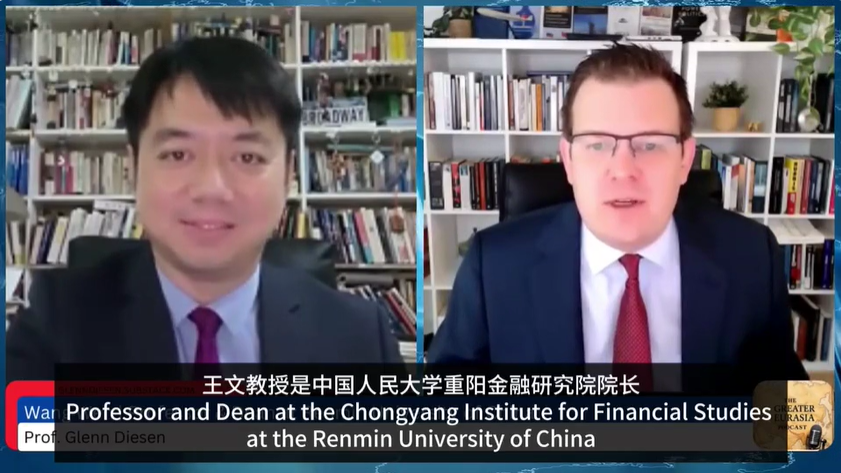
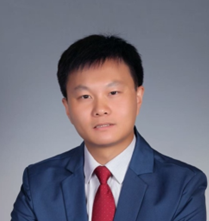
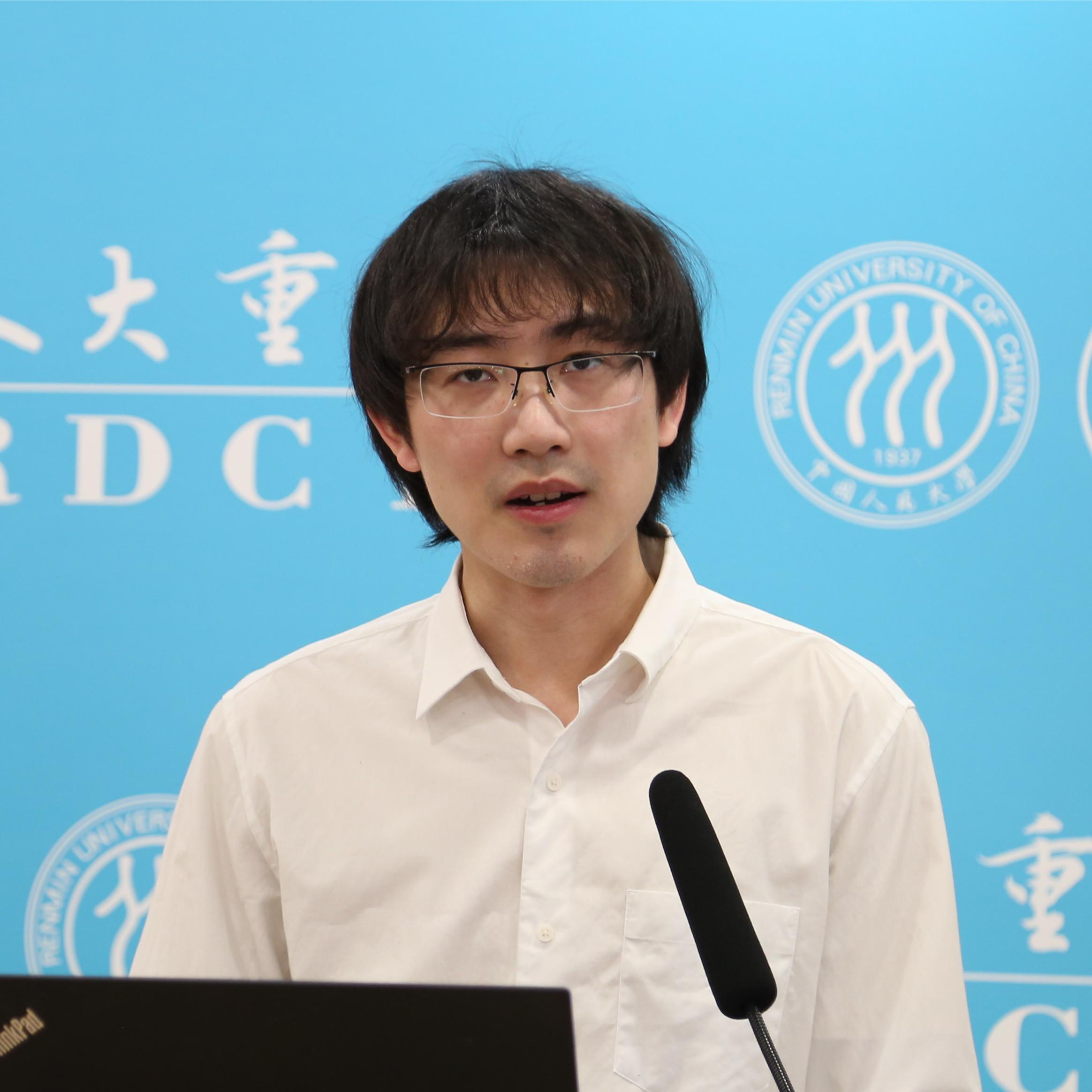
2025年12月底,中国人民大学重阳金融研究院院长、全球领导力学院院长王文应邀接受挪威东南大学国际关系学教授、著名政治学者格伦·迪森(Glenn Diesen)YouTube专访。
编者按:2025年12月底,中国人民大学重阳金融研究院院长、全球领导力学院院长王文应邀接受挪威东南大学国际关系学教授、著名政治学者格伦·迪森(Glenn Diesen)YouTube专访。这是继6月双方对话被译成8种语言在全球广泛传播、9月对话谈中国“六场斗争”、“去美国化”狂揽500多条好评以来的第三次对谈,从多个角度全面解读中国的“去美国化”战略,访谈上线后不到一周即收获近500条肯定性的热评。现将对话视频及中英文内容发布如下:(中文约8600字,预计阅读时间24分钟)
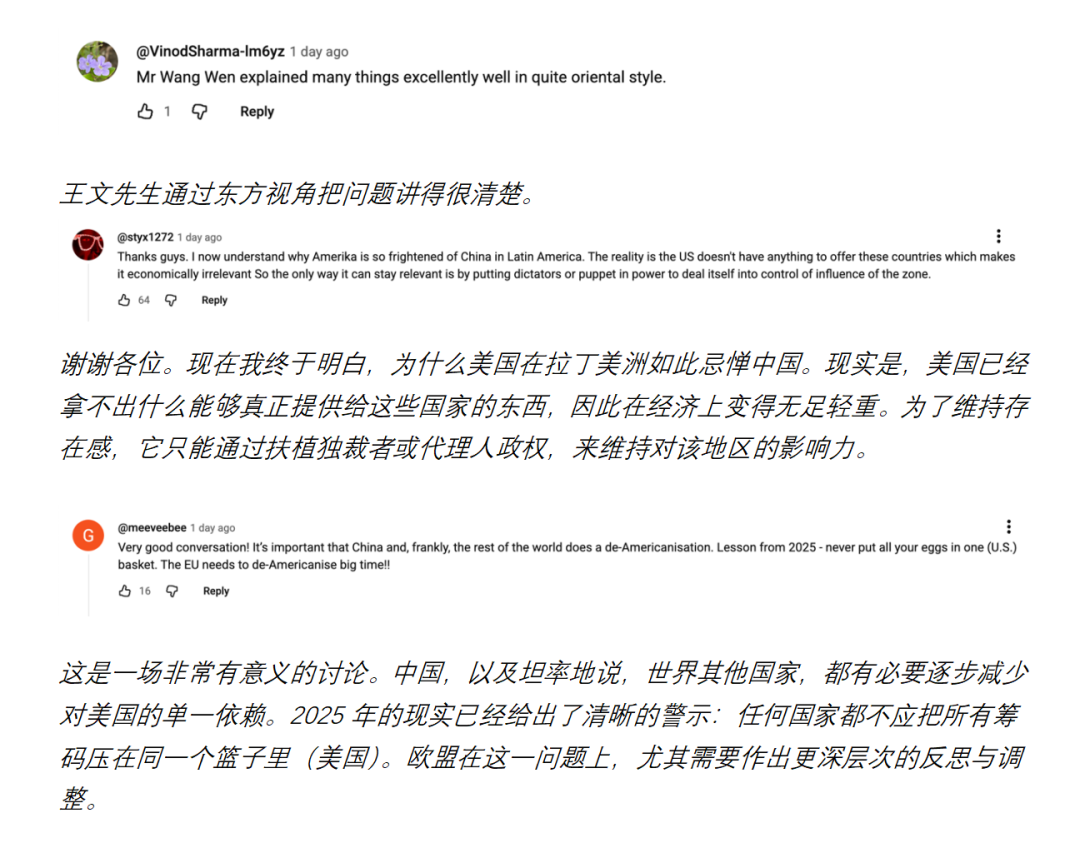
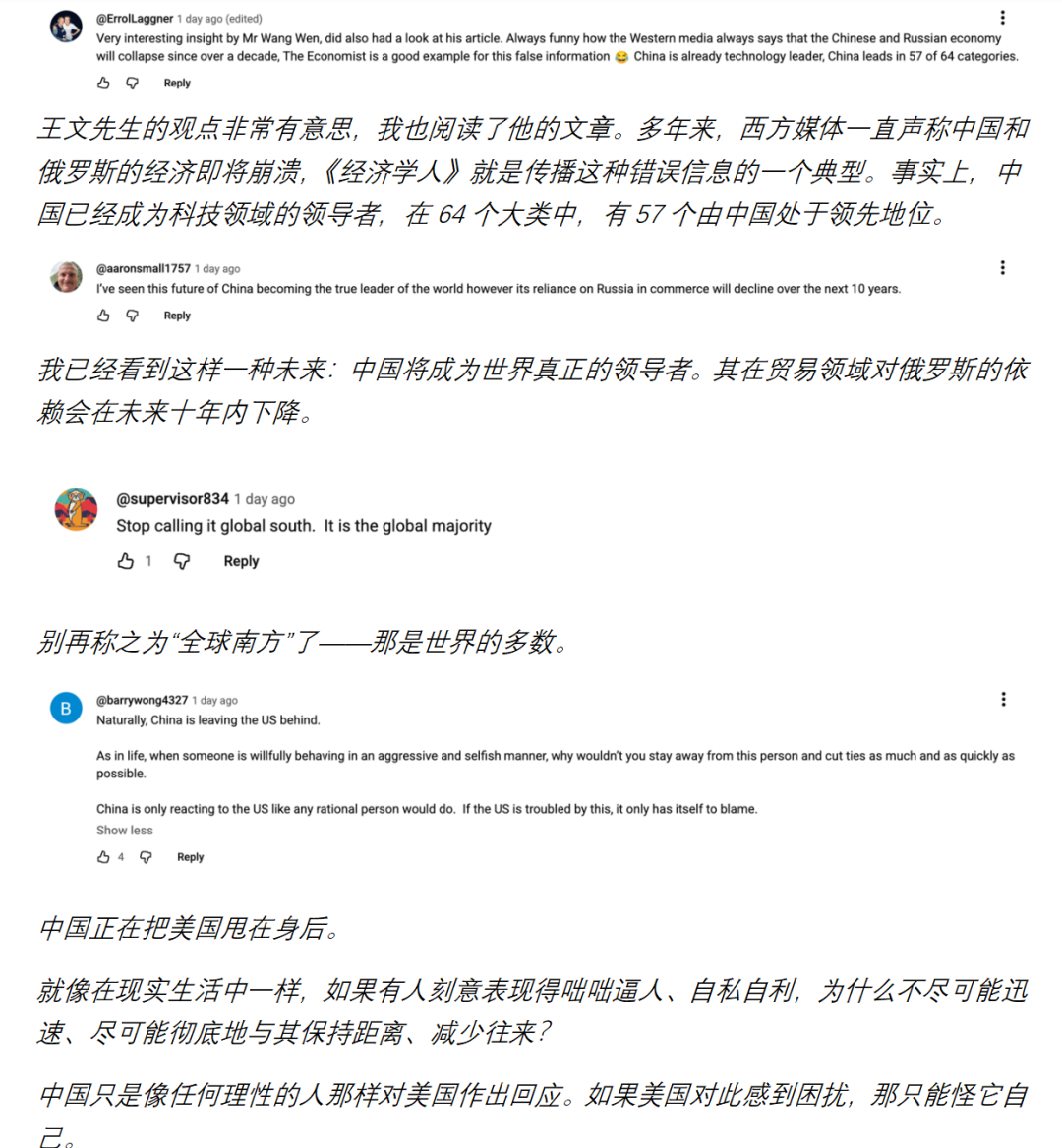
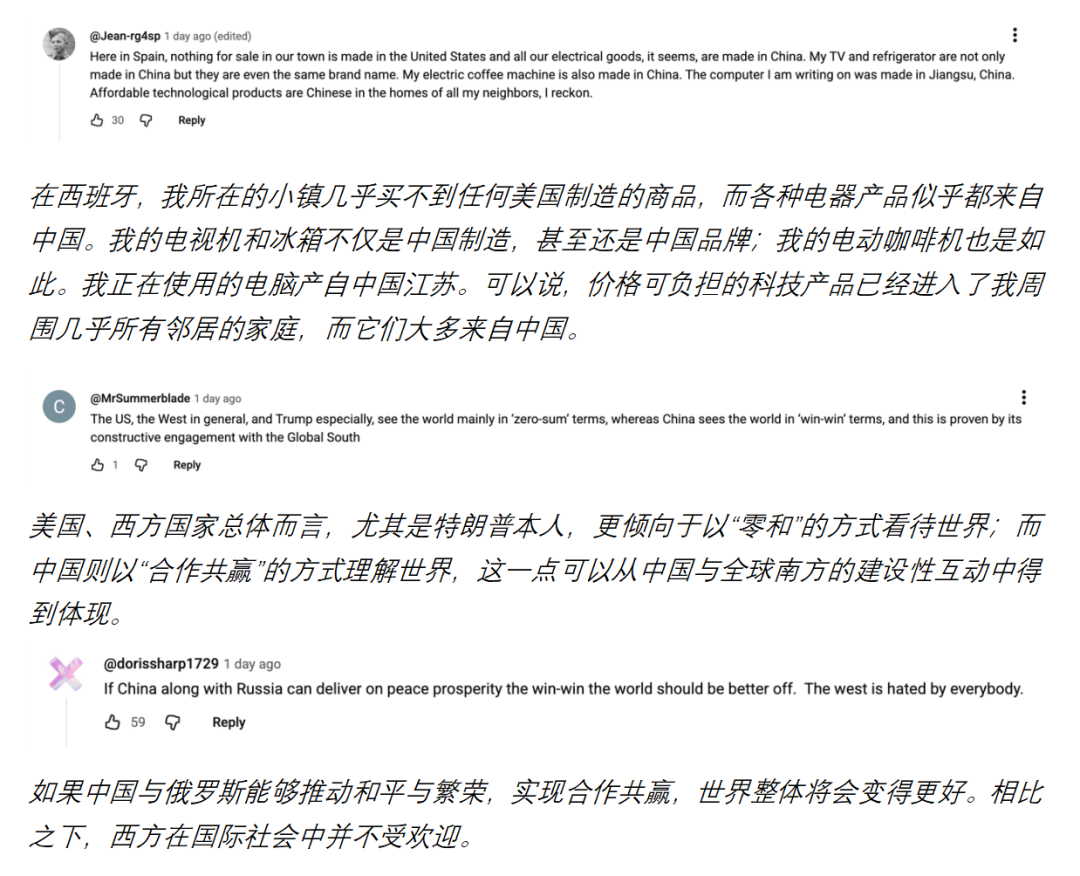
▲部分网友评论如图所示
01
“去美国化”战略并非中国主动预设
而是源于美国压力
格伦·迪森:欢迎回来。我们今天邀请到了中国人民大学重阳金融研究院院长、丝路学院副院长王文教授,非常感谢您再次做客。
我最近读了您的一篇文章,觉得非常有意思。我们可以看到中美关系已经发展了相当长一段时间。大约在二、三十年前,人们还常常谈论中国和美国之间的相互依赖。但如今,我们看到的是美国在许多指标上不断走弱,而中国不断变得强大,这也带来了彼此相互的猜疑与恐惧。
人们常说,如果你欠别人一百美元,那是你的麻烦;但如果你欠一百万,那就是别人的麻烦。我想我们正朝着类似局面发展。
而在2008年到2009年全球金融危机背景下,中美关系变得更加不稳定,因为美国主导的金融体系开始出现裂痕。如今,美国更加担忧中国的崛起,谈论“脱钩”、“去风险”、“友岸外包”等。当然中国也必须以某种方式回应,设法降低对这一关系的依赖。正是在这样的背景下,您写下了这篇关于中国“去美国化”的文章。我认为这很引人入胜。
我觉得一个好的切入点是:能否请您概述一下,中国推动“去美国化”的动因是什么?这在多大程度上仅仅是对美国政策的回应?又能否应对新的多极权力结构现实——即中国不能“把鸡蛋放在一个篮子里”?
王文:谢谢你,迪森教授,很高兴再次见到你,也非常感谢你关注我的文章。这篇文章于10月发表在美国著名期刊《外交学人》(The Diplomat),过去一个月产生了很大反响。很多美国、欧洲、日本以及其他国家的朋友都读了这篇文章,很大程度上是因为标题:中国的“去美国化”战略。
在这篇文章中,我谈到了过去七年中国“去美国化”进程中的六个领域:包括贸易、金融、安全、思想、高科技和教育,列举了大量数据来佐证我的观察。
正如你所问到的,所谓的“去美国化”战略,并不是中国主动预设,而是被美国逼出来的。事实上,自1978年改革开放以来,中国一直努力与美国建立友好关系,对美采取开放态度,吸引美资,发展对美贸易,并学习美国公司的管理经验和金融市场运作。
我想提及一个很可怕且庞大的数据:截至2016年,中国对外贸易仍有约20%依赖美国。坦率地说,这种依赖过去对中国有利。但在特朗普上台不久,美国便开始推行遏制中国的政策,发动贸易战,扣押华为高管孟晚舟,对包括华为在内的数千家中国企业实施制裁。这些遏制性政策令中国感到威胁,也促使中国采取反制与调整。
正如我在2022年8月发表于《纽约时报》的文章中指出:中国人民早已觉醒,不再像过去那样盲目崇拜美国。他们越来越意识到,过度依赖美国已成危险之举。从这个角度看,正是美国,迫使中国采取了所谓的“去美国化”战略。
今年我在另一篇文章中也提到,中国人民要“感谢”特朗普总统,因为他堪称一位独特的政治教育导师。他不仅教会中国人民看清美国的虚伪行径与国际社会的残酷本质,更重要的是,他教会我们如何在现代化进程中采取必要措施,捍卫国家的核心利益。这就是我所说的“去美国化”的目的。
02
贸易“去美国化”正是对美反制能取得成功的关键原因
格伦·迪森:诚然,我认为学者与政策制定者必须清醒认识到,大国之间始终存在竞争,坦诚面对这一现实至关重要。唯有如此才能明确妥协空间,既能在利益协调与合作中寻求共识,又始终清醒认识到竞争的必然性。
那么,该如何妥善处理并缓解这种竞争,特别是其中最具零和性质的方面?理想情况下,我们应将其转化为良性竞争,避免将经济争端军事化。
但要知道,上世纪90年代,美国经济高度集中,当时的全球化在很大程度上意味着美国化。说白了,全球都在使用美国的技术、产业、航运网络、银行体系乃至货币体系。随着权力格局的演变,两者之间的关系必须变化,这是合理的。这既会催生合作,也会引发竞争。
总而言之,我认为这就是所谓“去美国化”,其实正是对这种现实的认识。
不过我仍有疑问:中国正推动贸易多元化,将贸易从美国转移到其他国家,逐步减少对美国的依赖。就整个世界或国际经济结构而言,你认为这会产生哪些深远影响?
王文:您提出的问题确实很有见地。据我所知,自2013年中国提出“一带一路”倡议以来,中国越来越重视与“全球南方”国家的合作。中国与俄罗斯、中亚、拉美、非洲以及东南亚等地区的双边贸易额年均增长率均超过10%。与此同时,过去十年间,中美双边贸易总额的相对比重呈现下降趋势。这种现象,我称之为“贸易去美国化”或“结构性调整”,也就是说中国在贸易上对美国减少了依赖。
正如您刚才提到的,以一组数据为例:五年前,中国与俄罗斯的双边贸易额仅为1000亿美元左右,而五年后的现在,已达2500亿美元,预计未来五年将突破3000亿美元大关。中拉贸易额已经超过5000亿美元,且今年起,这一规模有望在未来五年内超过中美贸易总额。因为今年中美双边贸易额仅约为5000亿美元。换句话说,在中国未来的对外贸易版图中,拉丁美洲的重要性可能超过美国。
我认为这本质上是多元化战略。因此,尽管未来美国仍会是中国重要的贸易伙伴,但其重要程度正在下降。中国贸易“去美国化”的战略结果,使中国的全球贸易结构更加均衡且安全。这正是中国2025年应对美国贸易战时,反制措施能取得成功的关键原因。中国在贸易战中不怕美国。相反,正如许多媒体报道,美国已输掉2025年中美贸易战,主要原因是美国在中国外贸格局中的份额持续萎缩。在2015年,中美贸易约占中国对外贸易总额的20%,而如今这一比例已降至9%。
另一方面,中国对外贸易结构的再平衡,有利于世界各国的发展。中国向全球出口了更多高质量、高性价比的商品,实现了商品和生产的“去美国化”,并帮助“全球南方”国家从中国的发展中受益。众所周知,过去发展中国家依赖西方产品,这些产品虽质量上乘但价格太贵。如今,中国在贸易领域的国际价格改革,使得“全球南方”国家以同等价格购买更多高质量的中国商品,从而获得更多实惠。这就是我经常说的:中国的崛起对世界有利。
过去常有人认为,中国制造价格便宜但质量不是很好,近年来中国产品质量越来越高,例如在电动汽车、太阳能发电以及电力装备等等领域。我认为,中国现在发起了一场国际价格改革,这对“全球南方”国家具有积极意义。
03
中美技术竞争未来最终会造福全人类
只要双方保持理性
格伦·迪森:确实如此。我完全赞同中国的做法。中国正在摆脱对美国的依赖,实现多元化。而且“去美国化”并不等同于反美。我刚从武汉回来,之前在中国几所大学做了客座讲座,讲的是俄罗斯与欧洲的关系。
王文:你应该来北京。
格伦·迪森:确实该来的,但是时间太紧张了。不过我刚才说的是俄罗斯的地缘经济问题,其实与我们讨论的主题相关。你刚刚谈到多元化,如果国家间合作而不推动多元化,我认为这是妄想。
我曾向俄罗斯方面强调,中国是其最重要的合作伙伴,也在构建多极体系。但由于中国体量远超对方,这种不对称性会带来依赖关系的不对等。这本身未必是问题,但需要说明的是,俄罗斯也在关键技术领域追求战略自主,例如建立自己的数字基础设施。他们也会寻求多元化,例如加强与印度等大国的贸易。中国仍是最重要的合作伙伴,但正如我们所言,没有哪个国家会把所有鸡蛋放在一个篮子里,因此各国都力求多元化布局。
我认为关键在于认知层面。这表明立场并不一定非此即彼,也不是国家与经济体系的运作方式。这同样适用于美国,如果美国担心过度依赖中国,那么在我看来,应该追求高度的技术自主权,而非试图通过贸易战击溃中国。这是两码事,后者极具破坏性和危险性。
如果中美双方能坐下来协商,当然双方在战略自主、技术、产业等领域通过某种贸易协定,管理竞争,那么很多问题都能得到妥善解决。那种认为一切都必须永远处于零和博弈的观点,我认为是错误的。
不过,这引出了我的下一个问题。多年来,中国作为技术追赶者一直在努力追赶美国,而如今,美国与中国的科技竞争已演变为技术主导权之争。你认为这种态势会如何加剧双方在技术领域的对抗?
王文:正如你所说,从多方面来看,如今中国的高科技产业正在迎头赶上。我认为这对中国来说是件好事。我们有信心迅速复苏并崛起。回顾过去七年,特朗普总统对中国实施高科技壁垒、遏制华为等众多公司,无疑是一场非常严峻且激烈的高科技竞争。
但在我看来,高科技并不是美国独有的。任何国家都不能垄断高科技的研发和生产,也不应该借垄断高科技过度获利,更不能把高科技武器化,压制其他国家,包括中国。因此,高科技领域的竞争应当是公平的、以市场为基础的。作为一个新兴经济体,中国通过持续提升技术环境、加大研发投入,在越来越多的领域实现了技术突破。这很正常,也很成功。
中国没有窃取、没有掠夺、没有参与殖民主义,所以美国没有理由指责中国行为不当或是不友好。我注意到一些媒体声称,中国窃取美国技术,但这种说法同样站不住脚。我举一个历史上很有趣的例子:大家都知道指南针和火药都是中国发明的,且在1000多年前,随后美国和其他西方国家都采用了这一发明并推动了技术革命。中国从未因此指责美国窃取中国技术。同样,中国在美国现有高科技产品与技术基础上持续创新,甚至在高铁基础设施、电动汽车、太阳能等领域超越美国。这种发展既造福人类,又推动文明进步。
因此,我认为当前中美之间的高科技竞争是正常的。中国科学家正在适应这种竞争,社会各界也能理性看待。我们不应以意识形态的角度来评判其竞争,美国也不应使用政治手段,特别是金融制裁、域外管辖和技术封锁等手段来应对科技竞争。相反,我认为美国应该以更开放的心态迎接这场技术竞争。技术竞争应当是健康的。我认为,中美技术竞争未来最终会造福全人类,只要双方保持理性。
04
美元霸权不利影响远大于其益处
格伦·迪森:我认为这个观点很有说服力。科技确实会扩散,且本该扩散。当然这种扩散可以带来积极影响。如果中美之间的竞争能够得到妥善管理,甚至可能对世界大有裨益。当全球仅存一个权力中心、一个技术主导国时,这个国家就有减缓扩散的意愿和能力,以维持其先发优势。然而,一旦出现两个或更多技术领导者时,技术扩散速度将显著加快,因为各方都必须通过技术转移等激励来争取广泛的支持。
我们可以在如今俄罗斯与印度的军事技术合作中看到这一点。俄方愿意向印方转让大量技术,这也使得印度更青睐俄罗斯而非西方阵营。当然,有人可能会说武器技术的传播未必是好的,但总体而言,技术传播应当被视为促进全球平等或公平的积极因素。
但我确实认为,美国之所以陷入恐慌,是因为他们现在实际上已无法与中国有效竞争,这是他们对因为落后而产生不稳定的恐惧。美国“寻租经济模式”导致其生产成本居高不下,而中国作为工业强国,能够大规模应用人工智能等新技术并从中获利。在美国,出于对与中国竞争的恐慌,他们投入了大量资金。例如在人工智能领域,有很多投资失误,造成了巨大的人工智能泡沫,如今他们显然已无力赚回这些投资。如今美国政府陷入了这种局面:美国曾指控中国实行国家主导的资本主义,而如今自己却要掌控科技公司,这种立场前后矛盾。但这场竞争的走向确实耐人寻味。
不过,我想谈谈金融领域,因为您的文章中也写了金融领域的“去美国化”。那么中国如何才能实现金融多元化,摆脱对美国金融工具的依赖?不少人认为中国只是想摆脱美元。您认为中国在多大程度上仍会继续使用美元呢?
王文:是的,金融领域的“去美国化”非常重要。我不确定你是否了解过去七年的情况。超过2000家中国公司曾受到美国金融制裁。这些制裁往往缺乏法律依据,只会增加我们所有中国人对美国金融霸权的怨恨,促使我们寻求有效的应对方法。
另一方面,中国采取更多反制措施,使美国为其金融制裁付出必要代价,从而维护了中国的国家利益。同时,中国也减少了对美元的依赖,在双边贸易、国际合作中采取更多“去美国化”措施,并推动国际金融支付体系的改革。与其说这是针对美国的措施,不如说是中国为维护自身利益而被迫采取的行动。
当前,美元霸权不利影响远大于其益处。二战结束后美元霸权确实为国际金融稳定做出了贡献。但如今看来,美元的强势已成为全球国际金融与经济贸易体系改革的最大障碍。全世界都应该减少对美元的依赖,以降低金融风险和遭受美元制裁的风险。
你刚才提到的俄罗斯问题,如果问俄罗斯人民,每一个俄罗斯人都会回答我们需要减少对美国的金融依赖,因为美国使用金融武器化来威慑俄罗斯。
我认为未来国际金融和国际货币体系的多元化,将更有助于各国的经济发展和社会稳定。我预测到2035年,美元霸权将进一步削弱,人民币以及其他货币的国际化趋势将持续增强,越来越多的国家将减少对美元的依赖。我认为这是未来发展的必然趋势。
05
中美应做“普通邻居”
格伦·迪森:很有意思,你提到这些非法制裁。文献中常有观点认为一个衰落的霸权国家总会面临两难境地。它该如何过渡,或现在该采取什么行动?一方面,它可能推动向多边体系的转型,维持金融稳定;另一方面,它可能会通过制裁新兴力量试图维持其霸权地位,实质上将金融权力工具武器化。但这种做法只会加速全球其他国家与其脱钩。
他们之所以提及俄罗斯,是因为普京曾对美国人说,俄罗斯从未真正推行过脱钩美元的政策,是美国主动让我们与美元脱钩。这件事是你逼迫的。但即便制裁明天就解除,俄罗斯人也再不会信任西方货币、银行、支付系统或保险体系了。因此,美国走上第二条道路的选择极具破坏性。
这或许深植于人性之中。谁都不愿眼睁睁看着自己的霸权地位消失,总想加以维护。但如今,这种行为已经变成自我伤害,成为一个危险的信号。随着中国日益“去美国化”,原本可能只是温和的再平衡,如今却演变成中国将美元和美国金融视为威胁,不惜一切代价规避。这很难看出符合美国的利益。
我换个角度问你,你把这种“去美国化”定义为建立中国模式作为替代方案,可以展开讲讲吗?这具体意味着什么?
王文:事实上,其余国家的发展进程——你提到了西方和其他国家都在探索自己的发展模式,这可以视为“去美国化”。过去半个世纪以来,大多数国家的现代化进程都以美国为蓝本。哈佛大学教授塞缪尔·亨廷顿,我们都很熟悉他。多年前他写了一本书,他曾写到自20世纪70年代以来,人类政治发展已进入“第三波”浪潮。另一位著名学者弗朗西斯·福山提出了“历史终结论”。他们所指的是,多国发展路径都向美国模式趋同。
我们当然曾经钦佩甚至崇拜美国的发展模式,但问题是,正如您提到,2008年国际金融危机,特别是2017年特朗普上任以来,全球各国都在重新审视自身发展路径,并调整与美国的关系。例如俄罗斯、巴西、印度、印度尼西亚等新兴经济体,都在重新审视自己的国家发展定位和身份。这些国家正在寻求保卫自己的国家安全,并在政治模式、经济体制、金融工具和军事体系等领域,探索符合自身国情的发展方向。中国也不例外。
首先,中国必须确保自身政治体制的安全,中国不愿重蹈苏联解体的覆辙,绝不会允许美国在中国境内挑起“颜色革命”。过去20年,世界上许多国家都经历了与美国有关的“颜色革命”。
其次,中国还必须确保经济、贸易和金融自主权,防止美国控制中国的经济命脉。事实上,许多国家的经济都因过度依赖美国而受其制约,特别是拉丁美洲的一些国家,这可以称之为“新殖民主义”。
第三,中国必须保障自身的科技和军事安全:必须防止美国遏制其科技和军事发展,并防止其构成长期威胁。同时,中国必须推进国家统一,在未来几年内解决台湾问题至关重要。此外,中国需要发展独立自主的知识体系和意识形态,以抵御美国在文化上殖民,防止持续不断的“美国化”渗透。
这并非要与美国彻底脱钩,是要与美国建立一种正常的关系:既避免过度依赖,也不回避必要的合作。
我举个很有意思的例子,虽然我不太确定它是否完全贴切。我曾说过,中国和美国的领导层就像一对亲密恋人,特别是上世纪八九十年代以及“9·11”事件后的21世纪初。当时中国支持美国的反恐战争,两国关系非常融洽。甚至在2008年北京奥运会期间,美国总统也来到北京,与中国国家主席共同庆祝奥运会的圆满成功。
多年前,中美两国关系确实非常密切,几乎如同亲密伴侣一般。但展望未来,我期待中美关系能像普通邻居一样。
邻国之间难免会有摩擦,但仍保持互动。面对共同挑战,他们会互相帮助。底线是,中美之间必须不惜一切代价避免军事冲突,因为这对任何一方都没有好处。我相信未来中美关系将回归正常轨道。
06
应当培养更多真正服务于中国的高素质、高水平人才
格伦·迪森:这个比喻我很中意,政治学界常提及这个比喻。尤其对大国而言,若彼此过于亲近,反而可能引发过多矛盾,最终导致关系破裂;但若两人分居,虽无法维持婚姻关系,却能成为好邻居。很多情况下,这种“分离但不脱钩”的做法反而是一种更优选择。对于像中美这样的大国,彼此间可能始终存在着潜在的猜疑,公开对抗无益于任何一方,“去美国化”有其合理性。
俄罗斯如今也采取类似策略。俄罗斯曾寻求与欧洲更紧密的融合,但由此产生的紧张局势变得难以维系,如今双方似乎都认为与其继续纠缠,不如分道扬镳。与其追求更亲密的关系,不如努力成为邻居。
这一点也与“颜色革命”有关,我认为这是抵制“美国化”的重要意义所在。这些革命在世界各地造成了诸多问题,尤其是在欧洲。并非说这是一场阴谋,但他们的做法遵循着一种令人不安的模式。美国的做法认为,民主必须包含一个强大的公民社会,一个能够独立于政府、自我组织的公民社会,这一点本身无可厚非。但他们更进一步,明确指出组织公民社会的应该是非政府组织,更具体地说是美国的非政府组织,甚至是由国家资助的非政府组织。这些非政府组织由美国政府资助,并与美国情报机构有关联,但不知何故,它们却想要去影响中国公民和社会,这简直是荒唐至极。
试想一下,如果中国政府与其情报机构合作,试图影响美国的公民和社会,无疑会遭到强烈抵制。事实上,历史证据已经表明,早在1983年,里根总统和中央情报局局长已经开始建立诸如“国家民主基金会”之类的非政府组织,其目的就是为了操纵和控制其他国家的公民社会。不需要用武力征服他国,只需控制其公民社会即可。这是一个巨大的问题,也是如今欧洲战乱频仍的原因之一。
我的最后一个问题是:鉴于我们都是学者,教育在“去美国化”过程中扮演着怎样的角色?教育是如何“去美国化”的?
王文:正如我之前提到的,“民主”和“公民社会”之类的词汇,在过去曾经广受推崇,但现在我们已经清楚地认识到,类似“民主”和“公民社会”之类的这些词汇极具美国特色,这种美国特色在他们自己的语境中有着非常特殊的意义。正因如此,我们回到您最后提出的问题:教育。如今中国教育同样需要与美国保持正常关系。
我们如今正大力推动中国知识体系与教材自主化建设,特别在过去五年间,中国编写的相关教材持续增长,特别是在政治学、经济学、金融学、社会学及法学等相关领域。
令人担忧的是,过去三十年间,每年有近百万中国青年赴海外求学,其中超过40%选择美国。他们曾是中国大学里最优秀、最聪明的学生,在美国获得硕士或博士学位后,许多人选择留美为美国服务。一个很有意思的数据是,硅谷超过30%的AI科学家本科学位都是在中国获得的。所以我常开玩笑说,过去七八年中美之间进行了一场非常激烈的高科技竞赛,但这所谓的“高科技竞赛”,其本质是中国本土的中国人与在美国的中国人之间的较量。其实这也是不正常的。
因此你提到教育的“去美国化”,意味着要使中国教育发展回归正常状态,并维持正常的发展关系。我们当然支持中国青年赴美留学,也欢迎美国学生来华深造,但这种交流不应演变为过度依赖。
然而特朗普总统却拒绝更多中国学生赴美留学,甚至禁止中国学生在美国学习科学、技术、工程和数学学科。我必须要“感谢”特朗普总统,这完全没问题。越来越多的优秀中国留学生将留在中国高校,未来为国家服务。因此从这个角度看,中美两国在新的历史条件下寻求新的教育定位。我认为这种双边关系的重新定位,将有利于未来两国的发展。
简而言之,回到你的问题,中国教育必须走自己的道路。中国必须拥有自己的知识体系和意识形态体系、纪律体系、教科书体系与理论体系。我们应当培养更多真正服务于中国的高素质、高水平人才,而非将大量顶尖人才输送至美国为其服务。我认为这正是教育新常态的体现。
我真的很感谢迪森教授给我机会深入解释“去美国化”。我再次强调,“去美国化”并不等于脱钩,仅意味着我们将恢复与美国的正常关系。我们不希望像过去那样依赖美国,因此我认为与美国的关系正常化对双方都有利。这就是我的要点,再次感谢。
格伦·迪森:感谢。您提到的人才流失现象确实耐人寻味,许多国家都经历过这种情况。最优秀的人才往往选择出国,寻求更好的发展机会;但随着国内就业机会的增加,他们自然会留在国内。然而如今这种针对中国学者的歧视,不仅是学者,还有专业人士,正导致大批专业人士大规模离开美国,纷纷返回中国,形成一场反向人才争夺战。这种现象最终为中国带来了显著利益,使其获得大量优秀且经验丰富的专业人才回归。
您说“不脱钩”,“去美国化”实际上是多元化。我认为这或许是个积极因素,对世界而言是件好事。可以说,多极化的权力格局、多元主义而非一元普遍主义,能赋予国际体系更强的抗冲击能力。从古希腊到美国建国,这种理念始终是其根基所在。
正如古希腊诸城邦及其他所有不同的城邦,在政府体制、教育模式、经济政策等方面进行创新实践:谁做得成功,其他人可能会效仿他们,它们相互学习,而不是将所有人塞进同一个框架。美国最初通过其联邦州制度也体现了这一理念。如今中国的经济确实呈现出高度分散化的特征。这个想法引人深思。
我强烈推荐大家阅读你的文章,因为当你谈“去美国化”时,如果只看标题,很容易误解为要与美国完全脱钩。但我认为你提出的这个区别非常重要,这确实有助于改善中美关系。非常感谢您抽出时间。
王文:谢谢迪森教授,我期待与您再次讨论。
英文版对话内容
Glenn Diesen: Welcome back. We are here with Professor Wang Wen, Professor and Dean of Chongyang Institute for Financial Studies at Renmin University of China, also the Deputy Dean of the Silk Road School. So thank you very much for coming back.
I recently read one of your articles, which I found very interesting. That is, we have seen the U.S.-China relationship evolving for quite some time. For about 20, 30 years ago, it was very common to describe this mutual dependence between the United States and China.
But of course, what we have seen is that the U.S. has kept weaken in many indicators, meanwhile China kept getting stronger, and this has created mutual suspicions and fear.
They always say that if you owe someone $100, then you have a problem. But if you owe them a million then they have a problem. And I guess this is where we are going now.
And from 2008 to 2009, the relationship became more unstable following the global financial crisis, given that the U.S.-led financial system began to crack.
Now we see the U.S. being more worried about the rise of China. They talk about decoupling, de-risking, friend shoring, all of this. But of course, China has had to respond in some ways: considering how to reduce dependence on this relationship. In this regard, you wrote this article on the De-Americanization of China, which I found fascinating.
So, I thought a good place to start would be maybe if you can outline: what are the motivations for China to De-Americanization? And to what extent is it merely a response to American policy, or just addressing the realities of a new multi-polar distribution of power in which China simply cannot have all its eggs in the American basket?
Wang Wen: Thank you, Professor Diesen, so nice to meet you again. And also, I greatly appreciate and thank you for reading my work. My latest article was published in The Diplomat last month. Actually, over the past month, this article has generated great influence. A lot of American friends, even a few European friends, Japanese friends, and many international friends, they have all read this article, because its title is “China’s De-Americanization strategy”.
In this article I talk about six fields of China’s De-Americanization process over the past seven or eight years. These include the De-Americanization of trade, finance, security, ideology, high-tech and education. I listed a lot of data to show and prove my observations.
And as you asked, the so-called De-Americanization strategy is not something China proactively presumed, but rather something it was forced into by the United States.
In fact, since China’s reform and opening up in 1978, China has consistently sought to establish friendly relations with the U.S., adopting an open policy toward the U.S., attracting American investment, increasing trade with the U.S., and learning from the management experience of American companies and financial markets.
But I have to share with you a very horrible and very huge data: by 2016 about 20% of China foreign trade was dependent on the U.S. Frankly, I admit this dependence benefited China in the past. But soon after, during his first term, President Trump began implementing policy to contain China, launching a trade war against China, detaining Huawei’s Ms. Meng Wanzhou, and imposing sanctions on thousands of Chinese companies including Huawei.
And this containment policy made China feel threatened, promoting countermeasures and adjustments. And as I pointed out in an article published in The New York Times in August 2022, I said the Chinese people have now awakened and no longer hold the United States in such a high regard. The Chinese people increasingly believe that relying on the U.S. as they did in the past is dangerous. From this perspective, it was the United States that forced China to adopt the so-called De-Americanization strategy.
And I also wrote in another article this year that the Chinese people should actually thank Trump, because President Trump was like an excellent political education teacher: teaching Chinese people to see through American hypocrisy and the cruelty of the international community, and more importantly, teaching us how to take necessary countermeasures to defend our country’s core interests in the modernization process. So this is what I mean, the so-called De-Americanization.
Glenn Diesen: I think it’s important that scholars and politicians recognize that there will always be some competition between the great powers, and it’s important to be honest about this, because then you can identify where it’s possible to compromise, where one can harmonize interest and cooperate, while at the same time also recognizing that there will be competition.
So how can this be managed and mitigated, especially the hardest zero-sum aspects of this competition? And again, ideally make it friendly competition, as opposed to militarizing economic disputes.
But you know, if you look at the extreme economic concentration in the United States in the 1990s, globalization meant Americanization to a large extent. That is, we all used American technologies, industries, shipping corridors, banks and currency, and so on. So as the distribution of power shifts, it’s quite reasonable to assume that the relationships will have to change as well. It opens up areas of cooperation and competition.
So De-Americanization, I think, is a recognition of reality. But I did want to ask, as China now diversifies its trade away from the United States to become less dependent, what do you see as the larger consequences in terms of how the entire world or the international economic system is structured?
Wang Wen: Yeah, interesting and very important questions you’ve asked. In terms of my understanding, since China proposed the Belt and Road Initiative in 2013, China has increasingly emphasized cooperation with countries in the Global South. The total bilateral trade between China and Russia, China and Central Asia, China and Latin America, China and Africa, China and Southeast Asia, has grown by more than 10% annually.
And meanwhile, total trade between China and the United States has seen a relative decline over the past decade. So this what I call De-Americanization, or structural adjustment. This has also led to China becoming less reliant on the U.S. in this trade relationship.
As you mentioned, for example, five years ago bilateral trade between China and Russia was only slightly over 100 billion U.S. dollars, but now five years later it has reached 250 billion U.S. dollars, and it is expected to exceed 300 billion U.S. dollars in the next five years. The bilateral trade between China and Latin America has already surpassed 500 billion U.S. dollars, and it’s likely to exceed the total trade between China and the U.S. in the next five years, because nowadays, this year, the bilateral trade between China and U.S. is only about 500 billion U.S. dollars.
So that means, in other words, in China’s foreign trade landscape, Latin America may become more important than the United States in the next five years. That I think is diversification. Therefore, in my view, the U.S. will still be a very important trading partner of China in the future, but its importance is declining.
The strategic result of China’s De-Americanization of trade is that China’s global trade structure has become more balanced and more secure. This is the key reason why China’s countermeasure against the U.S. trade war this year in 2025 was so successful, and why China is not afraid of the U.S. in the trade war. On the contrary, as many media outlets have reported, the U.S. has already lost the U.S.-China trade war of 2025. The main reason is that the U.S. share in China’s foreign trade landscape is declining. As I said, in 2015 U.S.-China trade accounted for about 20% of China’s total foreign trade, but now it is only 9%.
On the other hand, the re-balancing of China’s foreign trade structure is beneficial to the developing countries around the world. China has exported more high quality and affordable goods to the world, achieving De-Americanization of goods and De-Americanization of production, and helping developing countries in the Global South benefit from China’s development.
In the past, developing countries imported too many western products. Those products were of good quality, but too expensive. But now China has launched a price revolution in foreign trade, so Global South countries can buy more high-quality Chinese goods at same prices, thereby gaining more benefits. So that’s what I often said, the key reason why China’s rise is beneficial to the world.
In the past we often thought that “made in China” meant the quality was not very good and the price was low, but recently, currently, China’s production has become more and more high quality, right? For example, EV cars, solar production and electrical production. So that’s why I think China now has launched an international price revolution. This international price revolution I think is beneficial to the Global South countries.
Glenn Diesen: Very much so. China is diversifying away from dependence on the U.S., but De-Americanization doesn’t have to be anti-American.
I just got back from Wuhan, where I was giving some guest lectures at some universities in China, talking about Russian-Europe relations.
Wang Wen: You should come to Beijing. I missed you.
Glenn Diesen: I should have, yeah. But there was not enough time. Well, I was talking about Russian geo-economics, because on the same issue you’re speaking about now, diversification, the idea that if countries are partners that they don’t diversify, I think that is a delusion.
Again, for the Russians, I made the point that China is the most important partner, also for the development of a multi-polar system. But because the relations are asymmetrical, that is the Chinese economy is much much greater, this creates asymmetry, uneven dependence. Now this doesn’t have to be a problem on its own, but the Russians will likely then pursue strategic autonomy in key technological areas, so they have their own digital base, but also diversify by trading with India and other great powers. So again, China would be the main and most important partner, but again, no country puts all its eggs in one basket, which is why all countries seek to diversify.
And I think the recognition is important: it doesn’t have to be either pro or against. This is not how states and economies work. I think the same applies to the United States though, if they are worried about developing excessive dependence on China, Americans should ensure a high degree of technological sovereignty, not excessive dependence. But a trade war to break China? That’s not the same thing. That is destructive and dangerous. If the Chinese and Americans can sit down together, each side with areas where they want strategic autonomy, in technologies or industries, and come to some kind of trade agreement to manage the competition, then a lot of this can be handled. The idea that everything has to be zero-sum all the time, I think, is a mistake.
This does take me to my next question though. For many years China was a technological follower, trying to catch up with the United States. But now it’s essentially competing with the United States in terms of who’s the technological leader. How do you think or expect this will intensify into an unfriendly technological rivalry?
Wang Wen: Yeah, as you mentioned, nowadays in many views China’s high-tech production has caught up with that of the U.S. And I think this is a very good thing for China. Our confidence has recovered and risen up very quickly, because in the past seven years, when President Trump launched a high-tech war against China, containing Huawei and a lot others, I think this has been a very serious, very huge competition.
But in my opinion, the high-tech products are not exclusive to the United States. The U.S. cannot monopolize the research, development and production of all high-tech products. None should profit excessively from monopolizing high-tech. None should weaponize high-tech to suppress other countries, including China. So, I think competition in high-tech should be fair and market based.
As an emerging economy, China has achieved a technological breakthrough in more and more fields through continuously increasing in investment in research ond development and the technological environment. This is perfectly normal and perfectly successful. I think China has not stolen, not seized, not engaged in colonialism, so the U.S. has no reason to accuse China of being unfriendly or anything else.
Some voices I have heard in U.S. newspaper or U.S. media claim that China is stealing American technology. I think this view is also unfair. Let me give you a very interesting example in history, everyone knows the compass and gunpowder were invented in China more than 1000 years ago, and later the U.S. and western countries adopted these inventions and propelled the technological revolution. China didn’t accuse the U.S. for stealing China’s technology in the ancient age, right?
Similarly, China is now innovating based on existing American high-tech products and technology, even surpassing the U.S. in areas such as high-speed railway infrastructure, EV cars, and solar energy. This is process that benefits humanity and promotes the development of human civilization. So, I believe that the current high-tech competition between China and the U.S. is normal. Chinese scientists are adopting to this competition, and Chinese social scientists are also viewing this competition rationally. We should not judge its competition through an ideological lens.
The U.S. should not use political means, especially financial sanctions, extraterritorial jurisdiction and technological blockades, to respond to China’s technological competition. On the contrary, I think the U.S. should embrace this technological competition with a more open mindset. I think the technological competition should be healthy. The results of the technological competition between the U.S. and China, I think, will ultimately benefit all of humanity, if we engage in rational competition in high-tech.
Glenn Diesen: I think that’s a resonant point. Technologies do spread; they’re supposed to spread. Of course this can be very positive as well. I would even say that if the competition between the United States and China is managed in a good manner, it could be very good for the world actually.
Because when you have only one center of power, one dominant state that controls technologies, it has the ability to slow down their proliferation, to make sure that technologies do not spread fast. In other words, they can extend this first-mover advantage of the innovator. However, once you have two or more technological leaders, there’s a tendency for technology to spread much faster, because whoever wants to essentially appeal to the wider world, must offer incentives such as technological transfer.
You see this now with the recent Russia-India partnership in the military technologies, the Russians are willing to transfer a lot of technologies to India, so the Indians prefer the Russians over Western suppliers. Of course, one could argue weapon technologies are not always great to spread, but overall, the spread of technologies should be seen as something creates more equality or equity around the world.
But I do think what’s panicking the U.S. though is that realistically, they can’t compete properly with China anymore. And I think it’s this fear that it’s not stable that they’re falling behind. Their rent-seeking economy makes it very expensive to produce things, and also because China is such a massive industrial powerhouse, it can implement new technologies like AI on a massive scale and make money.
I think the U.S., in its panic over competition with China, has pumped a lot of money into areas like artificial intelligence, leading to malinvestments and a massive AI bubble. And now they don’t have the same ability to make that money back. So now we end up in this situation where the U.S. government accuses China of having state-managed capitalism, yet the U.S. government is taking ownership stakes in tech companies. So, you know, there is not that much consistency, but it is interesting where this competition goes. My point is that it can have both benefits and disadvantages.
But I also wanted to move on to the financial area, because you also wrote about De-Americanization in the financial space, how China can diversify away from the U.S. financial instruments of power. There’s always an interest. Many people assume that the Chinese just want to get rid of the dollar. But to what extent do you think China still has an incentive of using the dollar for its own interest?
Wang Wen: Yes, it’s very important for De-Americanization in the financial sector. I don’t know whether you know that in the past seven years, over 2000 Chinese companies have been subjected to U.S. financial sanctions. These financial sanctions are illegal and have only increased resentment among Chinese people towards U.S. financial hegemony, promoting them to seek effective ways to circumvent these sanctions.
On the other hand, China takes more countermeasures to make U.S. pay the necessary price for its financial sanctions, thereby defending China’s national interests. China is also reducing its reliance on the U.S. dollar, adopting more de-dollarization measures in bilateral trade and cooperation with other countries, and promoting reforms of the international financial payment system. This is less a countermeasure against the U.S., but more an action forced upon China to defend its own interests.
Everyone knows that the current dollar hegemony is more detrimental than beneficial to the world. Yes, I admit after the end of World War II, dollar hegemony did have its contributions, playing a certain role in international financial stability. But now it seems that dollar hegemony is the biggest obstacle to the reform of the existing international financial, economic and trade system. The whole world should reduce its reliance on the U.S. dollar to reduce financial risks and the risks of being subjected to dollar sanctions.
Just now you mentioned about the Russian issues. If you ask the Russian people, every Russian will answer you that we need to reduce financial dependence on the U.S., because the U.S. uses the financial weapon to deter Russia, right?
So, I believe in the future, the diversification of the international finance and monetary system will be more conducive to the economic development and social stability of various countries. So, I predict that by 2035, dollar hegemony will further crumble, and the internationalization of the RMB and of other currencies will continue to increase, and more and more countries will reduce their reliance on the U.S. dollar. I think this is the necessary trend for the future.
Glenn Diesen: It’s interesting you mentioned all these illegal sanctions, because there’s a common argument in the literature that a declining hegemon will always face a dilemma, that is how does it transition or what does it do now? Because on one hand, it can facilitate a transition to a multi-polar system and preserve financial stability, or alternatively it can try to hold on to its hegemonic position by sanctioning rising powers, essentially weaponizing their dependence on its financial instruments of power. But then it will only encourage the rest of the world to decouple faster.
And they mentioned Russia because Putin made this comment, we never actually implemented a policy of decoupling from the dollar; it was America that decoupled us from the dollar; you’re the one forcing this through. But even if the sanctions end tomorrow, the Russians will never again trust Western currencies, Western banks, Western payment systems, insurance systems, or any of the sort. So, it is very destructive that the U.S. went with the second path.
I think it’s somewhat human nature. Perhaps nobody likes to see their hegemony go away, and they want to preserve it. But I think now the scale of self-harm is dangerous, because the De-Americanization of China could have been a mild rebalancing, but instead now we’re going to possibly see China treating dollar and U.S. banks as threats to avoid at all costs, which is hard to see as in the U.S. interest.
Let me ask you though, you define this De-Americanization as building up a China model as an alternative. Can you unpack this? What does it entail?
Wang Wen: I think in fact, that the process of the rest countries developing their own development model, because you mentioned the West, can be seen as De-Americanization. Because as we all know, for the past half century most countries’ modernization process have been modeled after the United States. The late Harvard Professor Samuel Huntington wrote that since the 1970s, human political development has entered a third wave. And another very famous professor, Francis Fukuyama, spoke about the end of history. Both of them were referring to the convergence of many countries’ model towards the American development model.
Of course we admire America, we worship the American development model. But the problem is that during the 2008 international financial crisis, especially since Trump took office in 2017, people around the world have been re-evaluating their developmental paths and readjusting their relationships with the United States. For example, emerging economies such as Russia, Brazil, India, Indonesia are all re-examining their national development positioning and identity. These countries are seeking to defend their national security and pursue their own development paths in areas such as political development models, economic market mechanisms, financial instruments and military security systems. I think China is no exception.
First, China must ensure the security of its political system. China does not want to repeat the path of Soviet Union’s collapse. China will not allow the United States to instigate a color revolution in China. Over the past 20 years, many countries in the world have experienced color revolutions linked to the United States.
Secondly, China must also ensure its economic, trade and financial autonomy, preventing the United States from controlling China’s economic lifeline. In fact, many countries’ economies are controlled by the United States due to excessive dependence on it, especially some countries in Latin America. This can be called new colonialism.
Thirdly, I think China must pursue its own technological and military security. China must prevent the U.S. from stifling its technological and military development, and posing threats in the long term. And also, China has to promote its reunification. We have to solve the Taiwan issues in the coming years. And finally, China must have its own independent knowledge and ideology system, to prevent being colonized by the American ideology and knowledge. And of course, this De-Americanization process does not mean completely decoupling from the United States, but rather about finding a normal relationship with the U.S.: neither completely dependent on U.S., nor avoiding necessary cooperation.
I can give you a very interesting example. I don’t know whether it is right. In the past, the China-U.S. relationship was like that of close lovers, especially in 1980s, 1990s, and the early 2000s. After September 11, China supported the U.S. in its anti-terrorism war and the two countries shared a very good relationship. Even during the 2008 Beijing Olympics, the U.S. President came to Beijing and celebrated the Olympics with the Chinese President. That was a very good relationship many, many years ago, almost like that of close lovers.
But in the future, I hope that China-U.S. relationship will be like that of normal neighbors. Neighbors who may have some kind of conflict, but they also interact; and when faced with common difficulties, they help each other. So, I think the bottom line is that the military conflict between the U.S. and China must be avoided at all costs, as it would benefit no one. In the future, the U.S.-China relationship will be back to normal.
Glenn Diesen: I like that analogy and you hear it often in political science, the marriage to neighbor analogy. It’s a good analogy. I like it because often especially with great powers, if they are too close to each other, it could create too much tension to the point it doesn’t work anymore. But if they get some distance from each other, they’re unable to live as a married couple, but they’re able to be good neighbors, and often this divorce without the decoupling is quite favorable. And I think for great powers like China and the U.S., where there will always be some suspicion, no one gains from open hostilities, that it’s better to have a bit of De-Americanization.
Well, you can say the Russians are doing the same now, they held the goal of being in a common Europe with Europeans, but I think it created too much tension, so they now see that a divorce is better. They would rather try to be neighbors instead of aspiring for something more. On color revolutions, I think this is an important part of what resisting “Americanization” should mean, because those revolutions have created many problems around the world, especially in Europe. This is not to say it is a conspiracy, but what the Americans have done is to say that democracy has to include a strong civil society, one capable of self-organization independent of the government, which is also fair enough. But then they said those who should organize civil society are NGOs, more specifically, American NGOs, being even more specifically, state-financed NGOs. These are NGOs financed by the U.S. government and linked to U.S. intelligence agencies, which for some reason are supposed to organize Chinese civil society. I mean, this is crazy stuff. Imagine if the Chinese government in cooperation with its intelligence services attempted to organize civil society in America, I can imagine there would be some pushback. Indeed, the evidence is already there: in 1983, President Reagan and the director of the CIA began to set up NGOs like the National Endowment for Democracy as a way of manipulating and controlling civil society in other countries. So, you don’t have to conquer countries with military, you can just take over their civil society. This is a massive problem, one of the reasons why we now have war in Europe as well.
My last question, given that we are both academics, is how does education fit within this De-Americanization initiative? How is education De-Americanized?
Wang Wen: As I mentioned just now, a lot of very interesting concepts, such as so-called democracy and civil society. In the past, we admired those terms very much, but now we have certainly woken up. Those terms so-called civil society, democracy are all very American style. They have very special American meaning. So that’s why back to your last question about education, now Chinese education also needs to maintain a normal relationship with the United States.
Nowadays we are promoting China’s knowledge and textbook autonomy. Especially in the past five years we have produced more and more China-authored textbooks, in political science, economics, finance, sociology, law, and similar fields.
And even worse, another very terrible thing, over the past 30 years, nearly 1 million young Chinese people have studied abroad every year, and more than 40% of them went to the United States. Many of them were among the best and most clever students in Chinese universities. After earning their master’s or doctoral degrees in the United States, many choose to stay there and serve the U.S.
We all know one very interesting data: more than 30% of AI scientists in Silicon Valley have their undergraduate degrees from China. So, I sometimes joke that over the past seven or eight years we have a very serious China-U.S. high-tech war, but this so-called high-tech war between China and the U.S. is essentially a war between Chinese people in China and Chinese people in the United States. So, this is also abnormal.
So therefore, you mentioned the De-Americanization of education, it means bringing China’s education development back to a normal condition, and maintaining a normal development. We certainly support young Chinese people studying in the U.S., and we welcome American students to study in China. However, this kind of exchange cannot evolve into excessive dependence.
So now President Trump is refusing more Chinese students from studying in the United States, and prohibiting Chinese students from studying STEM subjects in the U.S. I have to say "thank you". Thank you, President Trump. No problem. More distinguished Chinese students stay in the Chinese universities and serve China in the future. So, from this perspective, both China and the United States are seeking a new educational position under new historical conditions. I think this new positioning of bilateral relationship will be beneficial to the future development of both countries.
In short, back to your question: Chinese education must also follow its own path. China has to have its own knowledge system and ideological system, disciplinary system, textbook system and theoretical system, and cultivate more high quality and high-level talents who truly serve China, instead of sending many high level and high-quality talents to United States and to serve the U.S. I think this is the education new normal.
I really appreciate Professor Diesen to give me this opportunity to explain deeply about De-Americanization. I emphasize again, De-Americanization is not equal to decoupling from U.S. De-Americanization just means that we will be back to a normal relationship with America. We don’t want to be dependent on U.S. as in the past. I think this normal relationship with the U.S. will be beneficial for each other. That is my key point. Thank you again.
Glenn Diesen: Thank you, and the brain drain you refer to is interesting, because many countries have experienced this, the best and brightest often go abroad for better opportunities, but as the opportunities at home increase, more stay of course.
But now, with discrimination against Chinese scholars, not just scholars, also professionals, are essentially leaving America in huge numbers, going back to China, this reverse brain drain now is turning out to be quite beneficial for China, which is getting a lot of excellent and well experienced professionals back.
What you mean by “not de-coupling,” but “De-Americanization” is actually diversification. I think this could be a positive development for the world. You could argue that having multiple centers of power, pluralism instead of universalism, enables the international system to absorb more shocks. Indeed, from ancient Greece to establishment of America itself, it was largely based on this idea as well.
Like in ancient Greece, all these different city states would experiment with different forms of government, education, economy, and whoever did things successfully, others might emulate them, but then you learn from each other; you don’t try to put everyone into one box. The U.S. as well embraced this concept through its state system initially. And I know China does seem similar now, very decentralized economically. It’s a fascinating idea.
I would encourage everyone to read your article, because when you say De-Americanization, if you just read headlines, it almost seems as if we’re going to decouple from America. But I think it’s a very important distinction you draw, which indeed could improve relations between China and America as well. As always, thank you very much for taking the time.
Wang Wen: Thank you, Professor Diesen. I look forward to discussing with you again.




















 京公网安备 11010802037854号