发布时间:2026-07-10 作者: 王文 刘英
20年前,时任浙江省委书记的习近平同志用“莫名其妙、无中生有、点石成金”这十二个字,高度概括了义乌的发展奇迹。从改革开放之初名不见经传的小县城,一跃成为世界闻名的小商品之都,义乌早已超越了中国市场的成功叙事,更成为观察中国式现代化、理解中国发展逻辑、认识全球化未来的重要窗口。
编者按:7月7日,中国人民大学重阳金融研究院(人大重阳)院长、全球领导力学院院长王文和人大重阳研究员在《今日中国》杂志发表文章指出,义乌用20年时间向世界证明:“有效市场”与“有为政府”相结合的发展模式,正是中国式现代化的重要缩影和经验。文章还同时被翻译为英、法、德等多种语言面向海外传播。现将中英文内容发布如下:(全文约2700字,预计阅读时间7分钟)
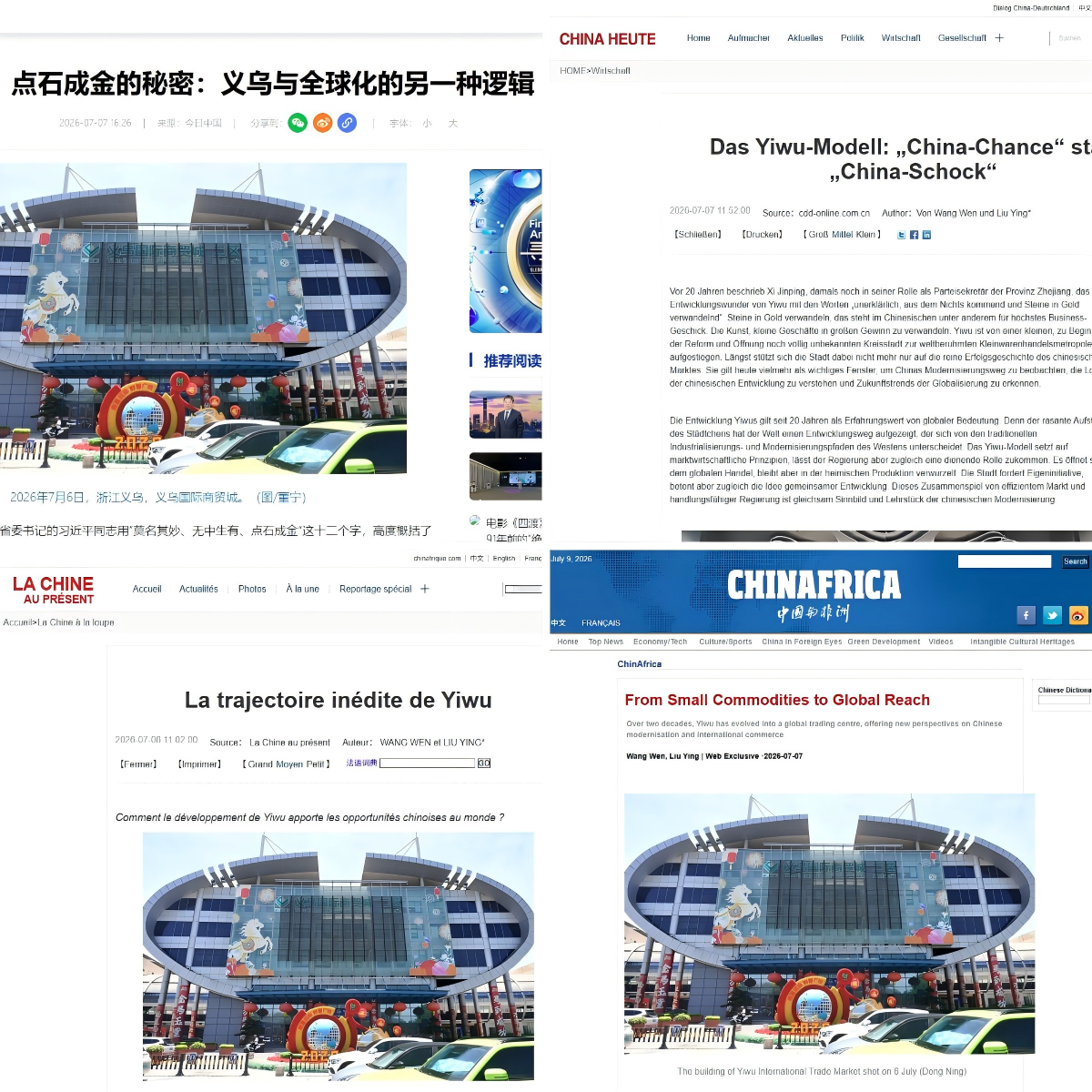
▲报道截图如上
20年前,时任浙江省委书记的习近平同志用“莫名其妙、无中生有、点石成金”这十二个字,高度概括了义乌的发展奇迹。从改革开放之初名不见经传的小县城,一跃成为世界闻名的小商品之都,义乌早已超越了中国市场的成功叙事,更成为观察中国式现代化、理解中国发展逻辑、认识全球化未来的重要窗口。
20年来,义乌向世界展示了一条不同的发展路径:坚持市场化方向,同时发挥政府的服务角色;拥抱全球贸易,同时立足本土制造;鼓励个人奋斗,同时强调共同发展。这种“有效市场”与“有为政府”相结合的发展模式,正是中国式现代化的重要缩影和经验。
01 内在密码:植根于人民的“有效市场”与“有为政府”
义乌的崛起,源于其“鸡毛换糖”的商业基因。这片地少人多、资源匮乏的土地,在改革开放的浪潮中,率先将民间商业传统转化为充满活力的现代市场,完成了从露天马路市场到全球最大小商品集散中心的跨越。
义乌汇聚210多万种商品、贸易网络覆盖全球230多个国家和地区。但比规模更值得关注的,是其背后的运行逻辑。
一方面,政府扮演了“服务者”和“基础设施提供者”的角色,通过修建道路港口、完善物流体系、优化营商环境、创新监管模式,为市场发展扫清障碍、铺平道路;另一方面,政府充分尊重民营经济的活力,让千千万万的个体商户能够低门槛创业、低成本经营、高效率交易。
这种“百姓创造市场、政府服务市场、市场连接世界”的模式,既不同于政政府主导型经济,也有别于资本驱动的市场垄断。它的动力来自数以万计的小商户——他们以极低成本进入市场,以极高效率完成交易,并从中获得真实的收益。通过制度创新为普通人创造机会,防止资本的无序扩张与市场垄断,让发展红利为最广泛的民众所共享,这正是义乌模式的核心竞争力。
02 世界启迪:“民生型全球化”的实践价值
长期以来,一些西方叙事往往把中国发展奇迹简单归结为“廉价劳动力”或“国家补贴”。但义乌的发展表明,中国经济真正的竞争力,在于其强大的市场组织能力、产业协同能力和高效的供应链体系。
对于很多欧洲和非洲国家而言,“义乌”并不陌生。在非洲街头的小商铺、法国南部的批发市场、北非的港口仓库、中东欧的跨境商贸中心,人们都能看到来自义乌市场的商品。这座城市连接的,不只是商品贸易,更是全球发展中国家、数百万中小企业和亿万普通家庭的生计与梦想。
对非洲而言,义乌是一条可借鉴的普惠发展之路。非洲拥有全球最年轻的人口结构和广阔的消费市场,却面临工业基础薄弱、供应链不完善等挑战。义乌的路径表明,即便缺乏资源禀赋,只要能培育起开放且高效的市场生态、降低交易成本、激发民间活力,同样可以形成全球竞争力。在义乌,无数家庭作坊和小微企业通过市场平台进入国际市场,形成“千家万户做外贸”的格局,这种以中小企业为主体的发展模式,对非洲国家极具借鉴意义。
对欧洲而言,义乌是一扇观察经济韧性的窗口。近年来,尽管全球“去风险化”“脱钩断链”论调不断升温,但义乌贸易却始终保持旺盛活力。原因在于,义乌连接的是全球最真实、最基础、最广泛的民间需求。它所代表的,是一种服务于普通家庭、中小商户和创业者的“民生型全球化”。无论国际局势如何变化,这种根植于亿万人民日常生活的全球化纽带,都拥有最强大的生命力。
03 时代价值:不断进化的中国智慧与全球方案
全球化并未终结,而是在深度重构。今天的义乌,已从传统商品贸易加快向数字贸易、跨境电商、海外仓等新业态升级,从“买全球、卖全球”演进为“链全球、通全球、服务全球”。进化中的“义乌经验”,正在为全球化注入新的确定性。
更重要的是,义乌是开放包容的。今天,超过1.5万名外商常驻于此,来自100多个国家和地区的人们在这里和平共处、共同创业。这里不仅是贸易枢纽,更是文化交流中心,呈现出一个多元共生的全球化微观图景。在全球保护主义抬头的当下,义乌所代表的开放合作、互利共赢理念,本身就是对世界的重要贡献。
作为“南南合作”的重要节点,义乌不仅为发展中国家提供了物美价廉的商品,更成为了他们观察中国市场化、工业化经验的重要窗口。从“鸡毛换糖”到“世界超市”,再到今天的“全球节点”,义乌的发展证明:现代化不存在唯一模板,各国完全可以立足自身国情,探索自己的发展道路,并在开放合作中实现繁荣。
李强总理在2026年夏季达沃斯论坛提出,世界对中国的认知正从“中国冲击”转向“中国机遇”。义乌的20年实践,恰恰为这一判断提供了微观支撑——当义乌商户用AI多语言客服服务全球买家、当非洲青年在义乌学成回国创业、当“义新欧”班列成为亚欧供应链的稳定通道,义乌展现的正是“中国机遇”而非“中国冲击”的实质内涵。
这正是“义乌经验”20年给予世界的重要启示,也是中国式现代化为全球发展带来的中国机遇。
英文版内容如下:
From Small Commodities to Global Reach
Wang Wen, Liu Ying
Twenty years ago, Xi Jinping, then secretary of the CPC Zhejiang Provincial Committee, famously described Yiwu's development miracle as turning the impossible into the possible, creating something out of nothing and making gold from stone. From an obscure county town at the start of China's reform and opening up in late 1970s, Yiwu in east China’s Zhejiang Province has grown into the world's leading hub for small commodities. Its story has long transcended a simple narrative of market success. Today, Yiwu offers an important window into Chinese modernisation, providing insight into China's development model and a glimpse of the future of globalisation.
Over the past two decades, Yiwu has demonstrated a distinctive development path: remaining committed to market-oriented reform while fostering an active, service-oriented government; embracing global trade while maintaining strong local manufacturing; and encouraging individual entrepreneurship while advancing shared prosperity. This combination of an effective market and a proactive government is a defining feature of Chinese modernisation.
The secret to success
Yiwu's rise can be traced to its long tradition of "trading chicken feathers for sugar." With limited land and scarce natural resources, local people transformed a grassroots trading culture into a thriving modern marketplace during the reform and opening up period, turning a modest open-air market into the world's largest wholesale centre for small commodities.
Today, Yiwu offers more than 2.1 million types of products through trade networks that span over 230 countries and regions. Yet, more significant than its scale is the development model that underpins its success.
On the one hand, the government has acted as a facilitator by investing in infrastructure, improving logistics networks, optimising the business environment and reforming regulatory systems to remove barriers and create favourable conditions for market growth. On the other hand, it has protected the vitality of the private sector, enabling millions of small business owners to establish enterprises with low barriers to entry, operate at low cost and trade efficiently.
This model, in which ordinary people create markets, government supports markets and markets connect with the world, differs from both state-dominated economic systems and capital-driven monopolistic markets. Its dynamism stems from millions of individual entrepreneurs who can enter the market with minimal barriers, complete transactions efficiently and earn tangible returns. Through institutional innovation, the government has created opportunities for ordinary people while preventing unchecked capital expansion and market monopolies, ensuring that the benefits of development are shared widely across society. That, ultimately, is the enduring strength of the Yiwu model.
Global lessons
For many years, some Western narratives have attributed China's development miracle primarily to cheap labour or state subsidies. Yiwu's rise, however, tells a different story. China's competitive strength lies in its exceptional ability to organise markets, coordinate industrial ecosystems and build highly efficient supply chains.
For many people across Europe and Africa, Yiwu is already a familiar name. From neighbourhood shops in Africa and wholesale markets in south France to port warehouses in North Africa and cross-border trade hubs in Central and Eastern Europe, Yiwu-made products have become part of everyday commerce. What Yiwu connects is not only the movement of goods, but also the livelihoods and aspirations of developing countries, millions of small businesses and countless ordinary families around the world.
For Africa, Yiwu offers an inclusive development model worthy of close attention. The continent has the world's youngest population and enormous consumer potential, yet many countries continue to face challenges such as limited industrial capacity and underdeveloped supply chains. Yiwu demonstrates that even without abundant natural resources, a region can build global competitiveness by fostering an open and efficient market ecosystem, reducing transaction costs and unlocking grassroots entrepreneurship. In Yiwu, countless family workshops and small businesses have gained access to international markets through marketplace platforms. This small and medium-sized enterprise-led development model has particular relevance for many African economies.
For Europe, Yiwu provides a window into economic resilience. Despite growing rhetoric in recent years around "de-risking" and economic decoupling, the city's trade has remained vibrant. The reason is straightforward: Yiwu is connected to the broadest and most enduring sources of global demand. It represents a form of people-centred globalisation that serves ordinary households, small businesses and entrepreneurs. Whatever shifts may occur in international politics, a globalisation rooted in the everyday needs of billions of people retains enduring vitality.
An evolving model
As globalisation undergoes profound restructuring, Yiwu is rapidly expanding beyond traditional commodity trade into new forms of commerce, including digital trade, cross-border e-commerce and overseas warehousing. It is evolving from a city that buys and sells globally into one that connects markets and serves the world. As the Yiwu model continues to evolve, it is bringing renewed certainty to an increasingly uncertain global economy.
One of Yiwu's defining characteristics is its openness and inclusiveness. Today, more than 15,000 foreign merchants live and work in the city, with people from over 100 countries and regions living side by side and building businesses together. Yiwu is not only a global trade hub, but also a centre for cultural exchange, offering a vivid example of an interconnected and diverse world. At a time when protectionism is gaining ground, the principle of openness, cooperation and mutual benefit that Yiwu embodies represents a meaningful contribution to the future of globalisation.
As an important hub for South-South cooperation, Yiwu not only supplies affordable, high-quality goods to developing countries, but also provides an important window through which they can observe China's experience of marketisation and industrialisation. From the humble tradition of "trading chicken feathers for sugar" to becoming the "world's supermarket" and now a global commercial hub, Yiwu's story demonstrates that there is no single path to modernisation. Every country can chart its own course based on its national conditions and pursue prosperity through openness and cooperation.
At the 2026 Summer Davos forum held in Dalian, China in June, Chinese Premier Li Qiang observed that the world's perception of China is shifting from "China shock" to "China opportunity". Yiwu's development over the past two decades offers a compelling grassroots illustration of this transformation. When Yiwu merchants use AI-powered multilingual customer service to serve buyers around the world, when young Africans study in Yiwu and return home to establish businesses and when the China-Europe "Yiwu-Xinjiang-Europe" freight trains serve as reliable arteries of Eurasian supply chains, Yiwu gives tangible expression to the idea of "China opportunity."
After two decades of development, Yiwu demonstrates how Chinese modernisation can generate new opportunities for global growth.

















 京公网安备 11010802037854号