发布时间:2026-01-28 作者: 王文
2026年1月,中国人民大学重阳金融研究院院长、全球领导力学院院长王文应邀接受瑞典“一带一路”研究所副所长侯赛因·阿斯卡里(Hussein Askary)YouTube专访,对国际秩序、中拉合作、中非关系等议题进行了深入解读。
编者按:2026年1月,中国人民大学重阳金融研究院院长、全球领导力学院院长王文应邀接受瑞典“一带一路”研究所副所长侯赛因·阿斯卡里(Hussein Askary)YouTube专访,对国际秩序、中拉合作、中非关系等议题进行了深入解读。此前,王文曾与美国时政博主Jackson Hinkle对话谈中国强大底气获超120万次观看;在马斯克赞助的爆火栏目中雄辩,浏览量破百万;于2025年6月、9月和12月三次接受挪威东南大学国际关系学教授、著名政治学者格伦·迪森YouTube专访狂揽超1500条好评。现将对话视频及中英文内容发布如下:(中文约7500字,预计阅读时间19分钟)
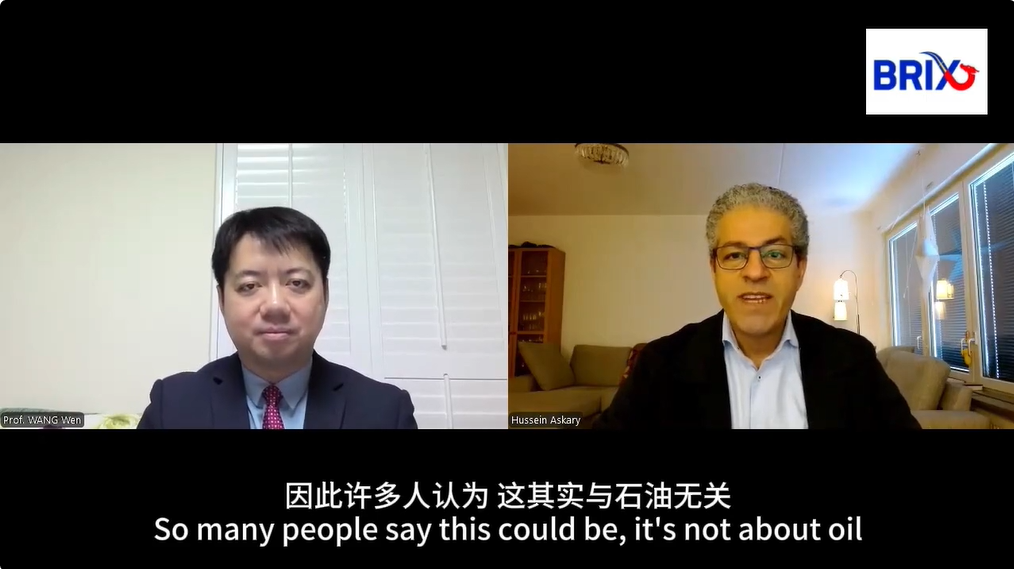
阿斯卡里:大家好,欢迎收看来自瑞典“一带一路”研究所的新一期播客。我是侯赛因· 阿斯卡里。这是我们今年(2026年)的第二期节目。在去年(2025年)的最后一期节目中,我们探讨了一个旧体系的终结。而在今年的第一期节目里,我们则谈到了新秩序的诞生。但我们始终强调,当前正处于一个充满紧张与危险的时期。原因在于,旧体系不愿放弃其单极主导地位,也不希望世界上有新兴力量崛起,更不愿看到一套不同的运作体系逐渐成型。
今年,一个有趣的现象是,美国总统特朗普以入侵委内瑞拉来开启新年,同时又在公海上拦截挂有俄罗斯国旗的油轮。与此同时,中国外交部长开启了今年的首次出访,选择了非洲,并将其置于优先位置,这一传统已经持续了数十年。这是一个非常值得讨论的问题,也是我们今天的主题。因此,我们邀请了一位非常杰出的学者,他是中国人民大学重阳金融研究院的院长王文教授,非常感谢您在周日抽空参加我们的节目。
王文:谢谢你,阿斯卡里教授,好久不见。很高兴能有这个机会与您交流。我也非常荣幸能再次见到您。
01 美国若侵犯中国在拉美利益必将遭到坚决反制
阿斯卡里:我们今天的主题是中非关系,以及为什么中国会把非洲作为优先关注的对象。但我们不能脱离当前的背景来看待这个问题。正如我之前提到的,今年伊始就发生了美国突袭委内瑞拉绑架该国总统,以及美英执法人员在公海上劫持俄罗斯油轮等事件。这些行为给世界带来了巨大的紧张局势。
目前,一些石油公司的高管已经告诉特朗普,委内瑞拉的石油开发前景存在很大问题,目前并不具备投资价值。因此许多人认为,美国这一行径其实与石油无关,其真实目的是将中国势力彻底赶出西半球。那么中国国内的人们,包括您本人在内,以及您周围的学术精英、媒体和政府决策圈,是如何看待目前这一整体局势的?
王文:是的,这确实是一个非常重要的议题。事实上,在过去的一周里,中国坚决反对美国介入委内瑞拉局势,并要求释放马杜罗总统。同时,中国也强烈反对在公海上劫持俄罗斯油轮的行为。在中国人看来,美国的这种行为极其专横,带有明显的霸权、欺凌性质。美方的这些举动无视国际法,破坏了国际社会的主权原则,这可能会将国际社会拖回到弱肉强食的“丛林法则”时代。
此外,就在几天前,中方也再次强调,中国始终与委内瑞拉政府保持着良好的沟通与合作,坚定支持委内瑞拉维护国家主权、安全、合法性、权利以及利益,并且坚定表示愿意进一步深化双边务实合作,促进共同发展。同时,中国政府相信,委内瑞拉临时政府也将继续维护中国在委内瑞拉的利益。正如你所提到的,如果美国企图通过霸权手段侵占或破坏中国在委内瑞拉的既定利益,必然会遭到中国的反制。
同理,如你所说,美国想要建立一套新体系,即一种西半球的新霸权。但问题在于,美国必须尊重中国在拉美的既有利益,因为中国在拉美拥有庞大的投资存量。目前,中国在拉美的投资存量已突破6000亿美元。因此,拉美已成为继东盟之后,中国的第二大投资目的地。此外,中国与拉美每年的双边贸易额已达到5000亿美元。可以说,中国在拉美的经贸利益已经与美国不相上下,在某些领域甚至已经超越了美国。
众所周知,中国与拉美之间如此庞大的投资存量和贸易总额,是不可能被轻易排挤出去的。如果美国企图通过非法的霸权手段侵害中国在拉美的利益,那么中国一定会采取果断措施对美国进行回击和反制。过去几年中国对美斗争的逻辑非常清晰:中国不会主动挑衅美国,但如果美国胆敢主动侵犯中国利益,中国必将对美国采取坚定且对等的回击措施。一个很有意思的例子就是去年(2025年)的中美贸易战。中国是极少数采取了“对等反制”措施的国家之一。
02“我们现在正处于一个非常危险的时刻”
阿斯卡里:这也是我们2025年底那期播客中讨论的重点,因为这是五百年来第一次,一个来自“全球南方”的国家——中国,挑战了像美国这样的霸权国家,并且有能力迫使它改变政策,比如关税政策。特朗普总统最终不得不作出让步,在韩国举行的G20峰会期间与习近平主席心平气和地交谈,并结束了整场关税争端。这表明,中国至少在经济实力上,已经具备了回击的能力。
但同时,当前的局势也给拉美国家带来了压力。有人认为,现在拉美各国都必须谨小慎微,否则就可能遭到特朗普的打击。不过,局势也可能出现逆转:拉美国家可能会站出来反抗美国,并与中国、俄罗斯、非洲国家等“全球南方”国家团结一致,共同抵制美国的这种行为。因此,这非但不会阻止世界秩序的重组,反而可能推动全球更快转向一种新的体系,而这个新体系将主要由“全球南方”国家主导。您是否也认同这一观点?
王文:我们现在正处于一个非常危险的时刻。就特朗普总统目前的政策取向来看,或许就在今年或明年,一场新的世界大战就有可能爆发。因为显而易见,在2026年,特朗普总统占领格陵兰岛几乎已成定局,在我看来这种可能性近乎100%。或许更重要的一点是,特朗普甚至有可能吞并加拿大,从而建立一个庞大的帝国,使其在北美的领土面积超过2300万平方公里。这是一种极其可怕的预判。
阿斯卡里:更糟糕的是,众所周知,特朗普总统已经宣布了每年1.5万亿美元的军费预算。这意味着仅美国一国的军费支出,就超过了世界其他所有国家的总和。我认为这种局面极其危险。
此外,还有一个危险信号:特朗普所谓实现乌克兰和平的尝试,如今已经彻底化为泡影。因此,相关各方不会再信任特朗普,乌克兰战争将会进一步升级,正如我们看到的“榛树”导弹袭击事件。目前局势非常危险。虽然我们希望事态不会进一步失控,但现实确实在恶化。
03 中非合作既源自历史,也出于共同利益
阿斯卡里:言归正传,我们回到今天的主题,您绝非传统印象中“足不出户” 的学者 ,您的足迹遍布全球,对自己所探讨的各个地区,都有着真实可感的实地考察经验。想来您在过去一年,也一定走访了不少国家。
关于非洲,有一个很有趣的现象:在长达29页的2025年美国《国家安全战略》中,关于非洲的内容只有寥寥半页。大概只有两个简短的段落,基本是在说“非洲没那么重要”。美国表示只会与少数几个资源丰富的特定非洲国家保持关系。至于其他国家,他们并不感兴趣。
考虑到非洲拥有14亿人口,这种态度极其荒谬。到2050年,非洲人口将达到25亿至28亿,且大部分是年轻人,而且非洲还拥有极其丰富的自然资源。我的意思是,西方人往往把这视为巨大的问题,因为他们只盯着移民、战争、饥荒和瘟疫。但中国恰恰相反,看非洲的眼光完全不同。这也解释了为什么中国外交部长王毅此时访问非洲。他访问了埃塞俄比亚、坦桑尼亚、莱索托和刚果共和国。为什么中国的外交政策会把非洲放在优先位置呢?那是个贫困的大陆,市场规模也不算巨大,而且问题丛生。为什么中国会将非洲视为重中之重?
王文:这是一个非常好的问题。因为我不确定外国人是否了解,中国和非洲之间有着非常特殊的历史纽带。早在1971年,正是非洲兄弟把中国“抬进”了联合国。而在1989年,非洲又帮助中国打破了西方的封锁。因此,自1991年以来,中国外长每年开年的首次出访必定选择非洲。其目的在于推动与非洲的务实合作,涵盖多个领域,包括基础设施、教育、经贸、能源、农业等诸多领域。中国正是想向世界表明,中国将永远属于发展中国家阵营,永远是“全球南方”的重要代表。因为在中国战略家的眼中,非洲对中国具有极其重要的意义。
请允许我简要解释一下其中的逻辑:
首先,我们知道,非洲由54个国家组成,占据了联合国近三分之一的席位。在涉及香港、台湾、西藏和新疆等中国内部事务上,非洲国家坚定支持一个中国政策。此外,在提升发展中国家代表性以及推动全球治理体系改革方面,中非双方拥有高度一致的价值观和利益追求。
其次,从经济层面来看,中非之间拥有巨大的经贸利益。众所周知,中国已连续16年保持非洲最大贸易伙伴地位。目前,中非年度双边贸易额已接近3000亿美元。非洲拥有丰富的能源和资源,这些都是中国发展所需要的。同时,中国在非洲的投资存量已超过500亿美元。
第三点是安全利益。中非在反对霸权主义、支持多边主义、应对气候变化以及打击恐怖主义等方面,拥有高度一致的利益。此外,非洲也是中国“一带一路”倡议中最重要的合作区域之一。可以说,中非之间的外交政策非常契合。
最后是文化与社会纽带。因为如今已有超过两百万中国人在非洲长期生活、工作和学习,而且超过90%的非洲基础设施,包括铁路、公路、港口、地铁、桥梁、学校、购物中心等,都是由中国公司建设的。因此,我认为非洲对中国的战略重要性是不言而喻的。
为什么中国不像美国那样轻视贫穷的非洲?我认为有几个非常有趣的原因。首先是中国价值观中的平等互利,因为我们认为贫穷的兄弟不是负担,而是代表着平等发展的未来,更是一股共同发展的推动力,双方的合作旨在共同实现多边现代化并追求共同富裕。
第二点是我提到的历史回报和战略互惠,因为两千多年前中国古代著名的思想家、政治家、教育家孔子就说:滴水之恩,当涌泉相报。因为我们始终记得,过去是非洲帮助了我们,所以现在我们需要帮助非洲。
第三点是对未来价值的评估,我不认为现在的贫穷意味着永远贫穷。因为你提到非洲拥有超过15亿人口,我认为非洲是非常富有的,尤其是从未来角度看。
最后一点是,非洲是实践人类命运共同体的未来平台。因为我们都知道,中国外交的终极目标是建立人类命运共同体。现在中非已经达成共识,共同构建中非命运共同体。所以我认为在未来我们需要互相帮助。帮助非洲减贫与发展,不仅是中国的责任,也是中国实现经济可持续发展、扩大全球市场和实现共同富裕的必然选择。这就是中国的战略眼光。
阿斯卡里:这很有趣,因为这关乎更长远的眼光,需要看向未来而不仅仅是现在。正如你所说,穷人不会永远贫穷,只是他们过去没有获得摆脱贫困的工具和能力。中国成功做到了这一点,如今中国正在与其他国家分享经验。
我注意到,2023年第三届“一带一路”国际合作高峰论坛以来,习近平主席就共建“一带一路”倡议向现代化和工业化转型发表了非常重要的讲话。我听到一些领导人,比如埃塞俄比亚总理和其他人说:“我们不想只出口原材料然后换回制成品。我们想要工业化,想要实现经济现代化。”
我注意到现在非洲许多国家都有了这种动向,比如在埃及、埃塞俄比亚、乌干达,甚至最近在坦桑尼亚,工业园区建设和大规模工业的发展正在蓬勃展开,那里不仅生产纺织品和消费品,还生产家用电器、冰箱、电视机甚至汽车。中国公司正在那里投资开店,私营企业正在进行大规模建设。比如在坦桑尼亚,我们有夸拉工业园(Kuala Industrial Park),它能为坦桑尼亚直接或间接提供10万个就业岗位。当然,坦桑尼亚也是通往赞比亚、大湖地区等内陆国家的桥梁。事情正在朝着一个完全不同的方向发展。
04 三大因素决定了中国不走“国强必霸”之路
阿斯卡里:现在一些愤世嫉俗的人说,中国面临人口问题,所以你们需要劳动力,需要年轻工人,而这些工人在非洲。所以中国会将非洲作为其经济发展的“车间”。你会如何回应这种说法?
王文:是,也不是。中国和非洲有着非常特殊的历史纽带,同时也有着非常深入的务实合作。什么是务实合作?那就是我们彼此需要。我们拥有非洲所需的完整工业产能。这就是为什么我们提供大规模的基础设施和工业制造投资。
阿斯卡里:以及技术和数字技术的转移。
王文:是的,但另一方面,中非合作是互补的。当然,中国的经济问题之一,是非常严重的老龄化。这也是为什么我们现在发展人工智能,以应对老龄化带来的劳动力问题。非洲拥有充足的劳动力,而中国在制造业领域的投资可以解决当地的就业问题。所以我认为中非之间是一种互补关系。
阿斯卡里:没错。现在有些人由于媒体的影响,他们对中国持怀疑态度,甚至在非洲也有部分人受到影响。中国媒体虽然还不够活跃,但像CGTN等媒体在展示中国真实意图和工作方法方面做得很好。但人们仍在看BBC、CNN等媒体,所以他们会有疑虑。虽然他们看到了与中国合作的成果,但他们会问:中国与大英帝国或美国有什么不同?那些国家只对掠夺我们的原材料感兴趣,而且他们可能会动用武力。如果中国成为世界第一军事大国、经济大国和工业大国,有什么保证它不会变得像英、法、美帝国一样?
王文:我经常听到这样的怀疑。但中国可能永远不会重复世界上一些帝国霸权的历史错误,这是由中国的文化基因、发展路径和战略目标决定的。我想从三个方面作出解释:
首先,从文化基因的角度看,中华文明五千年的历史中从未有过“国强必霸”的传统。两千多年前孔子和孙子就警告过我们:如果变强后谋求霸权,最终必将走向灭亡。这就是我们的传统文化。
一个典型的例子是,600年前的中国明朝,郑和七下西洋。那是在哥伦布和麦哲伦航海之前的半个世纪,郑和的海军力量比半个世纪后的他们都要强大得多。然而当时的中国并没有像西方强权那样进行殖民掠夺或军事征服,而是建立了古代“海上丝绸”之路,进行丝绸、茶叶的和平贸易,带来的是技术、文化和友谊,而非枪炮、殖民和奴役。所以这就是为什么12年前,当中国成为世界第二大经济体时,中国启动了共建“一带一路”倡议。我认为到2035年中国极有可能成为世界第一大经济体,但中国将继续坚持现行的政策和互利合作。
其次,从发展逻辑看,中国也认为霸权模式无法持久。在中国,有超过一万名学者在研究美国衰落以及英国衰落的教训。我们认为,大英帝国的崛起依赖于从殖民地掠夺的市场资源,而美国霸权的维持则依赖于美元霸权、军事同盟和技术垄断。然而这两个帝国只能维持约100年。越来越多的人认为美国的霸权已经处于崩溃边缘。中国的发展依赖于14亿人民的辛勤劳动,以及我们的对外开放政策和互利合作体系。所以我认为未来中国将继续维持这种发展模式,不会诉诸霸权手段牟利。互利双赢的合作远比基于强权的掠夺更具可持续性。这就是现实,也是当前政策的结果。
最后我想解释的一点是,从制度设计的角度看,中国长期以来坚定承诺不称霸。因为中国宪法明确规定,中国坚持独立自主的和平外交政策,走和平发展道路,坚持互利共赢的开放战略。此外,中国是唯一承诺不首先使用核武器的核大国。有大量的证据可以证明,未来中国不会推行霸权。
总而言之,我认为关于“中国将成为新霸权”的误解其实是一种心理投射。要判断一个国家的未来行为,我们必须考察它的历史、现状和战略选择。中国过去从未走过霸权主义的老路,现在不走,将来也永远不会走。因为我们认为,霸权主义违背了文明发展的趋势。而且对于中国人民来说,我们不认同所谓的霸权主义。所以我强调,中国的战略对世界不是威胁,而是世界和平与发展的稳定力量。
阿斯卡里:谢谢。非常精彩的解释。关于“所有帝国都是短命的”这个观点非常有趣。它们往往以重大灾难告终,比如罗马帝国崩溃时,到处是瘟疫、饥荒和死亡。因此,这些霸权帝国的崩溃总是伴随着巨大的灾难和世界大战。
第二点是,帝国并不关心自己的百姓。关心权力和财富的是少数精英阶层。因为在罗马帝国,百姓很穷。在大英帝国,英国民众也很穷。当英国军队控制世界四分之三的版图时,伦敦街头却到处是乞讨的人。
王文:是的,我同意。现在美国人民也正在受苦,尤其是在美国试图统治世界的情况下。哪怕在纽约,你去看看那里的地铁,就会发现它多么破旧不堪。还有那么多人面临毒品和枪支问题。但在中国的城市,我们有安全保障,并且我们在推进减贫工作。所以我认为,作为一个大国,首要使命是保护自己的人民,而不是成为一个帝国。
阿斯卡里:这是人们需要理解的、延续了几千年的中国治理体系。所谓“天命”,意味着:如果你不关心人民的福祉,那么“天命”就会从你身上移走。反抗和战争会出现,你会被赶下台,因为你没有履行关爱人民的使命。我认为今天的中国领导层依然致力于此,因为他们认为中国人民的繁荣与安全是第一位的。这并不是以牺牲他人为代价的。
我认为中国关于国家间合作的哲学是:你不能住在着火的邻里中,却自认为家里是安全的;你不能在周围全是贫困的情况下独自繁荣。因此,这种理念认为,一个国家的安全与繁荣离不开周边国家和其他民族的共同发展。这是人们对中国不太理解的一点。我很感谢你能讲解这些历史背景。这就是为什么我们瑞典“一带一路”研究所希望瑞典和中国能共同合作,特别是在非洲。因为这是我们讨论的问题之一:欧洲和非洲、欧洲和中国应该在非洲开展合作。很多人都在抱怨非洲移民问题,讨论该如何应对非洲,认为应该阻止他们跨越地中海。但相反,我们必须发展非洲,让非洲人民能在自己的国家享受生活,而不是逃离。因为除非被迫,否则没有人会自愿离开家园。情况就是这样。总之非常感谢你抽时间参加访谈,希望再次见到你。
王文:再见,我很期待。谢谢!
英文版对话内容
Askary: Hello and welcome to a new podcast from the Belt and Road Institute in Sweden. My name is Hussein Askary. Today is Sunday, January 11th. This is our second podcast for this year. In the last year's last podcast, we talked about the end of a system. On the first podcast of this year, we talked about a new system being born, but all the time we have been saying that this is a period which is fraught with tension and danger, because the old system does not want to give up its unipolar dominance and does not want new powers to emerge in the world and to have a different system.
This year, interestingly, while Trump started this year, the US president, by invading Venezuela, by hijacking Russian flagged ship, the oil tankers and the high seas, we had the Chinese foreign minister in his first trip abroad for the year, visiting Africa, prioritizing Africa. This is a tradition which has been going on for decades. This is a very interesting question we want to discuss. This is the main theme. Therefore, we have invited a very distinguished scholar, Professor Wang Wen. He's the Dean of the Chongyang Institute for Financial Studies at the Renmin University of China. Thank you, Professor, for taking the time on a Sunday to join us.
Wang Wen: Thank you, Professor Askary. Long time no see. I'm so glad to have the opportunity to converse with you.
Askary: It's a great pleasure to see you again. Yeah, of course, our main subject today is China-Africa relations and why China prioritizes Africa. But we cannot forget about the context this thing is happening, because, as I mentioned, this year started with the invasion of Venezuela, the kidnapping of the president there, and the hijacking of Russian oil tankers in high seas by American and British law enforcement personnel. So this has creates enormous tension in the world now that oil company executives have told Trump that the question of oil in Venezuela is very questionable. It's not investable. So many people say this could be, it's not about oil, it's about getting China out of the Western Hemisphere. So how do people in China, including yourself, but also people around, you know, in the scholarly elite, in the media and in government circles, see this whole situation?
Wang Wen: Well, yes, this is a very, very important topic. So actually, in the past one week, China has strongly opposed the U.S. land on Venezuela and has demanded the release of President Maduro. And China has also strongly opposed the hijacking of Russian oil tankers on high seas. And in the eyes of all Chinese people, such a behavior by the U.S. is extremely domineering, hegemonic, and bullying. And such a behavior by the U.S. disregards international law, undermines the principle of sovereignty in the international community, and will lead the international community back to the era of jungle.
And also, in a few days ago, China also has emphasized recently that it has always maintained good communication and cooperation with Venezuela's government, firmly supported Venezuela in safeguarding its sovereignty, security, legitimacy, rights, and interests, and expressed its unwavering willingness to deepen bilateral pragmatic cooperation and promote common development.
And also, Chinese government believes that the Venezuelan interim government will persist in safeguarding China's interests in Venezuela. If the United States, as you mentioned, if the U.S. attempts to seize or undermine China's established interests in Venezuela through hegemonic means, it will inevitably face countermeasures from China.
So similarly, as you mentioned, the U.S. wants to establish a new system, a new hegemony of the Western Hemisphere. But the problem is that the U.S. has to respect China's existing interest in Latin America because China has a substantial investment stock in Latin America. As we all know, with an annual investment increment of about 20 billion U.S. dollars, China's investment stock in Latin America has surpassed 600 billion U.S. dollars. So Latin America is China's second largest investment destination after ASEAN. Additionally, China and Latin America enjoy a bilateral trade value of 500 billion U.S. dollars annually.
So it can be said that China's economic and trade interest in Latin America are close to those of the U.S. And in some areas now, they have been surpassed by those of the U.S. we all know such a large investment stock and total bilateral trade value between China and Latin America cannot be easily squeezed out. If the U.S. wants to infringe upon China's interests in Latin America through illegal hegemonic means, then China will definitely take decisive measures to fight and counter the United States. So as we all know, China's logic in its struggle against the United States over the past few years has been very clear. China will not actively provoke the U.S., but if the U.S. dares to actively infringe upon China's interest, then China will definitely take resolute and reciprocal countermeasures to the U.S. For example, a very interesting thing is in the past year, China-U.S. trade war. China is one of the very few countries that have taken reciprocal countermeasures.
Askary: Because in our podcast at the end of the year, this was our discussion, because for the first time in 500 years, a Global South nation challenged China, challenged a hegemony, which is the United States, and could force it to reverse its policy, like the tariff. President Trump had to give up and talk nicely to President Xi Jinping in Korea and end all the whole tariff stuff. So China has proven it has the economic might, at least, to reply.
But also, there is all this situation now, what it forces nations in Latin America, because some people say, oh, everybody in Latin America have to behave now, otherwise Trump will attack them. But we might have a reversal of this situation where nations will stand against the United States in Latin America and together with the Global South nations, with China, Russia, with Africa, stand against this kind of American behavior. So it might accelerate, rather than stop the move, the shift to a new global system which is mostly dominated by the Global South. Do you see it in this way?
Wang Wen: We are in a very dangerous moment because in terms of President Trump's policies, maybe this year or next year, there could be a new world war happening. Because it's very obvious that in this year, I mean, 2026, it is inevitable for President Trump to occupy the Greenland. I'm 100% sure. And also, maybe more importantly, it is even possible that President Trump will take over Canada and making the United States a huge empire, occupying over 23 million square kilometers across North America. So this is a terrible, very terrible prediction. And also, worse still, as we all know that President Trump has announced an annual military expenditure of 1.5 trillion US dollars. And this means that the total military expenditure of the United States alone exceeds the combined total of all other countries in the world. So I think this is very, very dangerous.
Askary: Also, one dangerous aspect is that Trump's so-called attempts to get peace in Ukraine has completly thrown out of the window. So they will never trust Trump again, and the war in Ukraine will escalate as we saw with the Oreshnik missile attacks. So this is a very dangerous situation. We hope it will not escalate, but that's what is going on.
Anyway, if we go back to our main theme, you are not a typical academic. You travel all over the world, East, West, South, North. So you have a real-life experience of the places you discuss. I think you traveled to many countries last year. Concerning Africa, because it's interesting, the US National Security Strategy 2025, which is 29 pages, had only half a page about Africa. And it's like two simple paragraphs where they say, well, Africa is not so important. We will have relations with a few selected African countries which are rich with natural resources. The rest we are not interested in. So it's quite absurd, given that Africa has 1.4 billion people. In 2050, Africa's population will be 2.5 to 2.8 billion people, young people, and it has enormous natural resources. I mean, people in the West see this as a big problem, because they only think about immigration and wars and famines and epidemics.
But China, on the contrary, they see Africa completely different eyes. And that's why maybe Minister of Foreign Affairs Wang Yi is visiting Africa now. He went to Ethiopia, Tanzania, Lesotho, the Republic of Congo. I guess, skipped Somalia because there might be some security issues, I don't know. But why is the Chinese foreign policy prioritizing Africa? It's a poor continent. It's not such a huge market. There are many problems. Why is China have Africa in top priority?
Wang Wen: Yeah, very good question. Because I don't know whether the people know, the foreign people know that China and Africa shared a very special historical bond. Because in 1971, Africa helped China return to the UN. And in 1989, Africa helped China break the Western blockade. So since then, every year, since 1991, as you mentioned, the first overseas visit of the Chinese foreign minister has been to Africa. So aiming to promote a pragmatic cooperation with Africa in many, many fields, including infrastructure, education, economy, trade, energy, agriculture, and so on. China just wants to show to the world that China will always belong to the camp of developing countries and will always be an important representative of Global South. Because in the eyes of Chinese strategists, Africa is of great importance to China. Let me explain to you very briefly.
Firstly, we think Africa comprises 54 countries, holding nearly one third of the seats in the UN. And Africa firmly upholds the one-China policy on issues related to Hong Kong, Taiwan, Tibet, and Xinjiang. And China and Africa share a higher consistent value and interest in terms of developing countries, representation, and global governance system.
Secondly, in terms of economy, China and Africa share immense economic and trade interest. Because we all know China has been Africa's largest trading partner for 16 consecutive years. The annual bilateral trade value between China and Africa has reached nearly 300 billion US dollars. And Africa possesses abundant energy, as you mentioned, and resources that China needs. And the China's investment stock in Africa has exceeded 50 billion US dollars.
Third point is the security interests. Because China and Africa share extremely consistent interests in opposing hegemony, supporting multilateralism, addressing climate change, opposing terrorism. And also, Africa is one of the most important cooperation regions for China's Belt and Road Initiative policies. So I think we have a very similar foreign policies. The final thing is the culture and social ties. Because nowadays over two million Chinese people have been living, working and studying in Africa for extended period, and more than 90% of African infrastructure, including railways, roads, ports, subways, bridges, schools, shopping malls and more, has been constructed by Chinese companies. So therefore I think the strategic importance of Africa to China is quite conceivable.
But the problem is, as you mentioned, why doesn't China despise poor Africa the way the United States does? I think there are a few reasons that are very interesting. First is China's value of equality and mutual benefits, because we don't think poor brother are a burden but rather a future of equal development, and even more so, a driving force for jointly achieving multilateral modernization and pursuing common prosperity. Second, as I mentioned, the historical return and the strategic reciprocity, because one very interesting Chinese proverb Confucius said 2,000 years ago is: a drop of water deserves a great spring in return. Because we always remember that in the past Africa helped us, so now we need to help Africa. Third point is the evaluation of future value. As you mentioned, I don't think that current poverty means poverty forever. Because you mentioned Africa has over 1.5 billion people, I think Africa is quite wealthy especially in the future. And the final point is that the future platform for practicing the community of shared future for mankind. Because we all know that the ultimate goal of Chinese diplomacy is to establish the community of a shared future for mankind. So now China and Africa have reached a consensus to build a China-Africa community of a shared future.
So I think in the future we need to help each other. Helping Africa with poverty reduction and development is not only China's responsibility, but also an inevitable choice for China to achieve sustainable economic development, expand China's global market and realize common prosperity. So this is China's strategic vision.
Askary: This is interesting because in terms of looking more long term, looking into the future not only now. As you said, a poor person is not poor forever. It's just that they did not get the tools and the ability to get out of poverty. China managed to get that, and now China is sharing that with other countries.
I have noticed that since the third Belt and Road Forum in 2023, which I and my colleagues attended in Beijing, President Xi Jinping made a very important remark about the shift in the Belt and Road initiative to more modernization and industrialization. And I heard some presidents, like the Prime Minister of Ethiopia, and others they said: look, we don't want to export raw materials and get goods back. We want to industrialize. We want to modernize our economies. And I think there is now a move I have noticed in many countries in Africa: in Egypt, in Ethiopia, in Uganda, but even in Tanzania recently. I saw the building of industrial parks, large scale industries where you can not only textiles and consumer goods but also you have household appliances, refrigerators, TV sets, even automobiles. Chinese companies are opening shop, private companies are building large scale. Like in Tanzania, we have the Kuala Industrial Park, which can employ 100,000 people in Tanzania directly and indirect. And of course, Tanzania is a bridge to landlocked countries in Zambia, the Great Lakes and so on. So there's a different way of things are going in a completely different direction.
Now some people cynical people say, in China you have a demographic problem. So you need labor, you need workers, young workers, and these workers are in Africa. So China will use Africa as a workshop for its economic development. How would you respond to that?
Wang Wen: Yes or no. Of course China and Africa we have a historical bond very special. But on the other hand, we have a very deep pragmatic cooperation. What is pragmatic cooperation? That is we need each other. Of course we have a very full industrial capacity which Africa needs. So that's why we provide a huge infrastructure, industrial manufacturing investment.
Askary: Also transfer of technology, digital technology.
Wang Wen: Yes, but on the other hand, that is our cooperation between China and Africa is complementary. Of course China's economic problem is that we face a very serious aging. And also that's why nowadays we have AI development to replace the aging problem, labor problem. But in Africa, you have labor but no problem. China's investment of manufacturing industry can solve the employment job problems. So I think this is a complementary relationship between China and Africa.
Askary: Yes, exactly. Now there are some people, I mean even in Africa, they are a bit skeptical because of the impact of media. Chinese media is not very active still, but they are doing a good job; like CGTN and others are doing a good job at showing the real intentions and the method of China working. But still people watch BBC, CNN and all these other things, so they are skeptical. Although they see the fruits of the cooperation with China, they will ask: what will make China different than the British Empire or the United States, which is only interested in getting raw materials from us? And they might use military. If China becomes the world's No.1 military power, economic power, industrial power, what is the guarantee it does not become like the British, French or American empires?
Wang Wen: I always hear such a skeptical view you mentioned. But probably China will never repeat the historical mistake of imperial hegemony, which is determined by China's civilization gene, development paths, and strategy goals. Let me explain to you from three points.
Firstly, from the perspective of civilization genes, the 5,000 years history of Chinese civilization has never had a tradition of "a strong nation inevitably seeking hegemony." Because as I mentioned, 2,000 years ago, Confucius and Sun Tzu warned us that if you become strong and seek hegemony, you will ultimately perish. So this is our traditional culture. One very typical example is that 600 years ago, during the Ming dynasty in China, Zheng He made seven travels to the West. That was half a century before Columbus and Magellan. Zheng He's navy force was much stronger than theirs half a century later. However, at that time, China did not engage in colonial plunder or military conquest like Western powers but instead built the ancient maritime Silk Road, conducting peaceful trade with silk and tea, and bringing technology, culture, and friendship rather than guns, colonization, and enslavement. So that's why 12 years ago, as you mentioned, when China became the world's second largest economy, China launched the Belt and Road Initiative. I think by 2035, China is highly likely to become the world's largest economy, but it will continue to adhere to its current policy and mutually beneficial cooperation.
The second point I want to explain to you is that, from the perspective of development logic, China also believes that the hegemonic model cannot last long. In China, there are more than 10,000 scholars studying the lessons of U.S. decline as well as the U.K. decline. So we think the rise of the British Empire relied on the resources and market plundered from the colonies, while the maintenance of American hegemony relied on the dollar hegemony, military alliance, and technological monopoly. However, the two empires could only last for about 100 years. More and more people believe that American hegemony is already on the verge of collapse. China's development relies on the hard work of its 1.4 billion people as well as our open-door policy and mutually beneficial cooperation system. So I think in the future, China will continue to maintain this development model and will not resort to hegemonic means to gain benefit. Because we think mutual benefit and win-win cooperation are far more sustainable than power-based plunder. This is the reality and the result of current policy.
The final point I want to explain to you is that, from the perspective of institutional design, China has long been firm in its commitment not to pursue hegemony. Because the Chinese constitution clearly states that China adheres to an independent foreign policy of peace, pursuing the path of peaceful development and adhering to a mutually beneficial and win-win strategy of opening up. And also, China is the only nuclear weapons state that has committed to no first use of nuclear weapons. There is a lot of evidence to prove that in the future, China will not promote hegemony.
So in summary, I think the misperception that China will become a new hegemony is a form of projection. To judge a country's future behavior, we must consider its history, its present situation, and its strategic choices. China has never taken the old path of hegemonism in the past, does not do so now, and will never do so in the future. Because we think hegemonism goes against the trend of civilized development. And also for Chinese people, we don't agree with the so-called hegemonism. So I think we must say that China's strategy is not a threat to the world but a stabilizing force for world peace and development.
Askary: Thank you. Very good explanation. It‘s very interesting the question that all empires are short-lived. They end with major disasters, like the Roman Empire when it collapsed, there was pandemics, famines, death everywhere. So always these collapse of hegemonic empires comes with big disasters and world wars.
Second is that, empires don‘t care about their own people. It‘s an elite which cares about its own power and wealth. Because in the Roman Empire, the people were poor. In the British Empire, the British people were poor. When the British army controlled three quarters of the world, people were begging in the streets of London.
Wang Wen: Yes, I agree. Now the American people are suffering when the United States is trying to dominate the world. Yeah, even in New York, you travel to New York, look at the New York subway, so poor, right? And there are so many people, they got the drugs and gun problems. But now in China's city, we have the safety and we push the poverty reduction. So I think, as a strong power, the first mission is to protect our people, not to be an empire.
Askary: This is something people need to understand about the Chinese governance system since thousands of years. The mandate of heaven means that if you don't care about the prosperity of your people, then the mandate of heaven will be lifted from you. There will be rebellions, there will be wars, you will be taken out of power because you didn't fulfill your mission in caring about the people.
And I think the Chinese leadership today is still committed to that, because they think the prosperity and security of the Chinese people comes first. But that's not on the expense of someone else. And I think the Chinese philosophy of cooperation of the nation is that you cannot live in a neighborhood which is burning and you are safe at home; you cannot have poverty around you and you are prosperous. So this idea that China's prosperity comes from the prosperity of other peoples. And this is something which people don't really understand about the Chinese.
I'm grateful for you to go through this historical background. And this is why the Belt and Road Institute in Sweden we want Sweden and China to work together, especially in Africa. Because this is one of the issues we discuss that Europe and Africa should work, Europe and China should work in Africa together. Because everybody here is complaining about the immigration from Africa, what to do with Africa. We should stop them and the Mediterranean sea.
So we have to develop Africa, so Africans can enjoy their own countries, not flee. Because you know, nobody would voluntarily leave their home unless they're under pressure. So this is the situation.
Anyway, I appreciate very much you took the time. Thank you so much. Thank you very much for joining us, Professor Wang Wen from Beijing. We hope to see you again.
Wang Wen: See you again, I'm looking forward. Thank you.




















 京公网安备 11010802037854号