发布时间:2026-11-02 作者: 王文
深圳APEC峰会将于11月18日至19日举行,中美俄三国元首是否会在此期间举行三方会晤引发各界猜测。10月13日,中国人民大学重阳金融研究院院长、全球领导力学院院长、吴玉章讲席教授王文在《全球事务中的俄罗斯》学术网站发表英文评论文章指出,若能实现,这场会晤有可能成为雅尔塔体系形成八十年之后,全球结构转型与大国关系升级的一次历史性调整。
编者按:深圳APEC峰会将于11月18日至19日举行,中美俄三国元首是否会在此期间举行三方会晤引发各界猜测。10月13日,中国人民大学重阳金融研究院院长、全球领导力学院院长、吴玉章讲席教授王文在《全球事务中的俄罗斯》学术网站发表英文评论文章指出,若能实现,这场会晤有可能成为雅尔塔体系形成八十年之后,全球结构转型与大国关系升级的一次历史性调整。现将中文译文及英文原文发布如下:(中文译文约3500字,预计阅读时间9分钟)
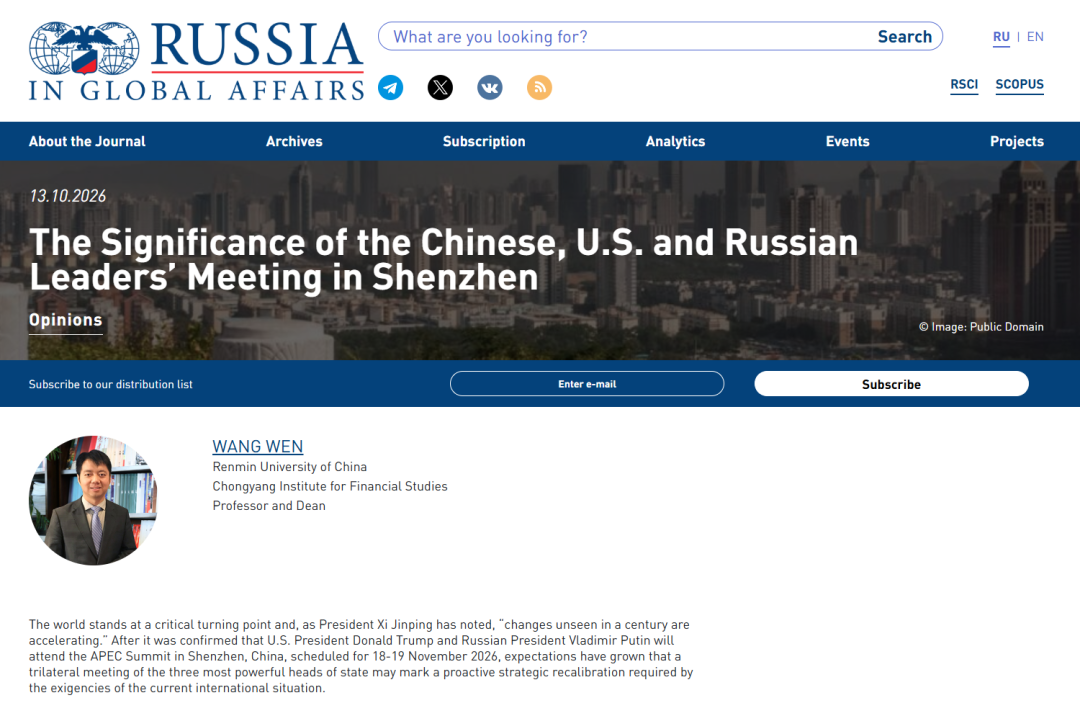
▲英文原文10月13日发表于《全球事务中的俄罗斯》学术网站
世界正处于关键的转折点,正如习近平主席所指出的,“百年未有之大变局正加速演进”。在美国总统唐纳德·特朗普和俄罗斯总统弗拉基米尔·普京同时出席定于2026年11月18日至19日在中国深圳举行的亚太经合组织(APEC)领导人非正式会议的可能性日益增加之后,外界日益期待,这三个最具实力的国家元首举行三边会晤,或将成为应对当前国际形势迫切要求而进行的一次主动战略再校准。
这场会晤有可能成为雅尔塔体系形成八十年之后,全球结构转型与大国关系升级的一次历史性调整。人们希望,三大国领导人之间的互动不会是西方媒体所炒作的“G3共治世界”,而是会催生一个新的“深圳国际体系”——一种与以联合国为中心的多边体系并行运作的模式,为动荡的世界注入确定性。
01深圳三边会晤:充分筹备的产物与紧迫的时代要求
大国领导人之间的面对面对话,从来不是一时兴起的产物,而是密集外交努力、二轨对话以及一系列双边交往累积的结果。过去一年多来,中美俄之间的双边沟通——包括各类对话、特使穿梭外交和电话交谈等稳步推进,就紧迫的全球性问题交换意见。
2026年高层官员的互访与表态,指向中美俄元首三边会晤具有很高的可能性。2月4日——中国农历立春之日,习近平主席分别同普京总统和特朗普总统通电话。5月第三周,特朗普总统和普京总统先后访问北京,与习近平主席会晤。9月23日至25日,习近平主席访问美国。10月1日,普京总统在瓦尔代国际辩论俱乐部第23届年会公开表示,只要议程合适,三边峰会是有可能的。
我所在的中国人民大学重阳金融研究院近年来多次组织中美俄三方学者和前官员的三边对话。多轮交流形成了明确共识:如果大国陷入螺旋式恶性竞争,任何一方都无法独善其身。这一认识为深圳APEC领导人非正式会议期间举行领导人会晤奠定了坚实的思想基础。
紧迫感同样十分明显。当前全球秩序正处于严重的“熵增”状态。旷日持久的俄乌冲突消耗资源,撕裂欧亚安全架构。中东局势持续动荡,地区冲突存在外溢风险。全球通胀、供应链碎片化与债务危机在全球南方蔓延。气候变化、人工智能治理、核不扩散等全球性问题迟迟得不到解决,缺少中美俄的深度参与。双边外交已不足以应对复杂的跨地区全球性挑战。
美国国内政治极化加剧,外交政策上的党派争斗消耗着国家的战略精力;俄罗斯深陷地缘政治安全压力,亟需与大国保持稳定关系;中国正处于高质量发展阶段,需要总体稳定的国际环境。这三大国各有其国内和外交政策的现实需要,同时也共同肩负着维护全球战略稳定的责任。
全球南方希望大国管控分歧、停止对抗,共同应对粮食、能源和债务安全等生存性挑战。世界已无法承受大国误判所引发的灾难性连锁反应。正是这种共同的全球危机感,催生了对中美俄领导人峰会的需要。APEC多边框架为三位领导人的沟通提供了合适的外交场合:多边背景下的三边会谈通常不适于进行秘密交易或划分势力范围,反而有助于聚焦地区和全球议程。
02“深圳国际体系”——雅尔塔八十年后的新范式?
1945年的雅尔塔会议奠定了二战后全球秩序的基础——这一体系已延续八十余年。诞生于战争废墟之上的雅尔塔国际体系,植根于划分势力范围的大国逻辑,最终造就了以两极对抗为特征的后战格局。
这一体系虽一度维持了和平,却内在地带有强权政治、阵营对抗和瓜分势力范围的属性。冷战结束后,曾有人试图以美国单极霸权取代两极结构;然而这场单极试验最终导致冲突增多、不平等加剧、全球治理失灵。八十年来,雅尔塔体系的底层逻辑越来越不适应当今的多极现实。
中美俄领导人可能在深圳APEC峰会框架内举行的三边会晤,其历史价值在于:这几个大国已开始共同探索一种超越雅尔塔体系陈旧思维的新秩序;这标志着所谓“深圳国际体系”的起点。
这一体系绝非意在取代联合国,也不是要抛弃现有国际机制另起炉灶。相反,它体现的是大国共同重塑其共处原则、纠正雅尔塔时代遗留下来的阵营对抗与势力范围争夺等固化思维的意愿。
在雅尔塔体系下,大国互动的底层逻辑是零和博弈、结盟和领土划分。相比之下,深圳三边峰会可能开辟一个可控竞争、预防冲突、政策协调和相互尊重各国核心利益的新方向。此类三边峰会的首要价值,在于管控大国的战略风险,建立危机沟通的护栏,防止局部冲突升级为大国之间的直接对抗。
此外,在全球公共产品的供给方面,三国可以协调努力,共同应对粮食安全、能源稳定和气候治理。最重要的是,这场会晤可能承认多极世界以及文明和发展道路多样性的客观现实;它可能摒弃以意识形态划线、强迫他国选边站队的做法。雅尔塔体系是诞生于战争的秩序,带有强权政治的烙印;相比之下,深圳三边峰会可能在和平环境中启动国际秩序的重塑——由大国自愿自我克制并寻求共处。这将是国际关系史上的一项重要努力。
这还将意味着,世界大国不再重走“二战胜利者重划全球版图”的历史老路,而是要在共处的前提下共同维护全球的基本稳定。这一转变的历史意义,将随着时间的推移被国际社会越来越清楚地认识到。当然,建设新的秩序范式是一个长期过程,三边峰会只是漫长旅程的起点,远非终点。
03不是G3,而是与多边主义相容的大国互动新模式
一些西方媒体和舆论界沿用陈旧的地缘政治概念,炒作所谓的“G3集团”,声称中美俄意图垄断全球事务。这是典型的欧洲中心主义的大国互动观,根植于19世纪结盟与秘密分赃的旧逻辑。必须明确指出:中美俄总统三边峰会不是“G3”。
“G3”概念本质上是由少数大国垄断全球决策的封闭小圈子,向世界其他国家发号施令、划分势力范围、迫使他国屈服。相比之下,中美俄三边互动应被理解为一种开放、以议题为导向、聚焦危机管理的沟通机制。
这种沟通的首要目标是管控彼此冲突、防止大国之间发生碰撞,而不是组成排斥他国的排他性集团。三边互动达成的共识,既不会凌驾于《联合国宪章》之上,也不会取代二十国集团、APEC等现有多边机制。
尽管存在合作空间,三国之间也存在着重大竞争与分歧。它们不会结成铁板一块的同盟。中俄将彼此关系定位为新时代全面战略协作伙伴关系,而非正式同盟。中美寻求基于相互尊重、公平与对等的建设性、战略稳定的关系。美俄虽有深层次矛盾,但保持着危机管理的底线。因此,三边关系是一种动态平衡,而非僵化的集团。
大国互动新模式与多边主义完全相容;两者是互补关系,而非相互排斥。多边主义涵盖所有主权国家,以《联合国宪章》的宗旨和原则为锚,尊重各国主权平等,回应全球南方广大发展中国家的诉求。中美俄作为联合国安理会常任理事国,其稳定沟通有助于联合国克服当前多边机制瘫痪失灵的现状。只有有效管控最具危险性的双边和三边风险,大国才能听到中小国家的声音,回应全球南方的关切。大国三边沟通是多边体系的稳定器,而不是其替代品。三边会谈的成果最终必须在全球多边框架内落实,并吸纳更多国家参与。关键在于,三大国不能只在谈判桌上讨价还价,而必须顾及全球南方国家的发展诉求。
在当前全球深刻变化之中,中美俄领导人可能在深圳APEC峰会期间举行的三边会晤,或将成为外交实践史上的一个关键节点。它可能提醒世界:对抗、战争和阵营对立并非大国唯一可选的历史路径。管控分歧、和平共处、有限协调,都是可行的选择。
当然,我们不应过于乐观。深层次的不信任、意识形态偏见和利益冲突,将继续考验三国的战略定力。然而,如果中美俄能够保持元首外交所建立的沟通渠道,坚持相互尊重,避免直接冲突,那么由深圳三边会晤开启的大国关系新范式将会扎根生长——为动荡的世界注入战略确定性提供一次难得的机遇。
英文原文
The Significance of the Chinese, U.S., and Russian Leaders' Meeting in Shenzhen
WANG Wen
The world stands at a critical turning point and, as President Xi Jinping has noted, "changes unseen in a century are accelerating." Following growing speculation that US President Donald Trump and Russian President Vladimir Putin may both attend the Asia-Pacific Economic Cooperation (APEC) Leaders’ Informal Meeting, scheduled to take place in Shenzhen, China, on 18–19 November 2026, expectations have grown that a trilateral meeting of the three most powerful heads of state may mark a proactive strategic recalibration required by the exigencies of the current international situation.
This meeting may come as a historic adjustment of the global structural transformation and the upgrading of major-power relations eighty years after the formation of the Yalta system. It is to be hoped that the interaction between the presidents of the three major powers will not be the "G3 joint management of the world" hyped by Western media, but will emerge as a new "Shenzhen International System"—a model that will operate in parallel with the UN-centered multilateral system and inject certainty into the turbulent world.
The Shenzhen Trilateral Meeting as a Product of Thorough Preparation and an Urgent Imperative of the Times
Face-to-face meetings between presidents of major powers are never spur-of-the-moment events; they are the cumulative product of intensive diplomatic efforts, Track II dialogues, and successive bilateral exchanges. Over the past year or so, bilateral communication among China, the U.S., and Russia—including various dialogues, shuttle diplomacy by special envoys, and telephone conversations—has steadily advanced, with the parties repeatedly sounding out each other's bottom lines and exchanging views on pressing global issues.
Visits and statements made by top-level officials in 2026 point to the high probability of a trilateral meeting of the Chinese, U.S., and Russian heads of state. On 4 February—the day marking the start of spring in the Chinese lunar calendar—President Xi Jinping held separate telephone conversations with President Putin and President Trump. During the third week of May, President Trump and President Putin visited Beijing in succession to meet with President Xi Jinping. On 23–25 September, President Xi visited the United States. On 1 October, President Putin publicly stated at the 23rd Annual Meeting of the Valdai Discussion Club that a trilateral summit was possible, provided the agenda was right.
The think tank I am affiliated with has frequently organized trilateral dialogues among scholars and former officials from China, the U.S., and Russia in recent years. Multiple rounds of exchanges yielded a clear consensus that if major powers engage in a spiraling vicious rivalry, no single party will remain unscathed. This realization has laid a solid conceptual foundation for the leaders' meeting during the APEC Summit in Shenzhen.
There is also a distinct sense of urgency. The current global order is in a state of severe "entropy increase." The protracted Russia-Ukraine conflict is draining resources and fracturing Eurasia's security architecture. The Middle East remains volatile, with the risk of regional conflicts spilling over their boundaries. Global inflation, supply chain fragmentation, and debt crises are spreading across the Global South. Global problems—such as climate change, AI governance, and nuclear non-proliferation—are not being resolved, lacking the deep involvement of China, the U.S., and Russia. Bilateral diplomacy is no longer sufficient to address complex cross-regional global challenges.
The intensifying domestic political polarization in the U.S., with partisan wrangling over foreign policy, is draining the nation's strategic energy; Russia, struggling with geopolitical security pressures, urgently needs stable relations with major powers; and China, currently undergoing a phase of high-quality development, needs a generally stable international environment. While each of these three major powers has its own practical domestic and foreign policy imperatives, they also share a collective responsibility for maintaining global strategic stability.
The Global South hopes that the major powers will manage their differences, halt confrontation, and jointly address existential challenges such as food, energy, and debt security. The world can no longer afford the catastrophic chain reactions resulting from miscalculations by major powers. It is this shared sense of global crisis that urges the need for a summit of the leaders of China, the U.S., and Russia. The APEC multilateral framework provides a fitting diplomatic setting for the three leaders' communication: trilateral talks in a multilateral context are generally inapt for striking secret deals or carving out spheres of influence, but instead help focus on the regional and global agenda.
The "Shenzhen International System"—a New Paradigm, Eight Decades after Yalta?
The 1945 Yalta Conference laid the groundwork of the post-World War II global order—a system that has endured for over eight decades. Born from the ruins of war, the Yalta international system, rooted in the major-power logic of delineating spheres of influence, ultimately created a postwar landscape marked by bipolar confrontation.
While this system maintained peace for a time, it was inherently characterized by power politics, bloc-based antagonism, and the carving up of spheres of influence. After the Cold War, attempts were made to replace the bipolar structure with U.S. unipolar hegemony; however, this experiment in unipolarity ultimately resulted in increased conflict, inequality, and failures in global governance. Over the past eight decades, the underlying logic of the Yalta system has become increasingly ill-suited to today's multipolar reality.
The historical value of the potential trilateral meeting of China, the U.S., and Russia's leaders—held within the framework of the Shenzhen APEC summit—is that these powers have begun to jointly explore a new order that transcends the outdated mindset of the Yalta system; this marks the starting point for what might be called the "Shenzhen International System."
This system is by no means intended to replace the United Nations or to abandon existing international mechanisms in favor of a new setup. Rather, it would indicate the major powers' joint intention to reshape the principles of their coexistence and correct the entrenched mindsets inherited from the Yalta era—bloc confrontation and contest for spheres of influence.
Under the Yalta system, the underlying logic of major-power interaction was zero-sum games, alliance-building, and territorial division. By contrast, the Shenzhen trilateral summit may draw a new direction of controllable competition, conflict prevention, policy coordination, and mutual respect for nations' core interests. The primary value of such a trilateral summit lies in managing the strategic risks associated with major powers, establishing guardrails for crisis communication, and preventing local conflicts from escalating into direct confrontation between major powers.
Furthermore, in the provision of global public goods, the three nations can coordinate their efforts in addressing food security, energy stability, and climate governance. Most importantly, the meeting may acknowledge the objective reality of a multipolar world and the diversity of civilizations and development paths; it may move away from drawing lines based on ideology and compelling nations to take sides. The Yalta system was an order born of war, bearing the imprint of power politics; by contrast, the Shenzhen trilateral summit may initiate a reshaping of the international order—conducted in a peaceful environment—where major powers voluntarily exercise self-restraint and seek coexistence. This will mark a significant endeavor in the history of international relations.
It will also signify that the world's major powers are no longer retracing the historical path of the "WWII victors redrawing the global map," but intend to jointly maintain fundamental global stability on the premise of coexistence. The historical significance of this shift will become increasingly apparent to the international community over time. Of course, building a new order paradigm is a long-term process, and a trilateral summit is merely the starting point of a long journey that is far from its final destination.
Not a G3, but a New Model of Major-Power Interaction Compatible with Multilateralism
Some Western media outlets and public opinion circles, using outdated geopolitical concepts, hype up a so-called "G3 bloc," claiming that China, the U.S., and Russia intend to monopolize global affairs. This is a classic Eurocentric understanding of major-power interaction rooted in the old logic of 19th-century alliances and the secret division of spoils. It must be made clear: the trilateral summit of the Chinese, U.S., and Russian presidents is not a "G3."
The "G3" concept is essentially a closed clique of a few major powers monopolizing global decision-making, dictating the terms to the rest of the world, demarcating spheres of influence, and compelling other nations to submit. By contrast, the trilateral interaction of China, the U.S., and Russia is presumed to be an open, issue-oriented communication mechanism focused on crisis management.
The primary goal of such communication is to manage mutual conflicts and prevent clashes between major powers, rather than to form an exclusive bloc for joint opposition to other nations. The consensus reached through trilateral interaction will neither supersede the UN Charter nor replace existing multilateral mechanisms such as the G20 or APEC.
While there is room for cooperation, significant competition and differences between the three nations also exist. They will not form a monolithic alliance. China and Russia characterize their relationship as a comprehensive strategic partnership of coordination for a new era, not a formal alliance. China and the U.S. seek a constructive, strategically stable relationship based on mutual respect, fairness, and reciprocity. While the U.S. and Russia harbor deep-seated conflicts, they maintain a baseline for crisis management. Thus, the trilateral relationship is a dynamic balance, not a rigid bloc.
The new model of major-power interaction is entirely compatible with multilateralism; the two models are complementary rather than mutually exclusive. Multilateralism involves all sovereign states; it is anchored in the purposes and principles of the UN Charter, which respects the sovereign equality of nations and addresses the aspirations of the vast number of developing countries in the Global South. Stable communication among China, the U.S., and Russia as permanent members of the UN Security Council helps it overcome the current state of paralysis and dysfunction of its multilateral mechanisms. Only by effectively managing the most dangerous bilateral and trilateral risks can major powers hear the voices of small and middle states and respond to the concerns of the Global South. Trilateral communication among major powers serves as a stabilizer for the multilateral system, not a substitute for it. The outcome of trilateral talks must ultimately be implemented within a global multilateral framework, incorporating the participation of more nations. Crucially, rather than engaging in mere bargaining at the negotiating table, the three major powers must consider the development aspirations of the Global South countries.
Amidst the current profound global changes, the potential trilateral meeting of the Chinese, U.S., and Russian leaders—held on the sidelines of the APEC Summit in Shenzhen—could be a pivotal moment in the history of diplomatic practice. It could remind the world that confrontation, war, and bloc rivalry are not the only historical paths available to major powers. Managing differences, peaceful coexistence, and limited coordination are viable choices.
Of course, we should not be overly optimistic about the prospects. Deep-seated mistrust, ideological biases, and conflicts of interest will continue to test the three nations' strategic resolve. However, if China, the U.S., and Russia maintain the communication channels established through head-of-state diplomacy, uphold mutual respect, and avoid direct conflict, the new paradigm of major-power relations initiated by the Shenzhen trilateral meeting will take root and grow—offering a rare opportunity for injecting strategic certainty into the turbulent world.




















 京公网安备 11010802037854号