发布时间:2026-04-27 作者: 王文 达尼洛·图尔克 卓奥玛尔特·奥托尔巴耶夫
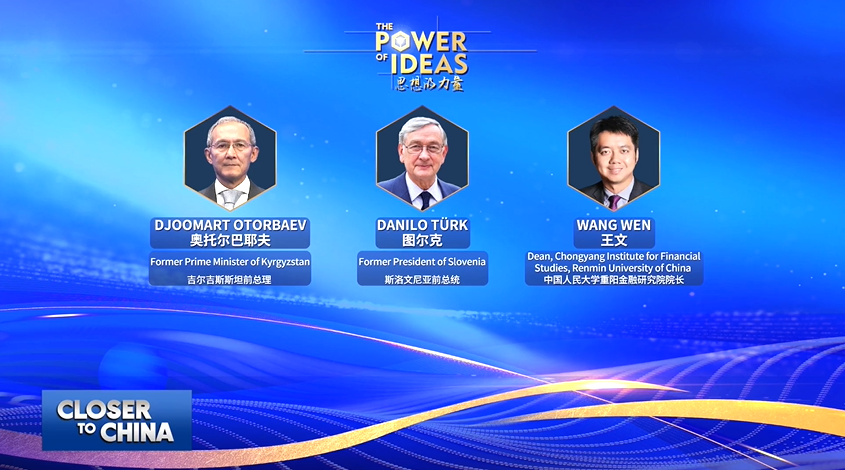
近日,中国人民大学重阳金融研究院院长、全球领导力学院院长王文受邀参加CGTN《思想的力量》节目,与斯洛文尼亚前总统达尼洛·图尔克和吉尔吉斯斯坦前总理卓奥玛尔特·奥托尔巴耶夫进行对话。
编者按:“中国现在要做的,就是不要太在意或太担心西方的批评,保持自信,把自己的事情做得比以前更好。”近日,中国人民大学重阳金融研究院院长、全球领导力学院院长王文受邀参加CGTN《思想的力量》节目,与斯洛文尼亚前总统达尼洛·图尔克和吉尔吉斯斯坦前总理卓奥玛尔特·奥托尔巴耶夫进行对话。现将对话中英文实录发布如下:(中文实录约4100字,预计阅读时间12分钟)
主持人:中国国家主席习近平在四年前提出了“全球安全倡议”。这一诞生于四年前的倡议,对当今的全球安全体系有何贡献?也许图尔克先生可以先谈谈。
图尔克:我认为,习近平主席提出的所有四项倡议都指明了前进的方向。中国显然有一个愿景,这个愿景现在已经摆在全世界面前。但中国知道,任何事情都不能强加于人,也不想把任何模式强加给别人,这一点非常重要。因此,包括“全球安全倡议”在内的这些对外倡议,实际上是邀请各方进行讨论,共同界定新的安全体系——这个体系只能通过各方达成协议才能建立。
不幸的是,我们今天很少看到这种达成协议的能力。就拿美国来说,现任美国领导层其实并不真正愿意与其他国家开展合作,反而更倾向于将自身的想法与意志强加于人,这种做法时常造成十分恶劣的后果。再放眼世界其它地区,局势整体存在一定程度的混乱,也普遍缺乏清晰的发展方向。在我看来,所有人都应当意识到,这些倡议的价值就在于它们为世界指明了前进方向。显然,这个方向不可能一夜之间就成为现实,它需要时间打磨,需要逐步调整完善,也需要各方作出妥协,但正确的方向已经明确,这才是最为关键的一点。
主持人:王文教授,既然图尔克先生提到了“妥协”,当今世界上很多国家都不愿在任何事情上妥协。我们怎么能指望别人妥协呢?
王文:我同意图尔克先生的观点。我认为过去四年确实是非常艰难的时期,发生了太多军事冲突,这是悲剧。在加沙、伊朗、俄罗斯、乌克兰,还有非洲、南美的一些国家,大量平民失去了生命。
▲点击查看视频
因此我认为,当下正是考验大国责任的关键时刻——大国尤其需要推动和平谈判,鼓励冲突各方坐到谈判桌前,通过协商找到和平解决方案,这一点至关重要。
主持人:奥托尔巴耶夫先生,“全球南方”国家如何看待当前全球体系的动荡?
奥托尔巴耶夫:我不能代表所有“全球南方”国家,但我想谈谈个人看法。多年来,安全架构没有进行任何改革,尤其是在中东地区。看看阿富汗、伊拉克、利比亚发生的事件——一些强国在这些地方的单边行动,到底有没有让世界变得更安全?没有。那么下一步该怎么办?我们必须思考如何修正这种状况。但那些采取单边行动的国家还没有听进去,他们还会得到更多教训,才会承认某些事情必须改变。当前中东发生的事件就是一个强有力的例证,说明旧的“丛林法则”已经行不通了。
因此,“全球南方”国家应该团结起来,发出共同的、强有力的声音。如何做到?我认为“集群化”的方法会很有用。我们有金砖国家,有重要经济影响力的国家已经团结在一起;我们有上海合作组织,它表明,即使是大国有时利益不同——看看印度、巴基斯坦、中国、伊朗,它们都是上合组织的正式成员——但我们仍然能找到共同点,并作出具有约束力的决议。这种“集群化”可以进一步发展,东盟就是国家间合作的完美典范。也许这些不同集群的架构不一定合并,但可以联合起来,发出共同的声音。
主持人:但现在,保护主义、经济保护主义正在肆虐全球,不光是美国,到处都在发生。外界有一股非常强大的声音说“我不想和你合作”,在这种情况下,我们如何确保各国继续进行经济合作?
奥托尔巴耶夫:我对“关税”和“制裁”的定义非常直接:制裁和关税是对失败的承认——那些无法在自由市场上竞争的人,才竖起了边界和壁垒。很简单,要想有竞争力,就必须表现得好。纵观全球,那些长期处于孤立状态的国家,从未实现过持续健康的经济增长。对任何国家或经济体而言,唯有竞争与合作并举,才能推动发展水平稳步提升。而设置贸易壁垒,本质上就是经济繁荣走向终结的开端,无疑是一种目光短浅的做法。
在我们中亚地区,我们的经济体量虽小于中国,但我们既希望与中国开展合作,也愿意与中国良性竞争。唯有如此,才能实现健康发展。倘若退出竞争,不仅经济发展会停滞不前,也无法真正赢得合作的机会。不同的发展模式、不同的管辖区域可以相互补充、协同发展,我相信这能够助力构建一个和谐的世界。我坚信我们与中国的合作将成为全球典范,其他国家会以此为榜样,学习如何携手合作——因为我们始终秉持和谐共事的原则,每个人都愿意倾听彼此,通过相互协作实现共赢。而非固执己见。
主持人:刚才奥托尔巴耶夫先生说的是健康竞争,大家共同成长。但那些不健康的呢?当有人把安全作为理由说“我们不想和你竞争,我们只会在自己周围砌墙”时,该怎么办?
图尔克:我认为奥托尔巴耶夫先生其实已经点出了这类政策本质上的不健康之处——那种重新把高关税当作管理全球经济关系工具的想法,既有害、也十分短视。在我看来,有一项核心原则非常重要:我们至少应当重启那些不久前还被实践证明能够引领世界发展的机制安排,先把这些已经被验证有效的成果重新恢复起来。
我来举几个具体的例子。首先,自20世纪50年代起,国际贸易领域就一直在推进关税削减工作,经过多轮连续谈判后,全球关税水平已经大幅下降,当时各方一度认为关税主导贸易的时代已经基本结束。后来虽然出现了反倾销措施这类非关税壁垒,但相关行为也得到了有效的规范。之后,贸易规则从商品贸易逐步延伸到服务贸易领域,相关发展也都取得了积极成果,世界贸易组织还专门设立了国际贸易争端处理机制来解决贸易分歧。几十年来,全球贸易发展态势积极,已经构建起一套成熟有效的制度成果。但现在,由于美国拒绝任命法官,世贸组织上诉机构已经陷入停摆,整个多边贸易体系都陷入了瘫痪。
所以,我认为首先要结束这种政治化瘫痪现有机构的行为,努力恢复那些已经取得的良好成果。不必完全改变世界,而是要恢复不久之前的一些好的安排,避免因政治冲动和意愿制造障碍。
在安全领域,情况也是如此。1992年到2000年,我在纽约担任本国常驻联合国代表,之后又出任联合国秘书长科菲·安南的特别助理。1992年的时候,世界格局似乎已经发生转变,大家都觉得否决权会退出历史舞台——当时全球氛围转好,各国已经普遍意识到需要展开更深度的合作。但仅仅过了大约三年,否决权就重新回到了安理会的博弈当中:起因是塞浦路斯问题,那本来是一个不属于大国关系核心议题的技术性决议,却引发了安理会成员,包括常任理事国之间的分歧,最终否决权被动用,阻断了相关议程。
我想说的是,世界不仅在向前发展,能够、也的确经历过倒退。向前迈进的方式之一是仔细思考:哪些不久之前的良好安排需要恢复?哪些全新的、高质量的、新的制度安排需要补充?在这种背景下,习近平主席提出的四项倡议非常有用,因为它们指明了方向。它们不提供具体的制度安排,也不强加任何解决方案,而是说:如果我们想取得进展,就必须朝着那个方向走。为了朝这个方向走,我还想补充一点:不久之前的“某些设计”必须恢复——它们不幸被放弃了,但必须重新捡起来,因为它们能创造我们前进所需的稳定。这就是我主张的总路线。我知道事情很复杂,需要时间。
主持人:肯定需要时间。王文教授,为什么我们会在中东或中美洲如此迅速地看到这种倒退,而在亚洲却有另一种声音说“我们不能回到过去”?为什么会有这种反差,尤其是现在?
王文:我认为现在越来越多的媒体和民众都在比较中国和美国的责任,甚至一些西方媒体也在批评特朗普领导下的美国,把美国视为国际体系的新麻烦制造者,这就是关键。
那中国呢?为什么现在在亚洲,特别是东亚和中亚,没有战争或军事冲突?我认为,中国的责任感、稳定的发展能力以及多边主义的方式,是维护国际稳定的关键因素。
▲点击查看视频
如果中国放弃多边主义,亚洲会发生什么?当然,我们承认与部分邻国有很多分歧,但我们有充分的耐心,以和平方式解决这些分歧。我们不想像某些国家那样:你不听我的,我就打你。所以我真诚地建议我的美国朋友们:你们需要保持耐心,承担起大国的责任,用智慧去解决分歧。你们需要尊重每一个人,推动国际和平,这是你们的责任。
▲点击查看视频
主持人:图尔克先生,当前全球治理面临很多挑战。您认为这些挑战是因为合作意愿下降,还是因为制度过时,不足以应对这些挑战了?
图尔克:每个人都能理解,在特定历史时刻创建的机构不可能一成不变。机构也需要调整,调整的形式不同,有时很快,有时需要更长时间。例如,冷战结束后的20世纪90年代初期,大国在联合国安理会中的合作相对良好,安理会能作出以前无法作出的决定。这说明现有机构仍然可以发挥有益作用。去年8月,联合国大会通过决议,决定今年在日内瓦召开全球人工智能大会。这表明今天的全球机构仍能做有益的工作。但这并非理所当然,改革是必要的。
至于改革具体应该如何进行,取决于多种因素。我想强调的是,不要认为事物是一成不变的。有时变化会非常快。我相信在人工智能等问题上,变化会来得很快,甚至有些出人意料。
主持人:世界还准备合作吗?
图尔克:是的,我认为世界仍有合作的空间。但无论国家间合作,还是更广义层面的合作,永远都是以合作者自身利益为出发点的。所谓合作原则,并不会凌驾于国家利益之上;恰恰相反,各国选择参与合作,本质上都是为了谋求自身利益,这也正是合作开展起来往往十分困难的根本原因。我们在海湾地区、中东等地发生的战争中,都能看到这个问题极为突出的体现,这部分内容值得单独展开讨论。但请不要忘记,无论国家利益、组织利益还是个体利益,永远都是所有行动的出发点,其它所有安排都建立在此基础之上。
主持人:我们之后肯定会再讨论战争相关话题,不过现在我想先聚焦一个更大的问题。王文教授,目前有不少人担忧:由于各国选择了不同的国际关系发展路径,未来的世界秩序可能会走向分裂碎片化。您如何看待这一担忧呢?
王文:我认为这取决于你如何看待各种改革方案。当今一些西方大国想要发动国际体系的“革命”,因为它们对现有体系不满。但对于所有新兴经济体,特别是中国、印度、巴西来说,我们希望维护联合国宪章的核心。我们只是想推动国际体系改革,而不是革命。尤其是中国——2013年以来,中国提出了很多倡议:“一带一路”倡议、全球发展倡议、全球安全倡议、全球文明倡议、全球治理倡议。但中国的做法不是强迫任何人服从我们的倡议,我们只是提供公共产品。如果你想与我们合作,我们很感激;如果你不想,没问题,我们等待、尊重你;所以我认为这是相互尊重。我们只是希望推动国际体系的可持续发展、可持续改革,这就是中国的做法。
▲点击查看视频
主持人:为什么这一改革更适合发展中国家?
王文:我认为,很多时候,一些大国对自己现有的霸权地位感到焦虑。所以有时媒体会发动宣传,妖魔化新兴经济体,这很明显。如果你看看那些西方主流媒体,关于中国的大部分新闻都是负面的——谈论“中国顶峰论”甚至“中国崩溃论”,同时妖魔化中国的做法和倡议。但没关系,我认为世界上大多数人的眼睛是雪亮的,大脑是清晰的,他们知道哪种方式更好。所以中国现在要做的,就是不要太在意或太担心西方的批评,保持自信,把自己的事情做得比以前更好。专注于国内的事情,让一切越来越好。
▲点击查看视频
主持人:奥托尔巴耶夫先生,当今世界进行这些改革的主要结构性障碍是什么?
奥托尔巴耶夫:“全球南方”国家的声音与其体量极不相称。这种情况应该继续下去,还是应该改革?当然应该改革。我举一个例子:在国际货币基金组织中,欧洲国家的经济规模与中国相近,但欧洲国家拥有超过26%的投票权,而中国只有6%,差距巨大。那么,为什么不更深入地审视这一过程?为什么不给“全球南方”更多的发言权?这一点各方都有目共睹,但改革之路不可能一帆风顺,二战后“全球北方”确立的主导地位早已形成路径惯性。
当前全球治理体系早已运转失灵,最鲜明的例证就是中东目前正在发生的危机:少数国家肆意决定轰炸主权国家、屠戮无辜平民,甚至随意推翻他国经合法选举产生的领导人,这套体系已经彻底失效了。我们为什么不推动联合国体系改革,包括对安理会进行改革呢?因为安理会如今并没有履行它本该承担的职责。“全球南方”国家的初衷,正是凝聚各方智慧,共同探索如何完善全球治理的基础架构。
英文对话内容
Host: Chinese President Xi Jinping proposed the Global Security Initiative four years ago. How does that initiative, which was born four years ago, contribute to today's global security regime? Perhaps Mr. Türk can start.
Türk: I think that all four initiatives voiced by President Xi show a way forward. China obviously has a vision, and that vision is now put before the whole world. But China knows that nothing can be imposed. China does not wish to impose any formula on others, and that's very important. Therefore, these foreign initiatives, including the Global Security Initiative, are an invitation to a discussion to define a new security system, which can only come about as a result of an agreement.
Unfortunately, we nowadays see very little capacity for that. If you look at the United States, or the current leadership of the United States, they are not really interested in working with others. They are more interested in imposing their own ideas and their own will, sometimes with rather detrimental effects. Elsewhere in the world, you see a degree of confusion and a lack of sense of direction. One has to appreciate what was achieved by these initiatives—they showed the direction. Obviously, that direction cannot be implemented overnight. It will take time, modifications, and compromises, but the direction is there. That, I think, is by far the most important.
Host: Professor, since Mr. Türk mentioned compromises, a lot of countries in the world today don't want to compromise on anything. How can we expect others to compromise?
Wang Wen: I agree with Mr. Türk's opinion. Nowadays, it is a very hard time. In the past four years, so many military conflicts have happened. It's a tragedy. So many civilians died in Gaza, in Russia, in Ukraine, and in various countries in Africa and South America.
So nowadays, I think it is a very crucial timing for testing the responsibilities of big powers—especially for big powers to push and promote peaceful negotiations. We should encourage all parties in a conflict to sit together, negotiate, and push for a peaceful solution. I think this is very important.
Host: Mr. Otorbaev, how are the Global South countries viewing the current turbulence in the global system?
Otorbaev: I cannot answer for all Global South countries, but I want to provide my personal opinion. The security architecture has not been reformed for many years. Look at the events in Afghanistan, Iraq, and Libya. Have the unilateral actions of some powerful countries in those places brought the world to a safer condition?? No. In that respect, we have to ask what should be done next and how to revise it. Those who take unilateral actions have not yet learned their lesson, so they may face more lessons before they agree that something must change. Current events in the Middle East are a very powerful example that the old "law of the jungle" doesn't work.
Again, the Global South countries should unite to provide a more common path. A common, powerful voice will be heard everywhere. How to achieve it? I think a "clusterization" approach would be a useful instrument. We have BRICS, where powerful economic countries around the world have united. We have the Shanghai Cooperation Organization (SCO), which demonstrates that even when bigger countries sometimes have different interests—like India, Pakistan, China, and Iran—we find common ground. We come out with resolutions and legally binding decisions. This clusterization could grow. Take ASEAN as a perfect example of cooperation among countries. Maybe these architectures of different clusters won't merge, but they can unite in providing a common voice.
Host: But right now, economic protectionism is rampaging throughout the globe, not just in the United States. How can we ensure continued economic cooperation while there is a very strong force outside saying, "I don't want to work with you"?
Otorbaev: My definition of sanctions and tariffs is very straightforward: sanctions and tariffs are the recognition of defeat. Those who can't compete in a free market erect borders and walls. In order to be competitive, you must perform. Look at the countries around the world that were isolated—they never achieve healthy economic development. Only competition and cooperation will improve the economics of any entity. Erecting barriers is the beginning of the end of economic prosperity.
That is why this approach is short-sighted. In our part of the world, Central Asia, we are smaller than China. We want to cooperate with China, but we also want to compete with China. That is the only way for healthy development. I believe that our cooperation with China will be exemplary, providing a model for many other countries to learn how to work together harmoniously. Everybody listens, not by insisting, but by cooperating.
Host: Mr. Otorbaev just spoke about healthy competition where we can all grow together. What about the unhealthy ones, where people use security as a reason to stay out and fill up walls around themselves?
Türk: I think he explained the unhealthy character of current policies—the whole idea of reverting back to higher tariffs as an instrument of managing global economic relations. This is very harmful and bad. An important principle here is: let us at least restore some of the arrangements that have proven in the recent past to lead the world forward.
First, in the field of international trade, we saw an evolution since the 1950s in the reduction of tariffs. Consecutive rounds of trade negotiations reduced tariffs dramatically. It was felt that the era of tariffs was more or less behind us. Then, non-tariff barriers, such as anti-dumping measures, were also successfully regulated. Beyond goods, we moved into services. Furthermore, an international judiciary—the WTO appellate body—was established to deal with trade disputes. Decades of positive development produced excellent institutional outcomes. Now, that system is blocked because the United States doesn't want to appoint judges, and the whole system is paralyzed.
The first condition should be to end this political paralysis of existing institutions and restore what was already achieved. You don't have to change the world completely; you have to restore some of the good arrangements from the recent past.
In security, when I represented my country at the UN between 1992 and 2000, it looked as if the world had changed and the veto would become a thing of the past because the global atmosphere had improved. But the veto came back about three years later over technical issues like Cyprus. The world can experience regressions. In this context, President Xi's four initiatives are very useful because they define the direction without imposing specific institutional arrangements. They say: if we want to make progress, we have to go in that direction.
Host: Professor, why do we see this regression happening so rapidly in the Middle East, while in Asia there is another force saying we cannot go back to the past? Why this contrast?
Wang Wen: More and more media and people are comparing the responsibilities of China and the U.S. Even some Western media criticize the U.S. and regard it as a new "troublemaker" in the international system.
Why is there no war or military conflict in East Asia and Central Asia nowadays? I think China's responsibility, stability, predictability, and multilateralist approach are key elements for international stability. Of course, we admit we have differences with our neighbors, but we have the patience to solve those differences through peaceful means. We don't want to be like those who say: "If you don't listen to me, I beat you". I sincerely suggest my American friends: you need to keep patience, exercise big power responsibility, and use wisdom to solve differences. You need to respect everyone and push for international peace.
Host: Mr. Türk, are the current challenges to global governance due to a declining will to cooperate, or because institutions are outdated?
Türk: Institutions created in a particular historic moment cannot last forever without change. They have to adjust. For example, in the early 1990s after the Cold War, cooperation in the UN Security Council was relatively good. This shows existing institutions can still play a useful role. Last year, the UN General Assembly adopted a resolution to convene a global conference on Artificial Intelligence. This shows global institutions can still do useful work, but reform is necessary. Change can come very quickly and unexpectedly, especially on issues like AI.
Host: Is the world still ready to cooperate?
Türk: Yes, but cooperation among states always proceeds from the interests of those who cooperate. Everybody wants to cooperate, but they do so in pursuit of their own interests. That is what makes cooperation difficult. Let us not forget that national interest is always the beginning; everything else happens afterwards.
Host: Professor, how do you respond to concerns that different approaches to international relations might lead to a fragmented world order?
Wang Wen: It depends on how you identify these different reform approaches. Nowadays, some Western powers want to launch a "revolution" because they are dissatisfied with the existing system. But for emerging economies, especially China, India, and Brazil, we want to maintain the core of the UN Charter. We want reform, not revolution. Since 2013, China has launched many initiatives: the Belt and Road Initiative (BRI), Global Development Initiative, Global Security Initiative, and others. But China's approach is not to force anyone to obey. We just provide public goods. If you want to cooperate, we appreciate it. If not, no problem—we wait and respect you. We want to push for sustainable, pragmatic reform of the international system.
Host: Why does this reform fit developing countries better?
Wang Wen: Sometimes, certain big powers feel anxiety about their existing hegemony. So, media might launch propaganda to demonize emerging economies. If you look at leading Western media, most news about China is negative—talking about "Peak China" or an impending collapse. Most people in the world are clear-headed and rational. They know which approach is better. So what China should do now is not worry too much about Western criticism. We should keep our self-confidence, do our own things better than before, and focus on domestic solutions. That will make things better and better.
Host: Mr. Otorbaev, what are the key structural barriers to conducting these reforms?
Otorbaev: The voice of the Global South is disproportionately low. Should this continue, or should it be reformed? Of course, it should be reformed. In the IMF, European countries have an economy similar in size to China's, but they maintain more than 26% of voting rights, while China has only 6%.
The process of reform will not be painless because of the inertia from the post-WWII dominance of the Global North. The current governance system is not working—the sharpest example is the Middle East. Governance fails when a few people decide to bomb independent countries or remove elected presidents. Why don't we reform the UN architecture, including the Security Council? The intention of the Global South is to brainstorm on how to improve global governance infrastructure.














 京公网安备 11010802037854号