发布时间:2026-09-30 作者: 王文
中国人民大学重阳金融研究院院长、全球领导力学院院长、吴玉章讲席教授王文受邀参加第23届瓦尔代俱乐部年会,并应约在《今日俄罗斯》(RT)官网刊发长篇英文评论《全球体系正步入“熵增”时代》,引发多国学界关注。
编者按:“长期存在的旧秩序已抵达关键节点,呈现出熵增失控、范式崩塌及文明转型的特征。”2026年9月26日,中国人民大学重阳金融研究院院长、全球领导力学院院长、吴玉章讲席教授王文受邀参加第23届瓦尔代俱乐部年会,并应约在《今日俄罗斯》(RT)官网刊发长篇英文评论《全球体系正步入“熵增”时代》,引发多国学界关注。此前,人大重阳曾9次受邀参加瓦尔代年会,并两次向普京总统提问。9月28日,观察者网发布文章中文版,现将中英文版内容发布如下:(中文版约6700字,预计阅读时间17分钟)
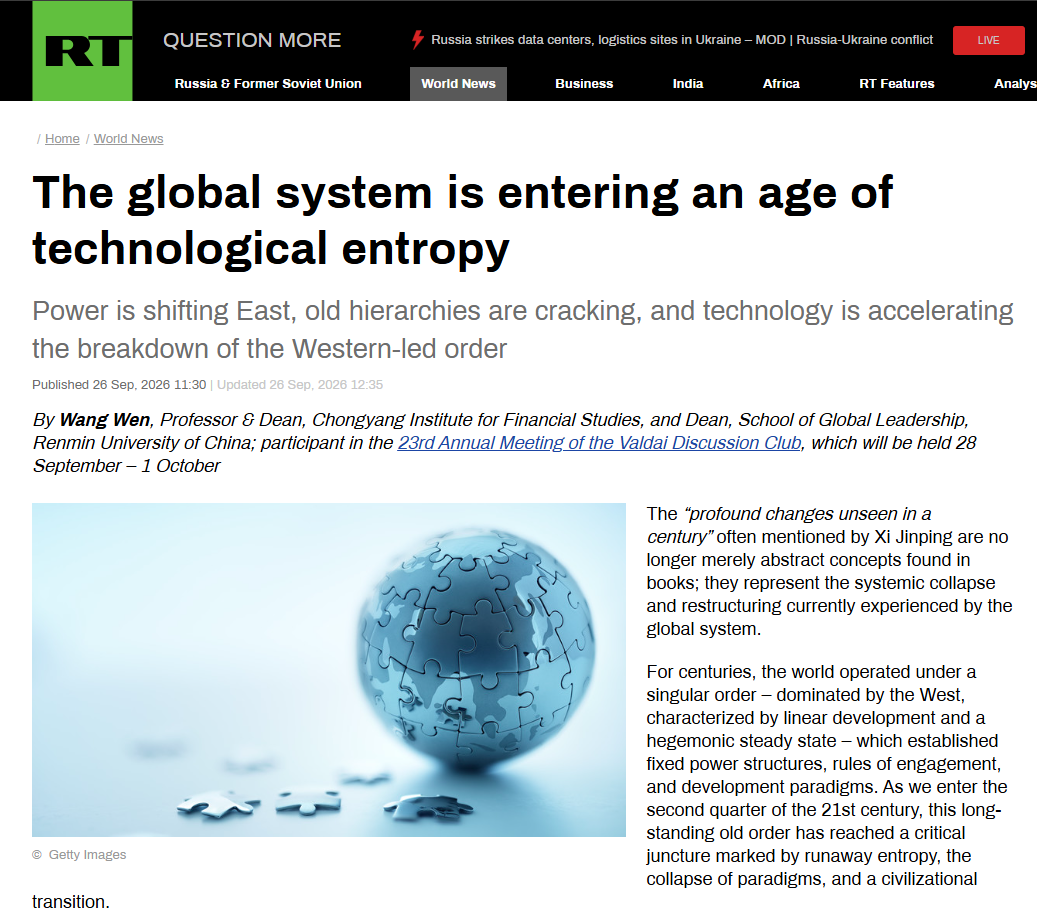
▲《今日俄罗斯》(RT)官网报道截图如上
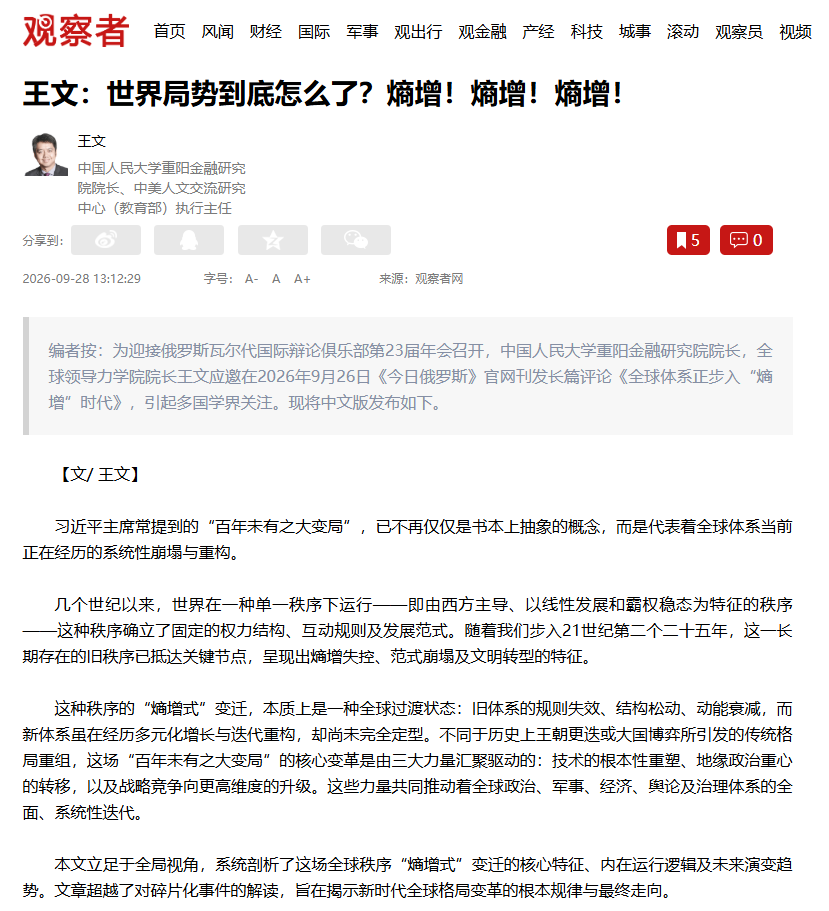
▲观察者网报道截图如上
习近平主席常提到的“百年未有之大变局”,已不再仅仅是书本上抽象的概念,而是代表着全球体系当前正在经历的系统性崩塌与重构。
几个世纪以来,世界在一种单一秩序下运行——即由西方主导、以线性发展和霸权稳态为特征的秩序——这种秩序确立了固定的权力结构、互动规则及发展范式。随着我们步入21世纪第二个二十五年,这一长期存在的旧秩序已抵达关键节点,呈现出熵增失控、范式崩塌及文明转型的特征。
这种秩序的“熵增式”变迁,本质上是一种全球过渡状态:旧体系的规则失效、结构松动、动能衰减,而新体系虽在经历多元化增长与迭代重构,却尚未完全定型。不同于历史上王朝更迭或大国博弈所引发的传统格局重组,这场“百年未有之大变局”的核心变革是由三大力量汇聚驱动的:技术的根本性重塑、地缘政治重心的转移,以及战略竞争向更高维度的升级。这些力量共同推动着全球政治、军事、经济、舆论及治理体系的全面、系统性迭代。
本文立足于全局视角,系统剖析了这场全球秩序“熵增式”变迁的核心特征、内在运行逻辑及未来演变趋势。文章超越了对碎片化事件的解读,旨在揭示新时代全球格局变革的根本规律与最终走向。
一、秩序“熵增式”变迁的六大核心特征:旧稳态的瓦解与全球多元无序状态的常态化
当前全球范围内的地缘政治冲突、经济波动、技术博弈及舆论极化,本质上都是这种秩序“熵增式”变迁的具体表现。由传统西方中心秩序所确立的稳态平衡,已彻底瓦解。当前的全球格局呈现出四大核心特征:逆风因素加剧、碎片化加速、风险共振以及战略竞争泛化。不确定性、非对称性和跨域传导已成为全球格局的新常态。
首先,地缘政治权力已彻底“去中心化”,传统大国曾经拥有的绝对优势已消磨殆尽。
那种曾主导一个世纪的地缘政治逻辑——即胜负取决于国家体量、军事力量或资源禀赋——已完全过时;技术民主化已成为重塑区域格局的核心变量。
在欧亚大陆和中东等核心地缘政治区域,人工智能、自主武器及智能侦察系统的大规模部署,极大地降低了战争与威慑的门槛,实际上抹平了曾经存在于传统大国之间的军事“代差”。欧洲的安全格局已打破美国垄断:法德两国致力于追求战略自主,而俄罗斯则利用智能装备挑战西方的军事霸权,导致区域权力呈现分层与碎片化态势。中东地区已彻底摆脱了由资源主导和大国控制所定义的旧秩序;中小国家——甚至像胡塞武装这样的非国家行为体——如今也能利用低成本智能装备施加非对称影响,扰乱区域航运与地缘政治局势,致使大国曾经拥有的绝对控制力不断瓦解。
地缘政治权力不再仅仅依附于领土、兵力或资源规模,而是锚定于技术算力、智能作战能力以及技术迭代速度。全球地缘政治博弈已进入新阶段:小国可发挥制衡作用,非国家行为体亦能打破既有格局。
其次,战略威慑体系呈现出分层化与扩散化特征,全球安全风险的重心已从大国对抗转向全域范围内失控的动荡状态。
冷战时期由美苏僵化的双极核对峙所建立的“恐怖平衡”已然瓦解,标志着全球核格局发生了范式转移;核武器的角色已从旨在实现全面相互制约的终极威慑手段,演变为控制区域局势的筹码。
核威慑格局已呈现出明显的层级分化:顶级核大国维持着作为“最后手段”的战略能力,同时避免爆发直接的热战;中等核国家依靠有限的核武库实现区域性自保;无核国家则寻求在大国的“核保护伞”下获得安全保障。核博弈已日益工具化与常态化,成为大国划定红线及宣示战略意图的常规手段。
与此同时,核风险呈现出广泛扩散的态势:尽管大国间爆发直接核对抗的可能性有所降低,但与核扩散、技术泄露、算法误判以及隐蔽性区域核博弈相关的风险却在不断上升。叠加智能化武器与核技术的深度融合,全球安全治理的模式已发生转变——从大国间的相互制衡,演变为应对多维度、隐蔽性强且渗透于各领域的复杂风险挑战。
第三,全球发展格局正经历从西向东的转移,延续了五个世纪之久的“西方中心”体系正在瓦解。
此轮变局中最具历史意义的转变,在于全球地缘政治、经济及文明重心的整体性转移——即从大西洋区域转向欧亚大陆及整个亚洲,从而从根本上颠覆了西方主导全球长达五个世纪的底层结构。
在经济层面,包括中国、东盟、印度及中东在内的亚洲各经济板块间的联动发展,正加速推动泛欧亚经济循环圈的形成;西方主导全球供应链、贸易规则及经济秩序的时代渐近尾声,而“全球南方”国家在发展议题上的话语权正日益增强。在安全层面,欧洲、中东与亚太地区的安全格局日益交织融合;大陆板块的地缘政治价值全面回归,而传统海洋霸权的影响力与控制力则持续衰减。
在文明与治理层面,亚洲倡导的多元共存与互利合作理念,正有力抗衡西方零和博弈的霸权逻辑;多元文明的复兴正在打破西方对文明的垄断,新兴多边机制正逐步取代传统的西方主导型机构,全球治理的多元化特征也日益凸显。
第四,霸权体系的信誉已然崩塌,西方主导的基于规则的全球体系已全面失效。
特朗普奉行的“美国优先”交易型外交,成为瓦解美式霸权的关键转折点,彻底终结了美国对全球事务拥有绝对单边控制权的时代。美国霸权的根基——即二战后建立的同盟体系、规则制定主导权以及公共产品供给能力——已被彻底瓦解:同盟信誉遭到挥霍,多边体系受到侵蚀,全球化秩序发生断裂,美国也从秩序的构建者转变为秩序的破坏者。
尽管拜登政府曾短暂尝试采取补救措施,但未能挽回美国的信誉。全球范围内对美国的信任赤字与制度信心缺失已根深蒂固;单边主义与保护主义横行,传统国际规则中的双重标准问题愈发刺眼,全球治理陷入了“熵增”式的真空状态——即旧规则已失效,而新规则尚未确立。
第五,国家间博弈的维度已全面升级,围绕认知与舆论的较量正成为核心的“无形战场”。
数字技术的普及从根本上重塑了大国竞争的模式,使竞争重心从传统的实体对抗转向精准的“认知战”。5G、算法推荐及大数据画像等技术构建了一种具有全方位渗透性、回声室效应固化及情绪主导特征的信息生态系统。
美西方凭借其长期掌握的话语权优势,不断输出极化叙事,制造阵营对抗,并撕裂他国的社会共识。数字时代打破了传统外交的官方壁垒;普通民众与非政府主体已成为全球战略博弈中的关键节点,公众情绪与认知直接影响着地缘政治态势及外交决策。操纵舆论与塑造认知旨在实现“不战而屈人之兵”的战略目标,而认知极化与舆论分裂则已成为全球秩序动荡的主要推手。
第六,全球经济与治理体系中的关键主体正经历全面转型,传统的垄断格局已被彻底打破。
在经济领域,那种“效率至上”的传统全球化模式已难以为继。地缘政治冲突、技术封锁及投资壁垒迫使全球经济转向一种优先考虑韧性与区域内循环的发展逻辑;区域一体化正取代全球一体化,成为抵御风险的核心机制,而新兴市场国家与“全球南方”则已成为全球经济的关键稳定器。
在治理领域,以联合国、国际货币基金组织(IMF)和世界银行等为代表的传统西方主导型机构,其效能正持续下降;与此同时,上海合作组织(SCO)、金砖国家(BRICS)及二十国集团(G20)等新兴多边平台正迅速崛起。全球冲突解决模式正从西方主导的强制性干预,向多元、协商与合作式的治理转变。与此同时,非政府力量与行业精英的全球影响力持续增强,推动全球治理主体的格局从单一由主权国家主导,转变为政府、国际机构与非政府实体共存的新形态。
二、秩序重构的四种新运行逻辑:一种摆脱西方传统范式的新时代战略范式
全球秩序的“熵变”远不止是动荡,更标志着全球运行底层逻辑发生了根本性、颠覆性的变革。当今世界的竞争、合作与冲突,已无法再用西方过时的现实主义范式——即基于实力构建霸权、零和博弈以及武力制胜——来加以解释。
一种适应多极化、数字化与区域化世界的新运行逻辑已经形成,它从根本上重塑了大国崛起、区域发展与全球治理的底层规则。
首先,强国实力的逻辑:从单纯依靠规模优势确立主导地位,转变为凭借技术与韧性赢得优势。
传统的国际竞争往往是规模的较量——即领土面积、军事吨位和经济总量等硬指标的比拼——大国借此确立霸权垄断并实施单边主导。然而,在当今秩序重塑与不确定性加剧的时代,衡量国家核心竞争力的关键指标已转变为技术算力、智能迭代能力、供应链韧性以及风险抵御能力。
智能武器正在重塑军事力量平衡;数字技术主导着舆论与认知;自主可控的产业链能有效对冲地缘政治制裁风险;区域闭环经济体系则能缓冲全球波动带来的冲击。中小国家可以通过特定技术领域的突破,实现非对称的制衡。反之,若缺乏技术创新与系统性韧性,大国的庞大体量反而可能沦为低效的负担——这一现实从根本上打破了西方历史上将“规模”与“霸权”画等号的逻辑。
其次,大国崛起的逻辑:从霸权更迭转向规则重塑。
几个世纪以来的西方历史叙事固化了一种现实主义范式:即崛起意味着冲突,实力增长意味着谋求主导权,霸权必然发生转移。事实上,所有西方国际关系理论本质上都是对欧洲殖民争霸史的总结与提炼。然而,当前全球格局的重构已彻底超越了旧有的“霸权周期”陷阱。
以中国为代表的新兴大国的崛起,摒弃了军事扩张、谋求霸权地位及集团对抗的老路,而是通过文明互鉴、区域协同与互利合作实现发展突破。唐朝鼎盛时期,其GDP占亚洲总量的80%;郑和船队的规模更是哥伦布船队的十倍。
尽管拥有如此压倒性的实力,中国却从未走上西方殖民征服或区域垄断的道路。这有力证明:实力并不等同于霸权,崛起也不必然引发冲突。一种东方的共生逻辑正在取代西方的支配逻辑,为大国崛起确立了全新的范式。
第三,安全与稳定的逻辑:从外部制衡转向自主韧性。
冷战以来,全球安全格局建立在大国对峙、盟友体系纠葛以及力量制衡之上,维持着一种脆弱的平衡。安全议程的主导权掌握在少数西方大国手中,导致大多数国家别无选择,只能依附于强者,被动地规避风险。在当前全球秩序发生“熵增”式变迁的时代,安全风险变得弥散且难以预测,依靠外部制衡维持稳定的机制已彻底瓦解;因此,自主可控能力、多元化的对冲策略以及系统性韧性,已成为安全体系的核心支柱。
在军事领域,各国正利用智能技术构建自主防御体系;在经济领域,各国通过建立区域性闭环产业链来缓解“脱钩”风险;在金融领域,各国推动本币结算以对冲美元武器化风险;在舆论领域,各国构建独立的话语体系以打破认知垄断。各国正摆脱对大国保护的依赖,转而利用系统性韧性和区域合作,将自身安全与发展的主动权牢牢掌握在自己手中。
第四,全球治理的逻辑:从西方垄断转向多元、共治的模式。
传统的全球治理曾是由少数西方发达国家主导的游戏——规则由西方制定,标准由西方界定,利益由西方垄断,而发展中国家只能被动接受与适应。全球秩序的“熵变”打破了这种垄断;“全球南方”的群体性崛起以及新兴多边机制影响力的增强,推动了治理主体、规则及理念的全面多元化。
治理的核心已从强者控制弱者转变为多元主体间的平等协商;规则已从服务于西方的单边标准演变为兼顾公平与普惠的共赢原则;发展逻辑也超越了零和博弈式的掠夺,转向包容共生与互学互鉴,标志着全球治理真正步入了多边主义的新时代。
三、全球秩序熵变的未来走向:多极格局的巩固、韧性共生与文明角色的回归
尽管当前全球秩序的熵变看似混乱且充满风险,但这绝非无序的动荡或内耗,而是旧秩序消亡与新秩序诞生过程中不可避免的“成长阵痛”。立足于这一变革的根本逻辑,我们可以清晰预见未来数十年全球演变的主要趋势。
三大确定性趋势将主导21世纪第二个季度的全球格局,从而彻底终结以西方为中心的霸权时代。
首先,全球格局将发生决定性转变,从单极动荡走向多极稳态,霸权影响力将经历持续且不可逆转的衰退。
美国绝对霸权的时代已彻底终结。虽然美国霸权不会一夜之间崩塌,但其相对实力将持续收缩与衰退,从全球主导者转变为区域性力量。全球力量对比将继续趋于平衡;亚洲作为地缘政治中心的地位将进一步巩固,欧亚大陆的融合进程也将稳步推进。
包括中国、东盟、印度和中东在内的亚洲各板块之间将形成深度互联,从而打造出一批能够与西方体系抗衡的新兴大国集群。旧有的集团对抗与零和博弈模式将逐渐淡出,取而代之的将是以大国竞争与合作、多元制衡及区域自主为特征的主流全球政治格局。
多极化将从一种趋势演变为稳固、持久的全球秩序。
其次,全球发展将发生决定性转变,从“效率优先”转向“韧性优先”,进而促成区域共生体系的全面形成。
全球化不会消失,但将经历根本性的转型与升级。以粗放式增长、同质化和西方主导为特征的旧全球化模式正在终结,而以精准化、区域化和多元化为特征的新模式正在兴起。各国将继续推动产业链与供应链的多元化、本土化和自主化,将安全与稳定置于首要位置。
区域经济协同与闭环体系将成为抵御地缘政治冲突、贸易保护主义及技术封锁的核心支柱。RCEP、上合组织(SCO)经济合作及金砖国家(BRICS)合作等新兴区域机制将持续提质增效,构建互利共赢且独立于西方的区域发展体系。全球经济将摆脱单一西方规则的束缚,确立一种以多元并行路径和韧性共生为特征的新发展格局。
第三,全球竞争正发生深刻转变,从单纯的实力对抗转向规则与文明的较量,这标志着东方文明价值观的全面复兴。
未来大国竞争的核心将不再是军事力量、领土争端或资源掠夺,而是围绕技术标准、治理规范、文明范式及认知叙事的终极博弈。以零和博弈、霸权主义和对抗思维为特征的西方文明逻辑,其弊端已暴露无遗,难以适应多元世界的发展需求。
相比之下,亚太地区植根于互学互鉴、共生共荣、和而不同及合作共赢的持久文明精神,将成为重塑全球文明秩序的核心基石。从玄奘译经、杨良瑶出使、郑和下西洋等千载传承,到当代亚太地区互学互鉴与民心相通的生动实践,这种倡导共生的东方文明将持续抗衡西方的对抗性叙事,并重写全球文明竞争的基本规则。
第四,全球治理正从少数精英垄断向广泛参与转型,公平与包容正成为时代的主流趋势。
未来的全球治理将彻底打破少数西方国家及精英阶层的垄断格局;“全球南方”的话语权与影响力将持续提升,新兴多边机制将成为治理的主要载体,非政府主体及公民社会的参与度也将不断加深。
核军控、人工智能、气候治理及公共卫生等全球性议题,将摆脱地缘政治博弈与阵营对抗的束缚,回归多边协商与合作共赢的本质。全球治理将不再是强权手中的工具,而将转变为全人类共同发展的平台;公平、包容与互利共赢将定义全球治理的新时代。
在秩序重构中拥抱东方共生之道
从宏观视角审视,这场百年未有之大变局,本质上是一个跨越数世纪的进程,旨在矫正秩序、恢复文明平衡并重塑全球格局。全球秩序的“熵变”过程,既体现了旧有西方霸权秩序的熵增衰亡,也展现了新型多元全球秩序的熵减新生。
地缘政治冲突、技术博弈、经济波动及舆论分歧,皆是新旧秩序更迭过程中不可避免的“成长阵痛”。西方数百年历史向世界展示的仅是强权间的霸权争夺;而亚太地区——凭借其数千年的文化积淀与新时代新兴大国的实践经验——正向世界昭示强国如何架起合作的桥梁。
未来的全球竞争绝非霸权更迭的零和博弈,而是一场关乎发展道路、文明形态与规则体系的价值观较量。由单边主义、集团对抗及零和博弈主导的旧时代已然终结,而以多边主义、开放包容及互利共生为特征的新时代正加速开启。
站在21世纪第二个季度的历史关口,人类终将摆脱西方主导秩序的桎梏与现实主义权力斗争的陷阱。通过技术创新夯实发展根基,借区域协同凝聚共生力量,凭文明互鉴化解分歧,我们将构建一个更加公平、稳定、坚韧且繁荣的全球秩序,从而开启一个多元共存与可持续发展的新文明阶段。
英文版文章如下:
The global system is entering an age of technological entropy
WANG Wen
The 'profound changes unseen in a century' often mentioned by Xi Jinping are no longer merely abstract concepts found in books; they represent the systemic collapse and restructuring currently experienced by the global system.
For centuries, the world operated under a singular order—dominated by the West, characterized by linear development and a hegemonic steady state—which established fixed power structures, rules of engagement, and development paradigms. As we enter the second quarter of the 21st century, this long-standing old order has reached a critical juncture marked by runaway entropy, the collapse of paradigms, and a civilizational transition.
This entropic shift of order is essentially a global transitional state where the rules of the old system fail, its structures loosen, and its momentum wanes, while a new system undergoes pluralistic growth and iterative restructuring without yet having fully crystallized. Unlike the traditional restructuring of global patterns seen in historical dynastic changes or great-power rivalries, the core transformation of this 'once-in-a-century' shift is driven by the convergence of three forces: the fundamental reshaping of technology, the shifting of geopolitical centers of gravity, and the escalation of strategic competition to higher dimensions. Together, these forces are driving a comprehensive, systemic iteration of global politics, military affairs, economics, public opinion, and governance.
Adopting a holistic perspective, this article systematically deconstructs the core characteristics, underlying operational logic, and certain future evolutionary trends of this global entropic shift. Moving beyond the interpretation of fragmented events, it identifies the fundamental laws and ultimate trajectory of the transformation of the global landscape in this new era.
I. Six core characteristics of the entropic shift of order: The disintegration of the old steady state and the normalization of global pluralistic disorder
Current global geopolitical conflicts, economic fluctuations, technological rivalries, and public opinion polarization are, in essence, concrete manifestations of this entropic shift in order. The steady-state equilibrium established by the traditional Western-centric order has completely disintegrated. The global landscape now exhibits six core characteristics: intensifying headwinds, accelerating fragmentation, the resonance of risks, and the generalization of strategic competition. Uncertainty, asymmetry, and cross-domain transmission have become the new normal of the global landscape.
First, geopolitical power has undergone complete decentralization, and the absolute advantages once held by traditional major powers have fully eroded.
The geopolitical logic that prevailed for a century—where victory was determined by sheer national scale, military force, or resource endowment—has become completely obsolete; technological democratization has emerged as the core variable reshaping regional landscapes.
In the core geopolitical regions of Eurasia and the Middle East, the large-scale deployment of artificial intelligence, autonomous weapons, and intelligent reconnaissance systems has drastically lowered the threshold for war and deterrence, effectively erasing the military 'generation gap' that once separated traditional major powers. Europe's security landscape has moved beyond the US monopoly; France and Germany are pursuing strategic autonomy, while Russia is leveraging intelligent hardware to challenge Western military hegemony, leading to a stratification and fragmentation of regional power. The Middle East has completely shed the old order defined by resource dominance and control by major powers; small and medium-sized states—and even non-state actors like the Houthis—can now exert asymmetric influence and disrupt regional shipping and geopolitics using low-cost intelligent equipment, causing the absolute control once held by major powers to steadily crumble.
Geopolitical power is no longer tethered to territory, troop numbers, or resource volume; instead, it is anchored in technological computing power, intelligent warfare capabilities, and the pace of technological iteration. Global geopolitical rivalry has entered a new phase where small nations can act as counterweights and non-state actors can disrupt the status quo.
Second, strategic deterrence systems have become stratified and diffuse, shifting global security risks from great-power confrontation to a state of uncontrolled volatility across all domains.
The 'balance of terror' established by the rigid US-Soviet bipolar nuclear standoff during the Cold War has collapsed, marking a paradigm shift in the global nuclear landscape; nuclear weapons have evolved from an ultimate deterrent for total mutual restraint into leverage for controlling regional dynamics.
Nuclear deterrence is now clearly stratified: Top-tier nuclear powers maintain a strategic last-resort capability while avoiding direct hot wars; mid-tier nuclear states rely on limited arsenals for regional self-preservation; and non-nuclear states seek security under the umbrella of major powers. Nuclear rivalry has become instrumentalized and normalized, serving as a standard tool for major powers to draw red lines and signal strategic intent.
Meanwhile, nuclear risks have become widespread; while the likelihood of direct nuclear confrontation between major powers has declined, risks associated with proliferation, technology leaks, algorithmic miscalculation, and covert regional nuclear maneuvering are rising. Compounded by the deep integration of intelligent weaponry and nuclear technology, global security governance has shifted from a model of great-power checks and balances to a complex challenge of managing risks that are multidimensional, covert, and pervasive across all domains.
Third, the global development landscape is shifting from West to East, and the Western-centric system that has prevailed for five centuries is unraveling.
The most historic transformation in this round of upheaval is the holistic shift of the global geopolitical, economic, and civilizational center of gravity from the Atlantic to the Eurasian landmass and Asia as a whole, fundamentally overturning the underlying structure of Western global dominance that has persisted for five centuries.
Economically, the interconnected development of Asian blocs—including China, ASEAN, India, and the Middle East—is accelerating the formation of a pan-Eurasian economic cycle; the era of Western dominance over global supply chains, trade rules, and economic orders is drawing to a close, while the Global South is gaining a powerful voice in development discourse. Regarding security, the security landscapes of Europe, the Middle East, and the Asia-Pacific are becoming deeply intertwined; the geopolitical value of the continental landmass is making a full comeback, while the reach and control of traditional maritime hegemony continue to wane.
In terms of civilization and governance, Asian concepts of diverse coexistence and mutually beneficial cooperation are countering the Western logic of zero-sum hegemony; the resurgence of diverse civilizations is breaking the Western monopoly on civilization, emerging multilateral mechanisms are gradually replacing traditional Western-led institutions, and the pluralistic nature of global governance is becoming increasingly distinct.
Fourth, the credibility of the hegemonic system has collapsed, and the Western-led global rules-based system has comprehensively failed.
Trump's transactional 'America First' diplomacy served as the critical turning point that broke the back of American-style hegemony, definitively ending the era of absolute US unilateral global control. The foundations of US hegemony—built after World War II upon alliance systems, rule-setting dominance, and the provision of public goods—have been thoroughly dismantled; alliance credibility has been squandered, multilateral systems have eroded, and the globalized order has fractured, transforming the US from an order builder into an order destroyer.
Although the Biden administration briefly attempted remedial measures, these failed to restore US credibility. Global deficits in trust and institutional confidence regarding the US have become entrenched; unilateralism and protectionism run rampant, double standards in traditional international rules have become glaring, and global governance has fallen into a vacuum of entropic change—where old rules have failed but new ones have yet to be established.
Fifth, the dimension of state-level rivalry has undergone a comprehensive escalation, with the battle for perception and public opinion emerging as a core, invisible battlefield.
The proliferation of digital technology has fundamentally restructured the model of great-power competition, shifting the focus of rivalry from traditional physical confrontation to precision-targeted cognitive warfare. Technologies such as 5G, algorithmic recommendation, and big-data profiling have constructed an information ecosystem characterized by pervasive reach, the solidification of echo chambers, and emotional dominance.
Leveraging their long-standing monopoly on discourse, the US and the West continuously export polarizing narratives, manufacture bloc-based confrontations, and fracture social consensus in other nations. The digital era has dismantled the official barriers of traditional diplomacy; ordinary citizens and non-governmental entities have become pivotal nodes in the global strategic game, with public sentiment and perception directly influencing geopolitical dynamics and diplomatic decisions. Public opinion manipulation and the shaping of perceptions achieve the strategic goal of subduing the enemy without fighting, while cognitive polarization and public opinion divides have become major drivers of disorder in the global order.
Sixth, the key actors in the global economy and governance are undergoing a comprehensive transformation, completely shattering traditional monopolistic patterns.
In the economic sphere, the traditional globalization model—which prioritized efficiency above all—has become obsolete. Geopolitical conflicts, technological blockades, and investment barriers are forcing the global economy to shift toward a development logic that prioritizes resilience and regional self-containment; regional integration is replacing global integration as a core mechanism for hedging against risk, while emerging markets and the Global South have become key stabilizers of the global economy.
In the realm of governance, the effectiveness of traditional Western-dominated institutions—such as the UN, IMF, and World Bank—is steadily declining, whereas emerging multilateral platforms like the SCO, BRICS, and G20 are rising rapidly. Global conflict resolution models are shifting from Western-led coercive intervention to diverse, consultative, and cooperative governance. Simultaneously, the global influence of non-governmental forces and industry elites continues to grow, shifting the landscape of global governance actors from one dominated solely by sovereign states to a new pattern of coexistence among governments, international institutions, and non-governmental entities.
II. Four new operational logics of order reconstruction: A new-era strategic paradigm breaking free from Western conventions
The entropic shift in the global order signifies far more than mere turbulence; it represents a fundamental and disruptive transformation of the underlying logic governing global operations. Current global competition, cooperation, and conflict can no longer be explained by the outdated Western realist paradigms of hegemony through strength, zero-sum games, and victory through force.
A new operational logic—tailored to a multipolar, digital, and regionalized world—has taken shape, fundamentally rewriting the underlying rules governing the rise of major powers, regional development, and global governance.
First, the logic of core national power: A shift from dominance through sheer scale to victory through technology and resilience.
Traditional international competition was a contest of sheer scale—territorial size, military tonnage, and aggregate economic output—whereby major powers could leverage their massive size to establish hegemonic monopolies and exert unilateral dominance. In the current era of shifting order and entropy, however, the primary benchmarks for a nation's core competitiveness have become technological computing power, the capacity for intelligent iteration, supply chain resilience, and the ability to withstand risks.
Intelligent weaponry is reshaping the military balance of power; digital technology governs the discourse on public opinion and perception; autonomous industrial chains hedge against the risks of geopolitical sanctions; and regional closed-loop economic systems buffer against global volatility. Small and medium-sized nations can achieve asymmetric checks and balances through breakthroughs in specific technologies. Conversely, without technological innovation and systemic resilience, a major power's sheer size risks becoming an inefficient burden—a reality that fundamentally shatters the Western historical logic equating size with hegemony.
Second, the logic of great power rise: shifting from hegemonic succession to rule reshaping.
Centuries of Western historical narrative have entrenched a realist paradigm—that rising implies conflict, growing strength implies a bid for dominance, and hegemony inevitably changes hands. Indeed, all Western international relations theories are essentially distillations of the history of European colonial rivalry. Yet, the current restructuring of the global landscape has completely transcended the old trap of hegemonic cycles.
The rise of emerging powers—exemplified by China—eschews military expansion, the pursuit of hegemonic status, and bloc-based confrontation; instead, it achieves developmental breakthroughs through civilizational mutual learning, regional synergy, and mutually beneficial cooperation. At its peak, the Tang Dynasty accounted for 80% of Asia's GDP, and Zheng He's fleet was ten times the size of Columbus; despite possessing such overwhelming strength, China never followed the Western path of colonial conquest or regional monopoly. This proves that strength does not equate to hegemony, nor does rising equate to conflict; an Eastern logic of symbiosis is replacing the Western logic of dominance-seeking, establishing a brand-new paradigm for the rise of great powers.
Third, the logic of security and stability: shifting from external balancing to autonomous resilience.
Since the Cold War, global security has maintained a precarious equilibrium based on great-power standoffs, alliance entanglements, and the balancing of forces. Control over the security agenda rested in the hands of a few Western powers, leaving most nations with no choice but to attach themselves to the strong and passively seek to avoid risk. In this era of entropic shifts in the global order, security risks have become diffuse and unpredictable, and the stability provided by external checks and balances has completely collapsed; consequently, autonomy and controllability, diversified hedging strategies, and systemic resilience have become the core pillars of security.
Militarily, nations are building autonomous defense systems powered by intelligent technologies; economically, they are establishing regional closed-loop industrial chains to mitigate the risks of decoupling; financially, they are promoting local currency settlements to hedge against the weaponization of the US dollar; and in the realm of public opinion, they are constructing independent discourse systems to break cognitive monopolies. Nations are moving away from reliance on the protection of major powers, instead seizing the initiative in their own security and development by leveraging systemic resilience and regional cooperation.
Fourth, the logic of global governance is shifting from Western monopoly to pluralistic, shared governance.
Traditional global governance was a game dominated by a handful of Western developed nations—where rules were set, standards defined, and benefits monopolized by the West, leaving developing countries to merely accept and adapt passively. The entropic shift in the global order has shattered this monopoly; the collective rise of the Global South and the growing influence of emerging multilateral mechanisms have led to a comprehensive diversification of governance actors, rules, and philosophies.
The core of governance has shifted from the strong controlling the weak to equal consultation among diverse actors; rules have evolved from self-serving Western unilateral standards into win-win principles that prioritize fairness and broad-based benefits; and the logic of development has moved beyond zero-sum plunder toward inclusive coexistence and mutual learning, marking the true entry of global governance into a new era of multilateralism.
III. Future trajectory of global order entropy change: Multipolar consolidation, resilient symbiosis, and the restoration of civilizational roles
While the current entropy change in the global order appears chaotic and fraught with risk, it is by no means random turbulence or internal attrition; rather, it represents the inevitable growing pains accompanying the demise of the old order and the birth of the new. By grounding our analysis in the fundamental logic of this transformation, we can clearly foresee the major trends of global evolution over the coming decades. Four certain trends will dominate the global landscape during the second quarter of the 21st century, effectively ending the old era of Western-centric hegemony.
First, the global landscape will shift decisively from unipolar volatility to a multipolar steady state, with hegemonic influence undergoing a continuous and irreversible decline.
The era of absolute US hegemony has definitively ended. While American hegemony will not collapse overnight, it will continue to contract and decline in relative terms, shifting from a position of global dominance to that of a regional player. The global balance of power will continue to equalize; Asia's status as a geopolitical center will be further consolidated, and the integration of the Eurasian landmass will steadily advance.
Deep interconnectedness among Asian blocs—including China, ASEAN, India, and the Middle East—will forge a cluster of emerging powers capable of acting as a counterweight to the Western system. Old models of bloc confrontation and zero-sum games will gradually fade, giving way to a mainstream global political landscape defined by great-power competition and cooperation, diversified checks and balances, and regional autonomy. Multipolarity will evolve from a mere trend into a solidified, stable global order.
Second, global development will shift decisively from efficiency-first to resilience-first, leading to the full formation of regional symbiotic systems.
Globalization will not disappear, but it will undergo a fundamental transformation and upgrade. The old model of globalization—characterized by extensive growth, homogenization, and Western dominance—is ending, while a new model defined by precision, regionalization, and diversification is rising. Nations will continue to diversify, localize, and autonomize their industrial and supply chains, prioritizing security and stability.
Regional economic synergy and closed-loop systems will serve as the core pillars for hedging against geopolitical conflicts, trade protectionism, and technological blockades. Emerging regional mechanisms—such as RCEP, SCO economic cooperation, and BRICS cooperation—will continue to enhance quality and efficiency, building regional development systems that are mutually beneficial and independent of the West. The global economy will break free from the constraints of singular Western rules, establishing a new development landscape characterized by diverse, parallel paths and resilient symbiosis.
Third, global competition is shifting profoundly from physical confrontation to a contest of rules and civilizations, marking a comprehensive resurgence of Eastern civilizational values.
The core of future great-power competition will no longer lie in military might, territorial disputes, or resource plundering, but in the ultimate contest over technological standards, governance norms, civilizational paradigms, and cognitive narratives. The flaws of the Western civilizational logic—characterized by zero-sum games, hegemony, and confrontation—have become glaringly apparent, rendering it ill-suited to the development needs of a diverse world.
In contrast, the Asia-Pacific region's enduring civilizational ethos—rooted in mutual learning, symbiosis, harmony amid diversity, and win-win cooperation—will serve as the core foundation for reshaping the global civilizational order. From the millennia-old legacies of Xuanzang's translation work, Yang Liangyao's diplomatic voyages, and Zheng He's friendly expeditions, to the vibrant contemporary practices of mutual learning and people-to-people connectivity across the Asia-Pacific, this Eastern civilization of symbiosis will continue to counter Western narratives of conflict and rewrite the fundamental rules of global civilizational competition.
Fourth, global governance is transitioning from elite monopoly to broad-based participation, with fairness and inclusivity becoming the prevailing trends of the era.
Future global governance will thoroughly dismantle the monopoly held by a handful of Western nations and elites; the Global South will see a sustained rise in its voice and influence, emerging multilateral mechanisms will become the primary vehicles for governance, and the participation of non-governmental actors and civil society will deepen.
Global public issues—such as nuclear arms control, artificial intelligence, climate governance, and public health—will break free from the constraints of geopolitical maneuvering and bloc-based confrontation, returning to the essence of multilateral consultation and win-win cooperation. Global governance will cease to be a tool for the powerful and instead become a platform for the shared development of all humanity, with fairness, inclusivity, and mutual benefit defining the new era of global governance.
Embracing the right path of Eastern symbiosis amid order reconstruction
Viewed from a macro perspective, the essence of this once-in-a-century transformation is a process—spanning centuries—of correcting the order, restoring the civilizational balance, and reshaping the global landscape. The entropic shift in the global order represents both the entropic decay and demise of the old Western hegemonic order and the entropic reduction and rebirth of a new, diverse global order.
All geopolitical conflicts, technological rivalries, economic fluctuations, and public opinion rifts are the inevitable growing pains accompanying the transition from the old order to the new. Centuries of Western history have taught the world only about hegemonic rivalry among the strong, whereas the Asia-Pacific region—with its millennia-old cultural heritage and the practical experience of emerging powers in the new era—is teaching the world how the strong can build bridges.
Future global competition is by no means a zero-sum game of hegemonic succession; rather, it is a contest of values regarding paths, civilizations, and rules. The old era defined by unilateralism, bloc confrontation, and zero-sum games has come to an end, while a new era characterized by multilateralism, openness, inclusiveness, and mutually beneficial symbiosis is rapidly unfolding.
Standing at the historical juncture of the second quarter of the 21st century, humanity will ultimately break free from the confines of the Western-dominated order and the traps of realist power struggles. By solidifying the foundations of development through technological innovation, fostering symbiotic strength through regional synergy, and resolving differences through mutual learning among civilizations, we will build a new global order that is fairer, more stable, more resilient, and more prosperous—thereby ushering in a new stage of civilization defined by diverse coexistence and sustainable development.





















 京公网安备 11010802037854号