发布时间:2026-07-06 作者: 王文
有人期待美元霸权顷刻崩塌,有人仍笃信美元的长期优势。在笔者看来,“去美元化”绝非一场一蹴而就的金融革命,而是一场持续数十年的、涉及全球利益重构的持久战,既是美元霸权的自我异化、也是全球经济格局变迁共同推动的历史必然。
编者按:“‘去美元化’绝非一场一蹴而就的金融革命,而是一场持续数十年的、涉及全球利益重构的持久战。”6月25日,中国人民大学重阳金融研究院院长、全球领导力学院院长王文在瓦尔代俱乐部官网发表英文评论文章强调,美元霸权将在全球金融经济秩序重构的过程中逐步、迭代、多层次地消融,最终融入一个更多元、更均衡的国际货币体系。现将中文译文及英文原文发布如下:(中文译文约3300字,预计阅读时间10分钟)
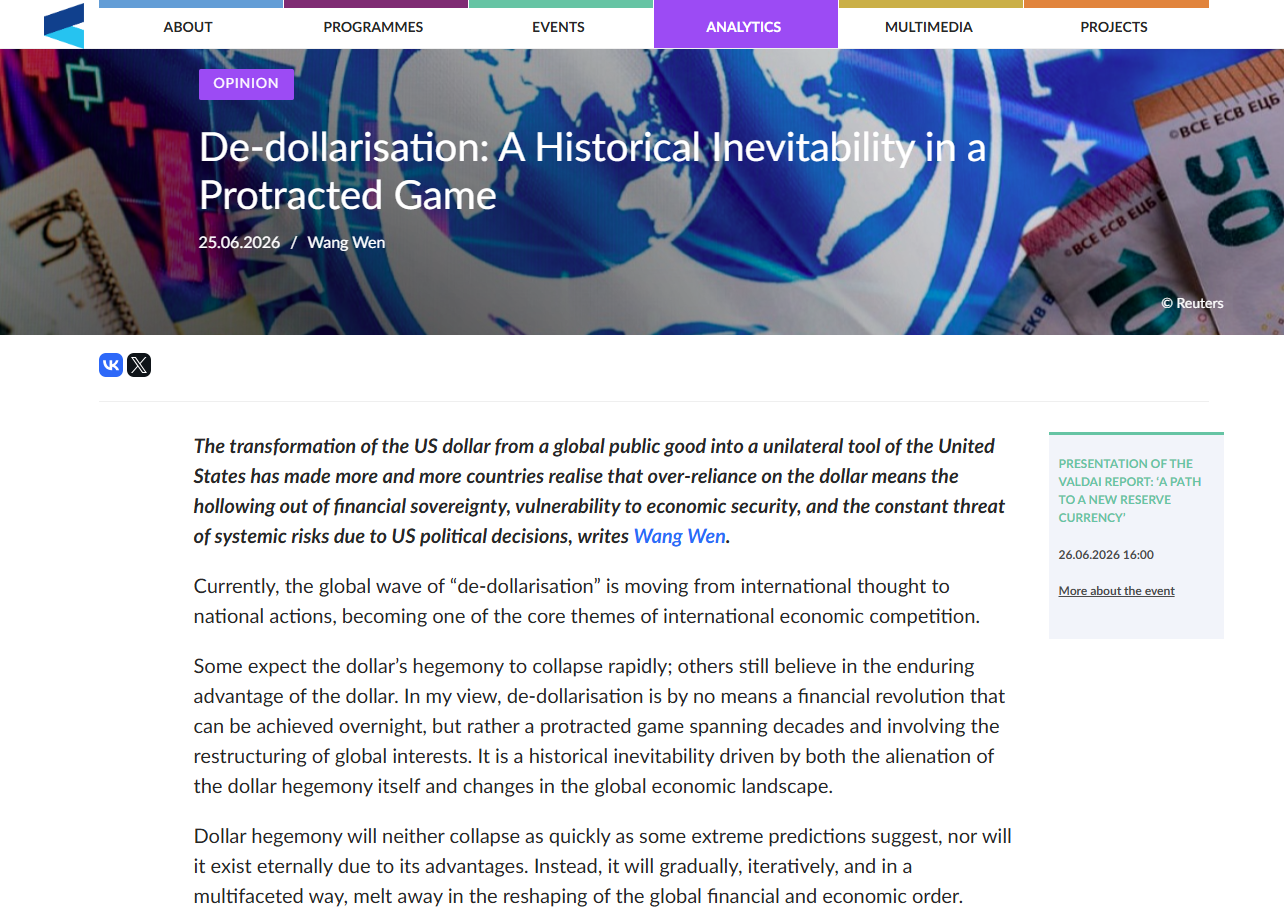
▲报道截图如上
当下,全球“去美元化”浪潮正从国际思潮走向国家行动,成为当前国际经济竞争的核心命题之一。
有人期待美元霸权顷刻崩塌,有人仍笃信美元的长期优势。在笔者看来,“去美元化”绝非一场一蹴而就的金融革命,而是一场持续数十年的、涉及全球利益重构的持久战,既是美元霸权的自我异化、也是全球经济格局变迁共同推动的历史必然。
美元霸权既不会像某些极端预测那样迅速崩溃,也不会因为其优势而永恒存在,而将在全球金融经济秩序重构的过程中逐步、迭代、多层次地消融,最终融入一个更多元、更均衡的国际货币体系。
“去美元化”的核心驱动力,源自美元霸权自身的“武器化”与“信用透支”。近年来,美国频繁将美元当作地缘博弈工具,动辄对他国实施金融制裁,冻结外汇储备、切断SWIFT通道、制裁金融机构,本质上是在透支美元的“公共信用”。美元从全球公共产品异化为美国单边主义工具,使越来越多国家意识到,过度依赖美元意味着金融主权的空心化、经济安全的脆弱性以及受美国政治决策牵连的系统性风险持续威胁。
2022年俄乌冲突爆发后,美欧冻结俄罗斯3000亿美元外汇储备,并将其主要银行踢出SWIFT系统,彻底撕下该系统“中立性”的面纱。伊朗、委内瑞拉等国则长期遭受金融封锁之苦。IMF报告提到,全球已有超过110个国家因担忧制裁而不同程度地参与“去美元化”安排。
与此同时,美国经济结构性矛盾加剧,财政赤字高企、债务规模庞大且通胀波动频繁,不断削弱美元信誉的根基。2026年5月,美国联邦债务突破39万亿美元,债务利息支出成为公共财政最大负担之一,进一步侵蚀美元的“无风险资产”光环。持续的美以伊冲突,叠加石油价格的剧烈波动,进一步动摇石油美元体系的稳定性,推动产油国积极探索非美元结算路径。美元霸权的自我异化,正从内部瓦解其根基,为“去美元化”提供不可逆的历史推力。
金砖国家引领的国际金融体系改革,是“去美元化”进程中最具标志性的里程碑。作为覆盖全球GDP总量37%、拥有10个成员国的新兴经济体合作平台,金砖国家正系统性搭建独立于美元体系的金融基础设施。2026年,金砖支付系统(BRICS Pay)正式上线,整合了巴西Pix、俄罗斯SPFS、中国CIPS等本土支付体系,可实现成员国本币直接结算,有效绕开SWIFT体系。与此同时,金砖国家正推进开发名为“Unit”的数字储备资产,由40%黄金与60%成员国货币共同构成,旨在打破美元在全球储备体系中的垄断地位。
在区域货币合作维度,东盟已正式启动本币结算计划;中国先后与巴西、伊拉克等国签署双边本币结算协议,伊拉克更是首次允许对华贸易采用人民币结算。当前,中俄贸易本币结算占比已超95%;沙特对华石油交易的人民币结算比例达41%,首次超越美元,标志着传统石油美元同盟出现实质性裂痕。自2026年1月起,伊朗对华石油出口已实现100%人民币结算。
外汇储备结构层面,全球央行正持续减持美债、增持黄金与非美元资产。美元在全球外汇储备中的占比,已从2001年72%的历史峰值回落至2025年的56.77%,连续12个季度低于60%关口。截至2025年末,全球央行黄金储备总价值达3.93万亿美元,正式超越海外官方持有的3.88万亿美元美债规模,黄金时隔多年重夺全球第一大官方储备资产地位。与此同时,人民币、欧元、日元、英镑及部分新兴市场货币的储备货币地位稳步提升。
当前,全球“去美元化”呈现“多点突破、梯次推进、多元并存”的鲜明特征,并表现出“非对抗性、非颠覆性、非单一化”的独特属性。
但必须清楚地意识到,这种突破仍是“局部性、渐进性、互补性”的,而非“全局性、颠覆性、替代性”的。
全球范围内,既未形成“反美元同盟”,也没有任何国家主张彻底废除美元,而是各国在自身利益驱动下,逐步从贸易结算、外汇储备、支付体系、货币合作等层面降低对美元的依赖,构建“美元+多元货币”的平行体系。
必须承认,当下的美元霸权已渗透至全球经济的毛细血管。SWIFT数据显示,2025年12月,美元在国际交易中的占比升至50.5%,创2023年以来最高水平。2026年2月,美元占比仍维持在49.25%,稳居全球第一大支付货币。欧元紧随其后,占比约为22.82%。全球超过90%的大宗商品仍以美元计价,跨国公司大多仍习惯以美元结算。
更重要的是,美国掌控SWIFT系统、全球主要金融机构和国际评级机构,形成对全球金融体系的绝对话语权。任何挑战美元的国家,都可能面临金融制裁、资本外流、货币贬值、经济动荡的连锁反应。
历史上,从欧元诞生到日元国际化、再到一些国家的货币实验,均因美元霸权的强大抵抗力而进展缓慢。这种路径依赖、制度惯性和霸权威慑,决定了“去美元化”不可能在短期内冲刺成功,必然是一场持久战。
同样,尽管人民币国际化稳步推进,2028年有望成为全球第三大支付货币,但与美元、欧元的差距依然显著。
中国在“去美元化”进程中处于“参与者、推动者、建设者”的角色,而非“颠覆者、挑战者、领导者”。
这个理性定位,决定了我们必须以长远视角行稳致远。中国从不寻求“去美元化”的激进目标,而是致力于推动国际货币体系多元化,建设更公平、包容、稳定的全球金融新秩序。这符合所有国家的共同利益。
对中国而言,推动“去美元化”关键在于三项任务:一是加速能源转型,减少对石油贸易的路径依赖,从根本上削弱石油美元的基础。包括大力发展可再生能源、储能和智能电网,提高能源自给率,降低交通领域对石油的刚性需求,提升能源安全和经济自主权。
二是稳步推进人民币国际化,构建本币结算网络,打破美元支付垄断。包括扩大双边本币结算协议的覆盖范围,完善CIPS系统,推动mBridge落地,提升人民币在贸易、投资和储备中的使用比例,让人民币成为全球多元货币格局的重要一极。
三是深化多边合作,依托金砖、上合组织、东盟等多边机制,凝聚“去美元化”的国际共识,共同建设多元化国际货币体系。
展望未来,“去美元化”进程将在曲折中持续推进,多元货币格局的形成乃是历史的必然趋势。2035年,美元霸权将得到进一步削弱,人民币国际地位将显著提升,成为全球重要的储备货币、支付货币和投资货币。
但欧元区内部政治经济分化、新兴市场币值不稳、全球金融市场对美元的路径依赖,都决定了多元货币体系的形成需要数十年的积累与调适,难以一蹴而就。全球货币格局将呈现“美元主导、多元并存”的特征,美元仍将是世界第一大货币。
国际货币体系的终极形态,不是单一货币的霸权,而是多元货币的平衡共处。这需要世界各国的共同努力,更需要时间的检验和历史的评判。
英文原文
De-dollarisation: A Historical Inevitability in a Protracted Game
WANG Wen
Currently, the global wave of "de-dollarisation" is moving from international thought to national actions, becoming one of the core themes of international economic competition.
Some expect the dollar's hegemony to collapse rapidly; others still believe in the enduring advantage of the dollar. In my view, de-dollarisation is by no means a financial revolution that can be achieved overnight, but rather a protracted game spanning decades and involving the restructuring of global interests. It is a historical inevitability driven by both the alienation of the dollar hegemony itself and changes in the global economic landscape.
Dollar hegemony will neither collapse as quickly as some extreme predictions suggest, nor will it exist eternally due to its advantages. Instead, it will gradually, iteratively, and in a multifaceted way, melt away in the reshaping of the global financial and economic order.
The core driving force of de-dollarisation stems from the "weaponisation" and "credit overdraft" of the dollar hegemony itself. In recent years, the United States has frequently used the dollar as a geopolitical tool, readily imposing financial sanctions on other countries, freezing foreign exchange reserves, cutting off SWIFT channels, and sanctioning financial institutions. Essentially, this is overdrafting the "public credit" of the dollar. The transformation of the US dollar from a global public good into a unilateral tool of the United States has made more and more countries realise that over-reliance on the dollar means the hollowing out of financial sovereignty, vulnerability to economic security, and the constant threat of systemic risks due to US political decisions.
Following the outbreak of the Russia-Ukraine conflict in 2022, the US and Europe froze $300 billion of Russia's foreign exchange reserves and removed its major banks from SWIFT, completely shattering the system's facade of "neutrality". Countries like Iran and Venezuela have long suffered from financial blockades. According to an IMF report, more than 110 countries worldwide have participated in de-dollarisation arrangements to varying degrees due to concerns about sanctions.
Meanwhile, structural contradictions in the US economy have intensified, with high fiscal deficits, massive debt, and frequent inflation fluctuations, continuously weakening the foundation of the dollar's credibility. In May 2026, the US federal debt surpassed $39 trillion, with debt interest payments becoming one of the biggest burdens on public finances, further eroding the dollar's "risk-free asset" aura. The ongoing US-Israel-Iran conflicts, coupled with volatile oil prices, further undermine the stability of the petrodollar system, prompting oil-producing countries to actively explore non-dollar settlement pathways. The self-alienation of US dollar hegemony is undermining its foundations from within, providing an irreversible historical impetus for de-dollarisation.
The international financial reforms promoted by the BRICS countries represent the most solid milestone in de-dollarisation. As a cluster of emerging economies covering 37% of global GDP and comprising 10 member countries, the BRICS countries are preparing to systematically build a financial infrastructure independent of the US dollar. In 2026, the BRICS Payment System (BRICS Pay) was launched, integrating payment systems from Brazil's Pix, Russia's SPFS, and China's CIPS, enabling direct settlement in member countries' local currencies, bypassing SWIFT. Simultaneously, the BRICS countries are developing "Unit", a digital reserve asset composed of 40% gold and 60% member currencies, challenging the US dollar's reserve monopoly.
At the level of regional monetary cooperation, ASEAN has launched a local currency settlement plan. China has signed local currency settlement agreements with Brazil, Iraq, and other countries, with Iraq allowing RMB settlement for trade with China for the first time. The proportion of local currency settlement in Sino-Russian trade exceeds 95%. Saudi Arabia's RMB settlement ratio for oil transactions with China reached 41%, surpassing the US dollar for the first time, marking a crack in the petrodollar alliance. Since January 2026, Iran has settled 100% of its oil exports to China in RMB.
In the realm of foreign exchange reserves, global central banks have continued to reduce their holdings of US Treasury bonds and increase their holdings of gold and non-dollar assets. The proportion of dollar reserves has fallen from a peak of 72% in 2001 to 56.77% in 2025, remaining below 60% for 12 consecutive quarters. By 2025, the total value of gold reserves held by central banks worldwide will reach $3.93 trillion, officially surpassing the $3.88 trillion in US Treasury bonds held by overseas official entities. Gold has reclaimed its position as the world's largest reserve asset for the first time. Meanwhile, the reserve status of the RMB, Euro, Japanese Yen, British Pound, and some emerging market currencies has steadily increased.
Currently, global de-dollarisation exhibits distinct characteristics of "multi-point breakthroughs, gradual progress, and diversified coexistence," and demonstrates unique features of being "non-confrontational, non-disruptive, and non-singular".
However, we must be clearly aware that these breakthroughs are still "partial, gradual, and complementary," rather than "global, disruptive, and substitutive".
Globally, no "anti-dollar alliance" has formed, nor has any country advocated for the complete abolition of the dollar. Instead, driven by self-interest, countries are gradually reducing their reliance on the dollar in areas such as trade settlement, foreign exchange reserves, payment systems, and monetary cooperation, building a parallel system of "dollar + multiple currencies."
We must acknowledge that the current dollar hegemony has permeated the capillaries of the global economy. According to SWIFT data, in December 2025, the dollar's share in international transactions rose to 50.5%, the highest level since 2023. By February 2026, the dollar's share remained at 49.25%, firmly holding its position as the world's largest payment currency. The euro followed closely behind, accounting for approximately 22.82%. Over 90% of global commodities are still priced in dollars, and most multinational corporations are accustomed to dollar settlements.
More importantly, the United States controls the SWIFT system, major global financial institutions, and international rating agencies, forming absolute dominance over the global financial system.
"Any country challenging the dollar could face a chain reaction of financial sanctions, capital outflows, currency devaluation, and economic turmoil."
Historically, from the birth of the euro to the internationalisation of the yen, and the currency experiments of some countries, progress has been slow due to the strong resistance of the dollar's hegemony. This path dependence, institutional inertia, and the deterrent effect of hegemonic power determine that de-dollarisation cannot be a short-term sprint, and will inevitably be a protracted battle.
While the internationalisation of the RMB is progressing steadily, and it is expected to become the world's third-largest payment currency by 2028, the gap with the dollar and the euro remains significant.
China's position in the de-dollarisation process is that of a "participant, promoter, and builder", not a "disruptor, challenger, or leader".
This rational positioning dictates that we must proceed steadily with a long-term perspective. China never seeks the radical goal of "de-dollarisation", but is committed to promoting the diversification of the international monetary system and building a more equitable, inclusive, and stable global financial order, which is in the common interest of all countries.
For China, advancing de-dollarisation hinges on three key tasks: First, accelerating energy transition and reducing path dependence on oil trade to fundamentally weaken the petrodollar's foundation. This involves vigorously developing renewable energy, energy storage, and smart grids to increase energy self-sufficiency, reduce the rigid demand for oil in the transportation sector, and enhance energy security and economic independence.
Second, steadily promoting the internationalisation of the RMB, building a local currency settlement network, and breaking the dollar's payment monopoly. This includes expanding the scope of bilateral local currency settlement agreements, improving the CIPS system, promoting the implementation of mBridge, increasing the proportion of RMB used in trade, investment, and reserves, and making the RMB an important pillar of the global multi-currency system.
Third, deepening multilateral cooperation, relying on multilateral mechanisms such as BRICS, the SCO, and ASEAN, building consensus on de-dollarisation, and jointly constructing a diversified international monetary system.
Looking ahead, the de-dollarisation process will continue to advance amidst twists and turns, and the formation of a diversified monetary system is an inevitable historical trend. By 2035, the dollar's hegemony will be further weakened, and the RMB's international status will be significantly enhanced, becoming an important global reserve currency, payment currency, and investment currency.
But political and economic divisions within the Eurozone, the instability of emerging market currencies, and the global financial market's path dependence on the dollar all dictate that the formation of a multi-currency system requires decades of accumulation and adjustment, and cannot be achieved overnight. The global monetary landscape will exhibit characteristics of "dollar dominance and diversified coexistence", and the US dollar will remain the world's primary currency.
The ultimate form of the international monetary system is not the hegemony of a single currency, but the balanced coexistence of multiple currencies. This requires the joint efforts of all countries, and even more so, the test of time and history.






















 京公网安备 11010802037854号