发布时间:2026-06-18 作者: 阿古斯蒂娜・贝劳斯特吉
有些理念,即便反复研读,也唯有亲身置身其中,方能真正领悟其精髓,“人类命运共同体”便是如此。我最初从文献中初识这一理念,在课堂上系统学习,最后在实践中深刻体会:这就是中国参与全球事务的内在逻辑。身处其中便能发现,这套逻辑有着完整的内在脉络,而外部视角的分析往往难以将其完整解读。
人大重阳网转自全球领导力学院公号:6月8日,丝路学院2025级“当代中国研究”专业硕士研究生阿古斯蒂娜・贝劳斯特吉Agustina Beláustegui(阿根廷)在中国“一带一路”官网(Belt and Road Portal)发表署名文章《非零和博弈:从内部视角读懂中国的全球治理逻辑》(Not a zero-sum game: learning the logic of China's world presence from the inside)。现将文章翻译发布如下:(中文译文约2800字,预计阅读时间8分钟)
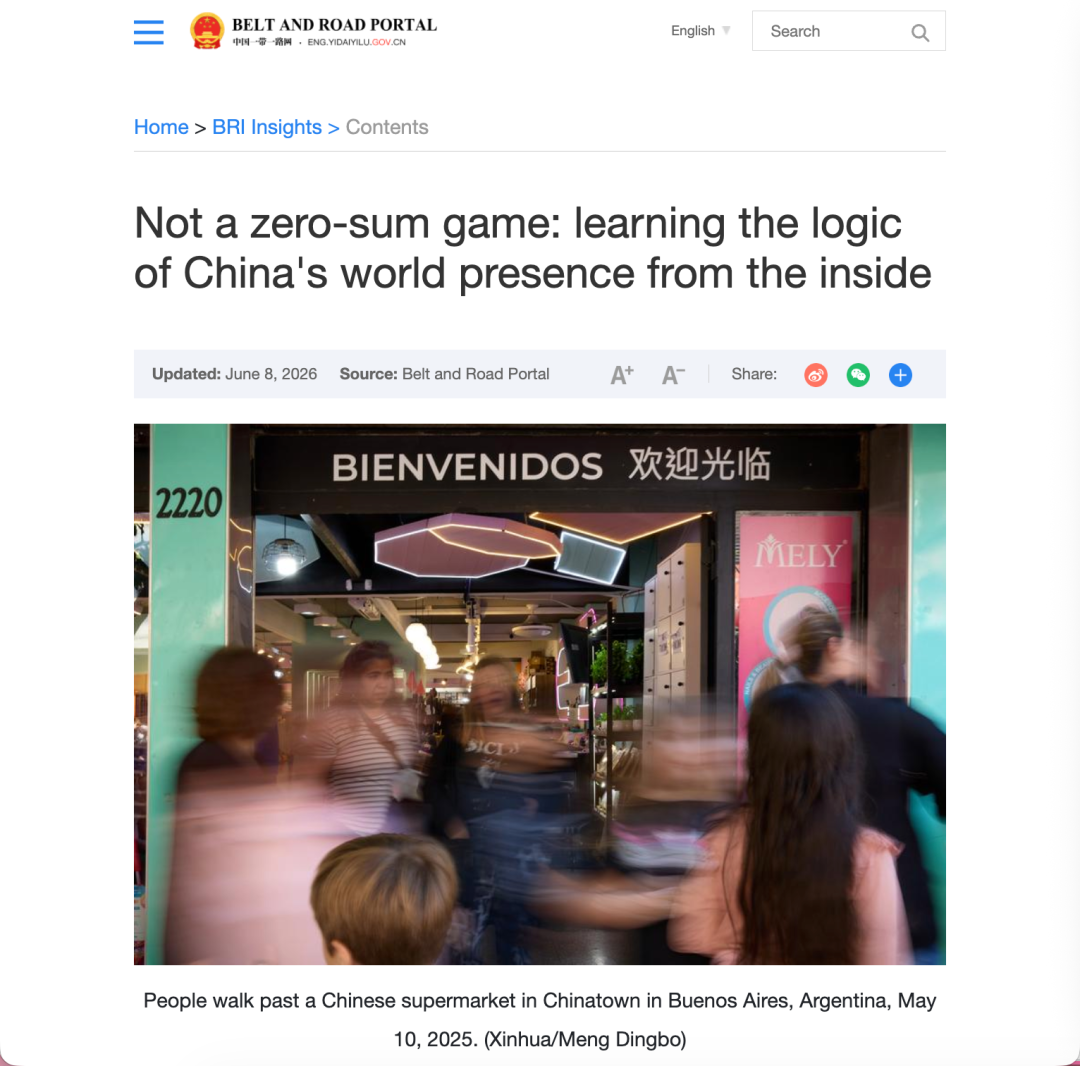
文章英文版于2026年6月8日发布在中国“一带一路”官网
有些理念,即便反复研读,也唯有亲身置身其中,方能真正领悟其精髓,“人类命运共同体”便是如此。我最初从文献中初识这一理念,在课堂上系统学习,最后在实践中深刻体会:这就是中国参与全球事务的内在逻辑。身处其中便能发现,这套逻辑有着完整的内在脉络,而外部视角的分析往往难以将其完整解读。
我来中国已有八个月,目前就读当代中国研究专业硕士学位。这段经历并未颠覆我既有的理论体系,却让我运用理论分析各类事务时,变得更加精准,共建“一带一路”倡议就是典型例证。2013年中国提出的“一带一路”倡议,现已发展成为21世纪最具影响力的全球公共产品之一。它搭建起涵盖实体与数字基础设施、物流通道、经济合作协定及融资工具的合作网络,覆盖全球150多个国家和地区。该倡议延续并创新了古代丝绸之路“互联互通驱动发展”的核心理念,却立足全新的地缘政治格局,当下,全球权力格局正经历深刻变革。
“一带一路”倡议,是中国国际合作理念的实际落地。这一理念认为,各国彼此依存不会带来风险,反而能筑牢稳定根基;广大发展中国家实现发展,是世界共同繁荣的前提,而非阻碍。
高质量共建“一带一路”也在不断拓展:早期主要建设港口、铁路、公路、电站等硬件设施,如今进入全新发展阶段,重点转向可持续发展、数字经济和能源转型领域。这样的转变绝非小修小补,体现出中国善于总结调整、不断发展。从外交研究视角来看,也能看出这项合作着眼长远,并不追求短期利益。
在中国实地研究这一理念,能让我从内部视角读懂它的真正内涵。我指的不是随处可查的官方言论,而是真实的学界思考:中国学者如何解读“一带一路”,研究机构怎样分析它现存的问题与发展方向,还有来自其他发展中国家的同窗,结合各自国情分享的看法。不同角度的观点碰撞,让人收获良多。
刚来中国时,我印象最深的,是这里做决策、看问题都具备长远眼光。长远规划不仅体现在国内发展上,也贯穿于对外合作当中。“一带一路”倡议的各个项目并非零散的短期合作,而是服务于数十年长远布局、互联互通的整体合作网络。
拉美参与“一带一路”倡议的时间晚于中亚和非洲,但相关合作早已融入稳步发展的中拉双边关系。目前,中国是多个南美国家的第一大贸易伙伴,也是整个拉美地区的第二大贸易伙伴。2025年中拉贸易额达5490亿美元,进一步说明双方经贸联系已进入高水平、结构化发展阶段。贸易格局的改变,不是短期政策调整带来的,而是长期发展形成的必然结果。拉美内部对这一结构性变化的讨论和政策适配仍在推进之中,主要因为当地分析对外关系的思路,形成于过往年代,适配的合作对象也和现在截然不同。
在“一带一路”框架下,拉美落地了港口、新能源电站以及矿业、现代农业等多个合作项目。这些项目精准解决了当地长期存在的难题:物流不畅、能源供给不足、自然资源加工能力薄弱等。这也彰显了“一带一路”倡议的初心:并非停留于单纯资源获取,而是着力帮助当地弥补基础设施、产业能力和发展条件短板,帮助拉美补齐发展短板、筑牢发展基础。这正是南南合作的应有之义——不贪图短期收益,而是携手谋求长远发展,实现互利共赢。
站在中国的视角能清晰看到,在如今太平洋物流网络中,拉美占据着重要区位,可当地还没有完全意识到这份价值。当前,跨太平洋与亚太方向贸易联系的重要性持续上升,锂、铜、绿氢等拉美战略资源,在全球能源转型中愈发关键,再加上南太平洋港口设施不断升级,多重有利条件汇聚在一起。对拉美来说,这是难得的长期发展机遇,而非转瞬即逝的商业机会。
对于历史发展轨迹特殊的拉美而言,人类命运共同体理念有着特别的意义:它倡导全新的国际关系相处模式,指出发展不是一方得益、一方受损的零和游戏。不同规模、不同议价能力的经济体之间,客观上存在发展差距,这一点无法改变。但这套理念带来了全新的合作思路,创造出传统合作模式无法实现的发展可能。
这一理念的核心内涵十分明确:气候变化、粮食危机、数字差距等全球性问题,没有任何一个国家能够独自解决。这个道理看似简单,却深刻改变了国际合作的方式。如今的合作更强调帮助合作方提升本地能力、促进技术交流、培育生产链和供应链能力。
数月的亲身经历让我明白,这套合作思路需要双方共同理解、携手践行,才能发挥实效。拉美拥有良好的合作基础:当地战略资源在全球能源转型中会愈发重要,其地理位置在太平洋贸易版图里也迎来新价值,同时新一代专业人才也在不断学习,力求吃透合作背后的逻辑。
所以,拉美要思考的不是要不要参与合作,而是该如何做好准备、从容参与。中拉合作也需重视债务、环境、产业升级和本地能力建设。而各类学术深造,包括来到中国学习,所能发挥的作用,也还有待我们进一步发掘。在这样的大环境下研究国际政治,不只是单纯的求学,更能让人以更透彻的眼光,去见证和参与未来数十年全球格局的重塑。对我来说,这八个月的读研时光,远不止一段学习经历,更让我找到了助力发展中国家深化合作的方向。
英文版原文
Not a zero-sum game: learning the logic of China's world presence from the inside
There are concepts one studies for years and only truly understands once one inhabits them. A community with a shared future for humanity is one of them. I first encountered it in the literature, then in the classroom, and finally in something harder to systematize: the logic with which China organizes its presence in the world, which from the inside acquires a coherence that external analyses rarely capture in full.
I have been in China for eight months, pursuing a master's degree in Contemporary Chinese Studies. What this experience has changed is not my theoretical frameworks but the precision with which I apply them to certain processes. The Belt and Road Initiative (BRI) is one of them.
The BRI was announced in 2013 and has since consolidated itself as one of the most influential public goods of the twenty-first century: a network of physical and digital infrastructure, logistical corridors, economic cooperation agreements and financing instruments that today involves more than 150 countries. Its architecture reproduces and updates the logic of the ancient Silk Road -- connectivity as a condition for development -- but in a radically different geopolitical context, one in which the global distribution of power is undergoing deep transformation.
The BRI is the operative expression of a vision of international order that China has been articulating with growing sophistication: one in which interdependence is not a source of vulnerability but of stability, and in which the development of Global South economies is a condition -- not an obstacle -- for global prosperity. The initiative has also been evolving. What began with a strong emphasis on physical infrastructure -- ports, railways, highways, energy plants -- has gradually shifted toward a more selective second phase, with greater attention to sustainability, the digital economy and the energy transition. That maturation is not a minor detail: it reflects a capacity for self-assessment and adjustment that, from a foreign policy analysis perspective, is indicative of an initiative with long-term ambitions rather than short-term impact.
Studying this in China provides a particular kind of access to how that vision is thought from within. I am not referring to the official discourse, which is accessible from anywhere, but to something more quotidian: the way Chinese academics analyze the initiative, the debates taking place within research centers about its limitations and evolution, and the way students from other Global South countries who share a classroom with me read it through their own national contexts. That multiplicity of perspectives is, in itself, instructive.
One of the things that struck me most upon arriving was the temporal scale with which politics is thought here. Long-term planning is not just a feature of China's domestic development model: it also permeates its conception of international cooperation. BRI projects are not designed as isolated interventions but as components of corridors that make sense over a horizon of decades.
For Latin America, the BRI arrived later than to Central Asia or Africa, but it is embedded in a bilateral relationship that has been growing consistently. China is today the main trading partner of several South American countries and the second largest for the region as a whole. This reconfiguration of trade flows is not the result of a recent policy shift: it is the sedimentation of a structural process that regional debate processes with a lag, partly because the categories through which Latin America reads its external relations were built in a different historical moment and in relation to different interlocutors.
The infrastructure projects developed under the BRI framework in the region -- ports, renewable energy plants, investments in mining and agribusiness -- share a common feature: they generally address deficits that the region has carried for decades -- logistical connectivity, energy capacity, value addition in natural resources. This is precisely the visionary nature of the BRI: instead of extracting the advantageous resources from developing countries, it builds up and addresses their disadvantages. This is what South-South Cooperation should look like: cooperation is not about short-term gains, but about pursuing long-term development and mutual benefit and win-win outcomes.
What is also visible from here is that Latin America occupies, in the new logistical map of the Pacific, a position whose value it has yet to fully internalize. The reorientation of trade routes toward the Indo-Pacific, the growing weight of Latin American strategic resources in the global energy transition -- lithium, copper, green hydrogen -- and the development of port infrastructure on the South Pacific coast are creating conditions that the region should read as a structural opportunity, not merely a commercial conjuncture.
The vision of a community with a shared future for humanity has a dimension that strikes me as especially significant for a region with Latin America's history: it proposes a framework for international relations in which development is not a zero-sum game. That does not dissolve the structural asymmetries that exist in any relationship between economies of different size and negotiating capacity. But it does establish a different grammar, one that opens possibilities that other frameworks foreclose.
The concept implies, in its most developed formulation, that global problems -- from climate change to food insecurity or the digital divide -- require responses that no single actor can build unilaterally. That premise, which at the philosophical level may seem self-evident, has concrete consequences for the architecture of agreements: it orients toward cooperation instruments that prioritize the building of local capacities, technology transfer and the development of productive chains rather than purely extractive relationships.
What these months have confirmed is that this grammar only works when both parties master it. Latin America has the conditions to participate in this relationship on favorable terms: strategic resources whose relevance to the global energy transition will only grow, a geographic position that is acquiring new value in the Pacific trade map, and a generation of professionals who are, increasingly, being trained with the tools to understand this process from the inside.
The relevant question, then, is not whether to engage but with what preparation to do so. And in that, academic training -- including training done in China -- has a role that we are still learning to leverage. Studying international politics in this context is not only an academic decision: it is also a way of being present, with greater analytical depth, in the processes that will define the global order of the coming decades. From that perspective, these eight months are not just a postgraduate experience. They are, also, a way of understanding how to improve the cooperation of developing countries.
注:本文作者阿古斯蒂娜・贝劳斯特吉(Agustina Beláustegui),阿根廷籍,现就读于中国人民大学丝路学院。本文仅代表作者个人观点,不代表中国人民大学立场。





















 京公网安备 11010802037854号