发布时间:2026-06-29 作者: 陆鹏
梳理两国交往历史就能看清脉络:孟加拉国民族主义党是推动孟中建交的核心力量。该党创始人、前总统齐亚・拉赫曼一手促成两国正式建立外交关系;卡莉达·齐亚领导下的两届民族主义党政府也与北京保持着友好的双边关系。
编者按:6月23日至26日,孟加拉国总理塔里克·拉赫曼对中国进行国事访问。在此之前,丝路学院2025届校友、孟加拉国籍学生陆鹏(MD Talebur Islam)在孟加拉国主流评论媒体Counterpoint发表署名文章《先访北京,再赴德里》(Beijing Before Delhi),就中孟双边自贸协定谈判、金融合作及区域互联互通等议题提出了前瞻性观察。现将文章译文及原文发布如下:(中文译文约3600字,预计阅读时间10分钟)
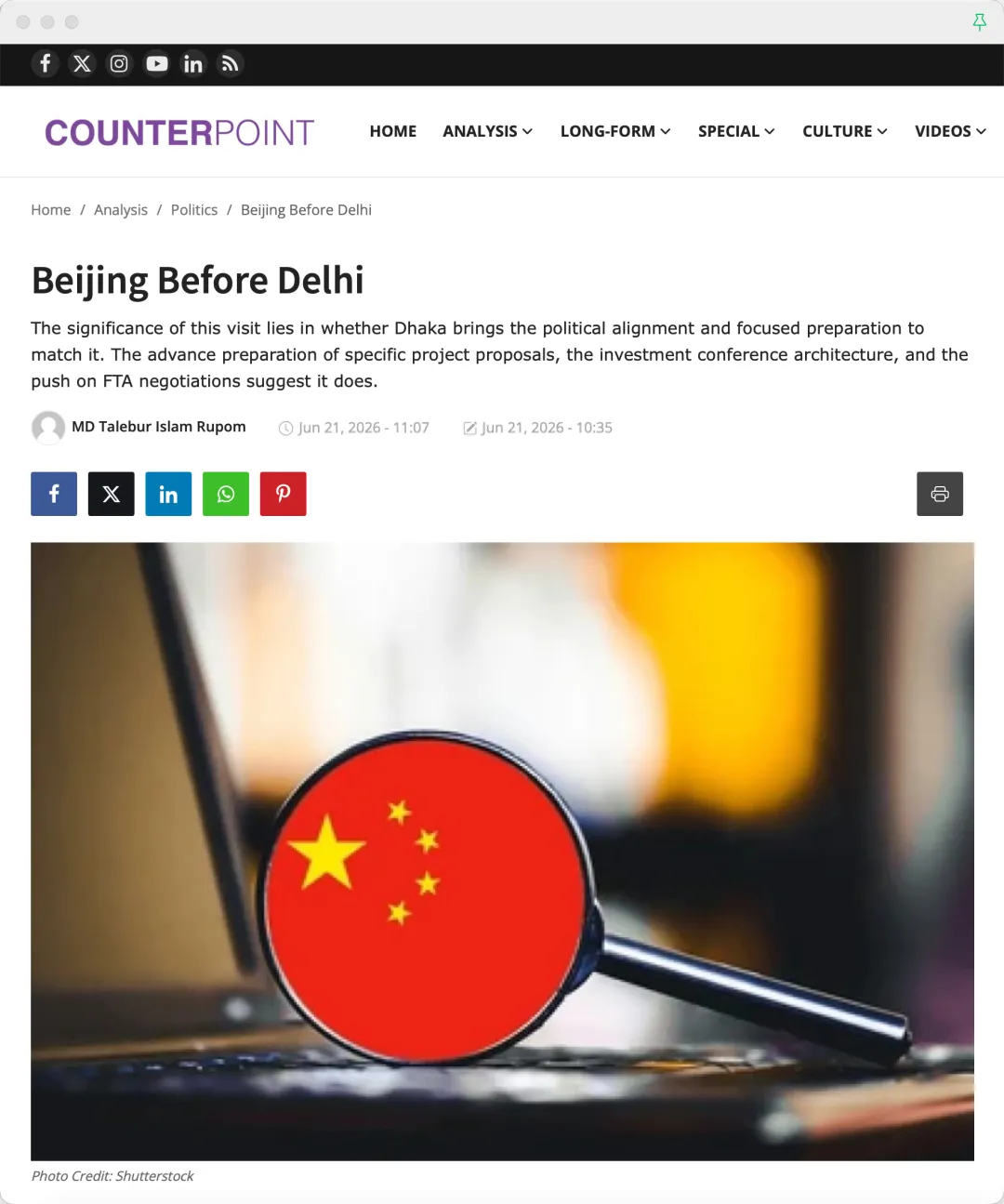
▲文章英文版于2026年6月21日发布在孟加拉国主流评论媒体Counterpoint
孟加拉国总理塔里克·拉赫曼将于6月23日至26日出访北京,此行释放的外交信号,远非任何外交公报所能涵盖。今年2月,孟加拉国民族主义党(Bangladesh Nationalist Party,BNP)以压倒性优势赢得大选;新政府上台后,将北京定为首个重大国事访问目的地,优先于德里、华盛顿及中东各国首都,象征意义十足。但若透过表象深入观察,便会发现孟加拉国与中国的关系,远比各类媒体报道呈现的更为立体多元。
一、民族主义党长期对华友好,亲近中国并非权宜之计
梳理两国交往历史就能看清脉络:孟加拉国民族主义党是推动孟中建交的核心力量。该党创始人、前总统齐亚・拉赫曼一手促成两国正式建立外交关系;卡莉达·齐亚领导下的两届民族主义党政府也与北京保持着友好的双边关系。所谓流传“民族主义党对中国心存戒备”的说法,很大程度上是哈西娜执政阶段政党博弈催生的舆论说辞,而非该党根本性的外交政策取向。
在谢赫·哈西娜执政的15年间,中国连续十五年稳居孟加拉国第一大贸易伙伴,同时也是孟加拉国最大的外资来源国。2015至2025年,中方企业向孟加拉国基建、制造业承诺投资总额超300亿美元;2025年3月,孟加拉国临时政府首席顾问穆罕默德·尤努斯与习近平主席会晤时,中国对孟加拉国的投资总额已接近420亿美元。如今塔里克·拉赫曼领导的新一届政府,继承了这份深厚而持久的中孟经济伙伴关系,同时也延续了民族主义党一脉相承的对华友好传统。
二、多项大额合作待推进,此次访华洽谈目标明确
孟加拉国目前有总额超90亿美元的融资项目等待落地,资金分为三大来源:中国政府专项项目贷款43.4亿美元、亚洲基础设施投资银行贷款38亿美元、金砖国家新开发银行贷款12亿美元。
双方重点推进项目涵盖蒂斯塔河综合治理修复工程、蒙格拉港升级改造、吉大港中国经济产业园区,以及新建铁路、数字互联互通配套设施等。6月24日,孟加拉国在北京举办投资合作洽谈会,总理作为首席嘉宾出席。
中国也出台了全面合作规划:中国国家发展和改革委员会提议将共建“一带一路”合作领域拓展至23个细分行业。合作内容不再只局限于修路、造桥、建设发电厂等传统基建,新增数字经济、绿色低碳发展、医疗卫生、海洋经济、跨境电商板块,同时启动孟加拉国新能源汽车产业链前期合作。
三、布局自贸协定,提前化解出口关税优惠到期风险
孟加拉国积极推进中孟自贸协定谈判,是着眼未来的长远战略安排。孟加拉国原本即将脱离最不发达国家行列,经多方争取获得三年过渡期,时间延后至2029年11月。过渡期结束后,孟加拉国服装等主力出口商品将不再享受关税减免政策,这一挑战必须提前谋划应对。
赶在优惠政策失效前敲定双边自贸协定,是此次总理访华的核心目标之一。与此同时,中方还提议签署货币互换协议与银行金融合作谅解备忘录,为构建全方位、多层次的中孟经济合作体系筑牢根基。
四、复盘2016至2024年往来:政治互信深度决定合作上限
梳理2016到2024年两国交往历程,能为本次达卡高层访华提供关键借鉴。
2016年10月,习近平主席访问达卡,这是三十年来中国国家元首首次访问孟加拉国,具有里程碑意义。双方签署27份合作文件,敲定244.5亿美元优惠贷款,以及136亿美元民间合资项目;孟加拉国正式加入共建“一带一路”倡议,卡纳普里河多通道隧道启动建设,中国专属经济特区同步落地。单这一次访问,中国就做出了孟加拉国建国以来规模最大的海外投资承诺。
但此后八年的合作实践证明,经贸合作能走多远,根基在于稳定对等的政治互信。哈西娜政府一边持续引入中方大规模基建投资,一边在核心外交议题上持续向印度倾斜。与之不同,塔里克·拉赫曼领导的新一届政府没有相关历史外交包袱:民族主义党过往执政期间,从未像哈西娜政府那样长期在外交上迁就印度。这份独立自主的外交空间,反而成为本次孟加拉国访华最突出的优势。
孟方提前梳理完整项目清单、筹备专项投资洽谈会、加速推进自贸协定磋商,种种筹备动作都说明,此次访华重在落地实打实的合作成果,而非仅开展礼节性外交活动。
五、全方位深耕政党与民间交流,搭建多层级沟通体系
中国对孟加拉国的合作布局,不仅聚焦经贸项目,更长期深耕多层级、全覆盖的政党与民间交流,这也是常被外界忽视的核心优势。
自2024年8月以来,中国与孟加拉国就建立了常态化高层沟通机制。2024年末,孟加拉国民族主义党、伊斯兰大会党代表团相继应邀访华;2025年2月,由8个政党、22名代表组成的跨党派代表团来华开展为期13天的深度交流。2026年4月,民族主义党总书记、地方政府部部长米尔扎·法赫鲁尔·伊斯兰·阿拉姆吉尔率高层代表团访华,与中国国家副主席韩正和中共中央对外联络部部长刘海星举行会晤,双方商定推进政党制度化交流、签署常态化合作谅解备忘录。2026年5月,孟加拉国外长应王毅外长邀请访华;6月10日至13日,孟加拉国议会代表团赴昆明出席中国—南亚合作论坛,持续夯实双边官方沟通纽带。
除政党交往外,双方人才合作也成果丰硕。据中国驻孟加拉国大使馆2025年数据,目前约有2万名孟加拉国留学生在华求学。这种面向青年一代的长效人才培育,是无法用贸易数据量化的深度合作。中方对孟合作始终保持高度连续性,不随孟加拉国政权更迭而变动,坚持维系各层级稳定往来,充分彰显了中方深耕中孟伙伴关系的长远战略考量。
六、两大核心战略项目,破解民生难题、打通区域通道
本次访华行程中,两大重点项目极具战略价值,分别聚焦民生水资源保障与区域互联互通格局。
其一为蒂斯塔河综合治理修复项目,这是孟加拉国民众高度关注的民生核心议题。印度数十年来始终未能落地蒂斯河河分水协议,导致孟加拉国北部水资源难题长期悬而未决。中方主动提供完整、可落地的综合治理方案,助力孟方破解多年民生困境。该流域覆盖朗布尔专区等北部核心区域,项目落地拥有深厚民意基础。加之2026年孟印《恒河分水条约》即将到期续签,进一步凸显了孟加拉国水资源外交的迫切性。
其二为孟中缅公路互联互通走廊,这是惠及长远的区域战略工程。通道联通中国昆明与孟加拉湾,打通中国云南与南亚的陆路大动脉,串联起亚洲两大高速增长经济板块,可为周边国家带来长期共赢红利。依托“一带一路”合作框架,中方还同步提出孟加拉湾蓝色经济合作、蒙格拉港现代化升级等合作规划,助力两国携手共建全新的区域海洋发展格局。
七、本次访华核心看点:务实落地,开启合作新局
塔里克·拉赫曼总理带着十余年来孟加拉国最强大选民意支持,携90亿美元发展合作清单抵达北京,既直观体现了孟加拉国迫切的发展需求,也充分彰显了孟方对中孟合作的十足信心。
中孟数十年的合作根基历经多届政府更迭,稳固且扎实。本次访问的核心价值,不在于发布形式化的联合声明,而在于孟加拉国新一届政府秉持独立自主外交立场,做好了充足筹备,全力对接中方合作布局。
从提前细化项目方案、筹办专项投资洽谈会,到加速推进自贸协定谈判,一系列务实筹备都表明,孟方此次访华重实效、求共赢,绝非礼节性走场。
英文版原文
Beijing Before Delhi
When Bangladesh's Prime Minister Tarique Rahman boards a flight to Beijing between June 23 and 26, he will be making a statement that no diplomatic communiqué could fully capture. A BNP-led government choosing Beijing as its first major state visit destination ahead of any other capital, such as Delhi, Washington, or Middle Eastern ones, after a landslide election victory last February, is certainly optics-rich. But anyone who looks beyond the symbolism will find a story that has been quietly building for years.
Bangladesh's relationship with China has always been more complicated than the headlines suggest.
The political history is worth recalling. The Bangladesh Nationalist Party (BNP) is not a newcomer to this relationship. Late President Ziaur Rahman, the party's founder, was instrumental in establishing Bangladesh-China diplomatic ties, and both BNP governments under Khaleda Zia maintained warm bilateral relations with Beijing. The narrative of BNP skepticism toward China was largely a product of domestic political positioning during the Hasina years, not a fundamental foreign policy orientation.
During the 15 years Sheikh Hasina held power, China became Bangladesh's largest trading partner, a position it has held for 15 consecutive years, and its single largest source of external financing. Between 2015 and 2025, Chinese investors committed over $30 billion to Bangladesh's infrastructure and manufacturing sectors, and by March 2025, when Chief Adviser Muhammad Yunus met President Xi Jinping, total Chinese investment had reached nearly $42 billion.
The political reality during those years, however, told a different story. Hasina's government was economically intertwined with China while being politically anchored to India. Delhi commanded the political relationship; Beijing built the infrastructure. The Tarique Rahman government has inherited a deep and durable economic partnership with China that successive governments have only sought to deepen.
What the Numbers Say
Bangladesh currently has financing proposals exceeding $9 billion pending across three institutions: $4.34 billion in project loans from the Chinese government, $3.8 billion through the Asian Infrastructure Investment Bank, and $1.2 billion from the New Development Bank. Priority projects include the Teesta River Comprehensive Management and Restoration Project, Mongla Port modernisation, a Chinese Economic and Industrial Zone in Chattogram, and new railway and digital connectivity infrastructure. An investment conference is scheduled in Beijing on June 24, with the Prime Minister attending as the chief guest.
China has arrived with its own ambitious agenda. Beijing's National Development and Reform Commission has submitted a plan proposing to expand BRI engagement across 23 specific sectors, going well beyond the roads, bridges, and power plants of earlier years to include the digital economy, green development, healthcare, maritime cooperation, cross-border e-commerce, and early-stage cooperation in Bangladesh's emerging electric vehicle ecosystem.
The FTA Calculation
Bangladesh's appetite for an FTA with China speaks to a longer-term structural calculation. The country has just secured a three-year deferral of its Least Developed Country graduation to November 2029, but the eventual loss of preferential trade treatment for its exports, particularly garments, remains on the horizon. Locking in an FTA with the world's second-largest economy before that transition arrives is precisely the kind of forward positioning this visit creates the opportunity to begin. China has also proposed a currency swap arrangement and a memorandum of understanding on banking and financial cooperation, the building blocks of a more comprehensive bilateral economic architecture.
From 2016 to 2024: What the Record Shows
The history of this relationship contains a lesson both sides carry into Beijing this month.
When President Xi Jinping visited Dhaka in October 2016, the first visit by a Chinese president in three decades, the two countries signed 27 agreements unlocking $24.45 billion in soft loans alongside $13.6 billion in private joint ventures. Bangladesh joined the BRI, the Karnaphuli Multi-Lane Tunnel was launched, and a dedicated Chinese SEZ was announced. In a single visit, China made the largest investment commitment Bangladesh had ever received from any country in its history.
What the eight years that followed demonstrated is that economic depth ultimately depends on the political alignment that sustains it. Hasina's government accepted China's investment while consistently delivering India political deference.
Beijing's People-to-People Engagement
There is another dimension to China's Bangladesh strategy that rarely gets the attention it deserves. Since August 2024, Beijing has been systematically building connections across Bangladesh's entire political spectrum. Delegations from Jamaat-e-Islami and BNP both visited China at the Communist Party of China's invitation in late 2024, followed in February 2025 by a 22-member cross-party delegation spanning eight political organisations on a 13-day trip. In April 2026, a high-level BNP delegation led by Secretary General and LGRD Minister Mirza Fakhrul Islam Alamgir met Chinese Vice President Han Zheng and CPC International Department Minister Liu Haixing in Beijing, agreeing to work toward a formal MoU on inter-party institutional exchanges. Bangladesh's Foreign Minister visited Beijing in May 2026 at Wang Yi's personal invitation, and as recently as June 10 to 13, a parliamentary delegation attended the China-South Asia Cooperation Forum in Kunming.
Beyond political delegations, Chinese Ambassador Yao Wen stated in 2025 that approximately 20,000 Bangladeshi students are currently enrolled in Chinese universities, a generational investment that no trade statistic can fully capture. What distinguishes China's approach is this continuity: Beijing has invested in the relationship at every level regardless of who holds office in Dhaka, and that long-term orientation is the clearest measure of how seriously Beijing takes this partnership.
Teesta, the Corridor, and the Bay
Two projects sit at the strategic heart of this visit. The Teesta River Comprehensive Management and Restoration Project remains the most politically charged item on the agenda. India had decades to deliver a Teesta water-sharing agreement and consistently failed. China stepped in with a concrete proposal, offering Bangladesh a practical pathway toward a challenge that had gone unresolved for too long. For the northern districts, particularly across the Rangpur division, the political resonance is considerable. The Ganga Water Sharing Treaty with India is also due for renewal in 2026, adding further urgency to Bangladesh's water diplomacy.
The second project with long-run significance is the Bangladesh-China-Myanmar road connectivity corridor extending to Kunming, which would open an overland trade route between Yunnan province and the Bay of Bengal, connecting two of Asia's fastest-developing economic regions with lasting mutual benefits. China's proposed BRI framework further includes Bay of Bengal blue economy cooperation and Mongla Port modernisation, positioning both countries as co-architects of the region's maritime future.
What to Watch
Prime Minister Tarique Rahman arrives in Beijing with a stronger electoral mandate than any Bangladeshi leader has carried in over a decade, and with a $9 billion development agenda that reflects both the scale of Bangladesh's needs and the depth of its confidence in this partnership. China's long-standing commitment to Bangladesh's development is well documented, built across decades and governments. The significance of this visit lies in whether Dhaka brings the political alignment and focused preparation to match it. The advance preparation of specific project proposals, the investment conference architecture, and the push on FTA negotiations suggest it does.
注:本文作者MDTaleburIslam(陆鹏),中国人民大学丝路学院2025届毕业生,孟加拉地缘政治分析师、国际关系评论员、专栏作者。仅代表作者个人观点,不代表中国人民大学立场。





















 京公网安备 11010802037854号