发布时间:2026-05-18 作者: 金臻
5月15日,中国人民大学重阳金融研究院助理研究员金臻在中国日报发表英文文章表示,中美各自拥有比较优势,若能优势互补,将能力存量转化为合作增量,将为世界提供更多实实在在的公共产品,也将为中美关系拓展新的合作空间。
编者按:5月15日,中国人民大学重阳金融研究院助理研究员金臻在中国日报发表英文文章表示,中美各自拥有比较优势,若能优势互补,将能力存量转化为合作增量,将为世界提供更多实实在在的公共产品,也将为中美关系拓展新的合作空间。现将中文译文及英文原文发布如下:(中文译文约2600字,预计阅读时间7分钟)
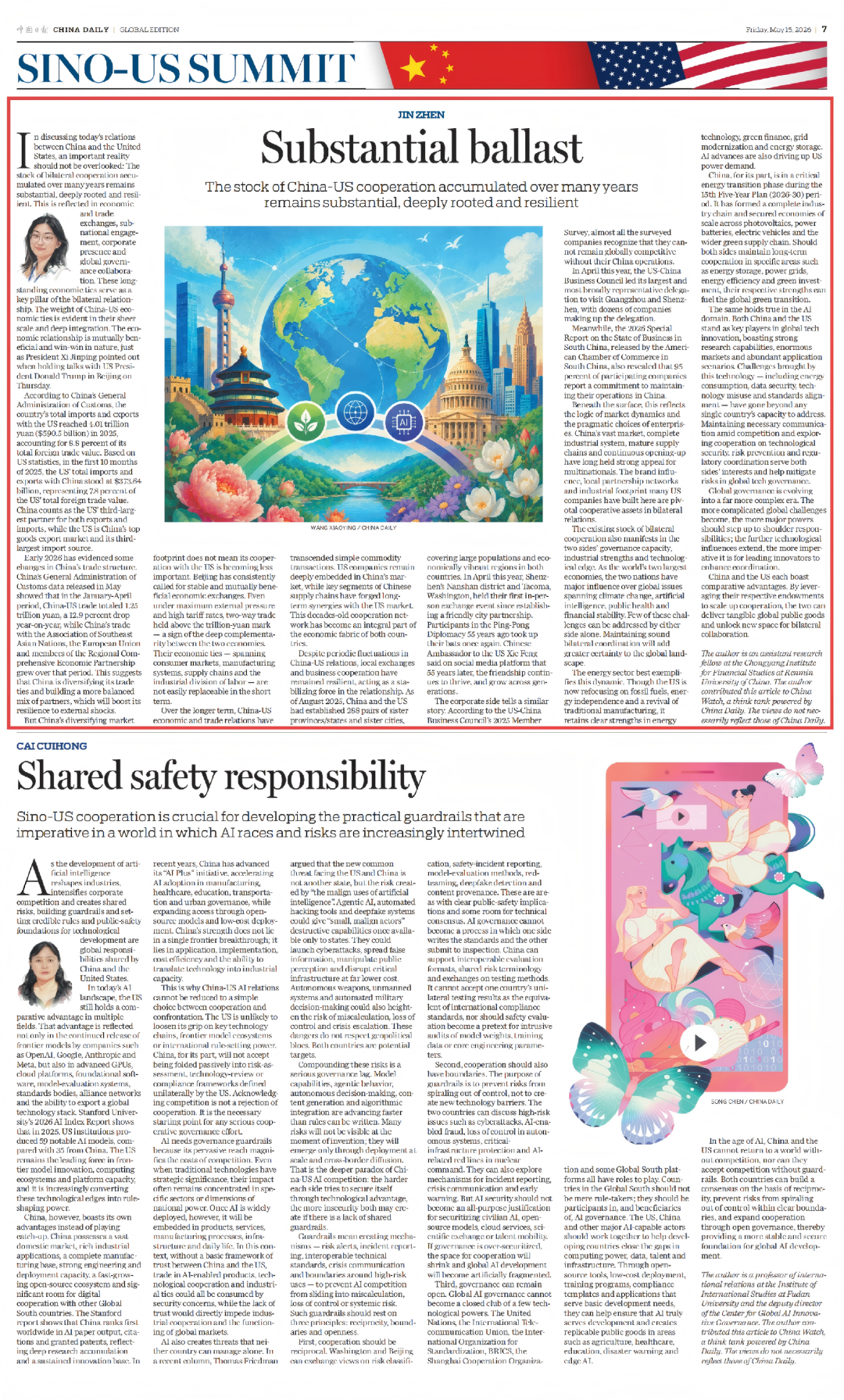 ▲英文原文发表于《China Daily》2026年5月15日07版
谈及当今的中美关系,一个重要的现实不应被忽视:中美历经半个多世纪积累下来的合作存量依然庞大、深厚且富有韧性。它体现在经贸往来、地方交流、企业布局,以及全球治理合作之中。这些长期形成的联系,构成了中美关系的重要支撑。
中美经贸关系的分量,首先体现在规模之大、嵌入之深。正如习近平主席最近同来华进行国事访问的美国总统特朗普会谈时指出,中美经贸关系的本质是互利共赢。据中国海关总署统计,2025年全年中国对美国贸易额达4.01万亿元人民币,占进出口总值的8.8%;按美方统计,2025年前10个月美国对中国进出口3736.4亿美元,占美国进出口总值的7.8%。中国是美国第三大出口目的地国和第三大进口来源国,美国则是中国第一大货物出口目的地国和第三大进口来源国。
进入2026年,中美贸易部分数据出现波动。据海关总署5月9日发布的数据,今年前四个月中美贸易额为1.25万亿元,同比下降12.9%。与此同时,中国对东盟、欧盟以及RCEP成员国的贸易继续保持增长。这说明,中国外贸伙伴结构更趋多元,市场布局更为均衡,也具备了更强的抗风险能力。
但中国市场布局的多元化调整,并不意味着中美合作的重要性在下降。中方始终主张在相互尊重的基础上推进正常经贸往来。即便在外部干扰最强、关税压力最大的阶段,中美贸易依然维持在万亿元量级,证明了两国经济之间存在深度互补关系。无论是消费市场、制造体系、供应链协作还是产业分工,中美之间长期形成的联系,短时间内都难以替代。
放在更长周期看,中美经贸关系也早已超越简单的商品买卖。大量美国企业深度参与中国市场,大量中国产业链与美国市场形成长期协同。这种经过几十年积累形成的合作网络,已经成为两国经济结构中的重要组成部分。
虽然中美宏观政治关系时有波动,但地方交流与企业合作仍保有韧性,也更能体现中美关系中的稳定力量。截至2025年底,中美之间已建立288对友好省州和友好城市,覆盖两国大量人口与经济活跃区域。今年4月,深圳南山区与美国华盛顿州塔科马市举办结为“国际友好交流城区”后的首次线下交流活动,55年前“乒乓外交”的亲历者再次挥拍。中国驻美大使谢锋在海外社交平台感慨:“55载岁月流转,这份友谊历久弥坚、代代相传。”
企业层面的情况同样能够说明问题。美中贸易全国委员会《中国商业环境调查2025》报告显示,几乎所有受访企业都认可在华业务对其维系自身全球竞争力不可或缺。今年4月,美中贸易全国委员会代表团访问广东,成员包括通用电气能源、美国银行、高通公司等43家知名企业,是其成立以来规模最大、覆盖行业最广的一支代表团。该委员会会长谭森在中国发展高层论坛2026年年会期间接受新华社采访时表示:“美国的CEO们对中国充满了热情。”华南美国商会发布的《2026年华南地区经济情况特别报告》也显示,95%的受访企业表示将坚定不移地继续深耕中国市场。
这背后体现的是市场规律和企业的现实选择。中国超大规模的市场、完整的产业体系、成熟的供应链能力,以及持续扩大的开放空间,对跨国企业始终具有吸引力。大量美企在中国积累的品牌影响力、地方合作网络和产业布局,本身就是中美关系中的重要合作资产。
中美之间的合作存量,也体现在两国各自拥有的治理能力、产业优势和技术水平之中。作为世界前两大经济体,中美在气候变化、人工智能 (AI)、公共卫生、金融稳定等全球性议题上都具有重要影响。很多问题单靠任何一方都难以解决,若中美能够保持必要协调,将为世界注入更多确定性。
能源领域最能说明这一点。虽然美国当前重新强调化石能源、能源独立和传统制造业回流,但在能源科技、绿色金融、电网升级、储能技术等方面仍具优势,AI技术的快速发展也正在推高其电力需求。中国则进入“十五五”能源转型关键阶段,并在光伏、动力电池、电动车、绿色供应链等领域已形成完整产业链和规模优势。中美若能在储能、电网、能效、绿色投资等具体领域保持长期合作,将有助于把各自优势转化为全球绿色转型的推动力。
AI领域同样如此。中美都是全球AI技术发展的重要力量,拥有领先的科研能力、超大的市场和丰富的应用场景。AI带来的能源消耗、数据安全、技术滥用、标准协调等问题,已超出单一国家应对能力。双方在竞争中保持必要沟通,围绕技术安全、风险防范和规则协调探索合作,既符合各自利益,也有助于降低全球科技治理风险。
全球治理正在进入更加复杂的新阶段。问题越复杂,越需要主要大国拿出责任担当;技术影响越深远,越需要主要创新力量加强协调。中美各自拥有比较优势,若能优势互补,将能力存量转化为合作增量,将为世界提供更多实实在在的公共产品,也将为中美关系拓展新的合作空间。
英文原文
In discussing today's relations between China and the United States, an important reality should not be overlooked: The stock of bilateral cooperation accumulated over many years remains substantial, deeply rooted and resilient. This is reflected in economic and trade exchanges, subnational engagement, corporate presence and global governance collaboration. These long-standing economic ties serve as a key pillar of the bilateral relationship. The weight of China-US economic ties is evident in their sheer scale and deep integration. The economic relationship is mutually beneficial and win-win in nature, just as President Xi Jinping pointed out when holding talks with US President Donald Trump in Beijing on Thursday.
According to China's General Administration of Customs, the country's total imports and exports with the US reached 4.01 trillion yuan ($590.5 billion) in 2025, accounting for 8.8 percent of its total foreign trade value. Based on US statistics, in the first 10 months of 2025, the US' total imports and exports with China stood at $373.64 billion, representing 7.8 percent of the US' total foreign trade value. China counts as the US' third-largest partner for both exports and imports, while the US is China's top goods export market and its third-largest import source.
Early 2026 has evidenced some changes in China's trade structure. China's General Administration of Customs data released in May showed that in the January-April period, China-US trade totaled 1.25 trillion yuan, a 12.9 percent drop year-on-year, while China's trade with the Association of Southeast Asian Nations, the European Union and members of the Regional Comprehensive Economic Partnership grew over that period. This suggests that China is diversifying its trade ties and building a more balanced mix of partners, which will boost its resilience to external shocks.
But China's diversifying market footprint does not mean its cooperation with the US is becoming less important. Beijing has consistently called for stable and mutually beneficial economic exchanges. Even under maximum external pressure and high tariff rates, two-way trade held above the trillion-yuan mark — a sign of the deep complementarity between the two economies. Their economic ties — spanning consumer markets, manufacturing systems, supply chains and the industrial division of labor — are not easily replaceable in the short term.
Over the longer term, China-US economic and trade relations have transcended simple commodity transactions. US companies remain deeply embedded in China's market, while key segments of Chinese supply chains have forged long-term synergies with the US market. This decades-old cooperation network has become an integral part of the economic fabric of both countries.
Despite periodic fluctuations in China-US relations, local exchanges and business cooperation have remained resilient, acting as a stabilizing force in the relationship. As of August 2025, China and the US had established 288 pairs of sister provinces/states and sister cities, covering large populations and economically vibrant regions in both countries. In April this year, Shenzhen's Nanshan district and Tacoma, Washington, held their first in-person exchange event since establishing a friendly city partnership. Participants in the Ping-Pong Diplomacy 55 years ago took up their bats once again. Chinese Ambassador to the US Xie Feng said on social media platform that 55 years later, the friendship continues to thrive, and grow across generations.
The corporate side tells a similar story. According to the US-China Business Council's 2025 Member Survey, almost all the surveyed companies recognize that they cannot remain globally competitive without their China operations.
In April this year, the US-China Business Council led its largest and most broadly representative delegation to visit Guangzhou and Shenzhen, with dozens of companies making up the delegation.
Meanwhile, the 2026 Special Report on the State of Business in South China, released by the American Chamber of Commerce in South China, also revealed that 95 percent of participating companies report a commitment to maintaining their operations in China.
Beneath the surface, this reflects the logic of market dynamics and the pragmatic choices of enterprises. China's vast market, complete industrial system, mature supply chains and continuous opening-up have long held strong appeal for multinationals. The brand influence, local partnership networks and industrial footprint many US companies have built here are pivotal cooperative assets in bilateral relations.
The existing stock of bilateral cooperation also manifests in the two sides' governance capacity, industrial strengths and technological edge. As the world's two largest economies, the two nations have major influence over global issues spanning climate change, artificial intelligence, public health and financial stability. Few of these challenges can be addressed by either side alone. Maintaining sound bilateral coordination will add greater certainty to the global landscape.
The energy sector best exemplifies this dynamic. Though the US is now refocusing on fossil fuels, energy independence and a revival of traditional manufacturing, it retains clear strengths in energy technology, green finance, grid modernization and energy storage. AI advances are also driving up US power demand.
China, for its part, is in a critical energy transition phase during the 15th Five-Year Plan (2026-30) period. It has formed a complete industry chain and secured economies of scale across photovoltaics, power batteries, electric vehicles and the wider green supply chain. Should both sides maintain long-term cooperation in specific areas such as energy storage, power grids, energy efficiency and green investment, their respective strengths can fuel the global green transition.
The same holds true in the AI domain. Both China and the US stand as key players in global tech innovation, boasting strong research capabilities, enormous markets and abundant application scenarios. Challenges brought by this technology — including energy consumption, data security, technology misuse and standards alignment — have gone beyond any single country's capacity to address. Maintaining necessary communication amid competition and exploring cooperation on technological security, risk prevention and regulatory coordination serve both sides' interests and help mitigate risks in global tech governance.
Global governance is evolving into a far more complex era. The more complicated global challenges become, the more major powers should step up to shoulder responsibilities; the further technological influences extend, the more imperative it is for leading innovators to enhance coordination.
China and the US each boast comparative advantages. By leveraging their respective endowments to scale up cooperation, the two can deliver tangible global public goods and unlock new space for bilateral collaboration.






















 京公网安备 11010802037854号