Commentaries
Your Present Location: Teacher_Home> Wang Wen> CommentariesThe End of Western Decoupling From China
The End of Western Decoupling From China
The British prime minister’s arrival in Beijing signified a structural shift in Western policy toward China – and the end of a strategic narrative of containment.
Source: The Diplomat
Update: Jan 29th 2026
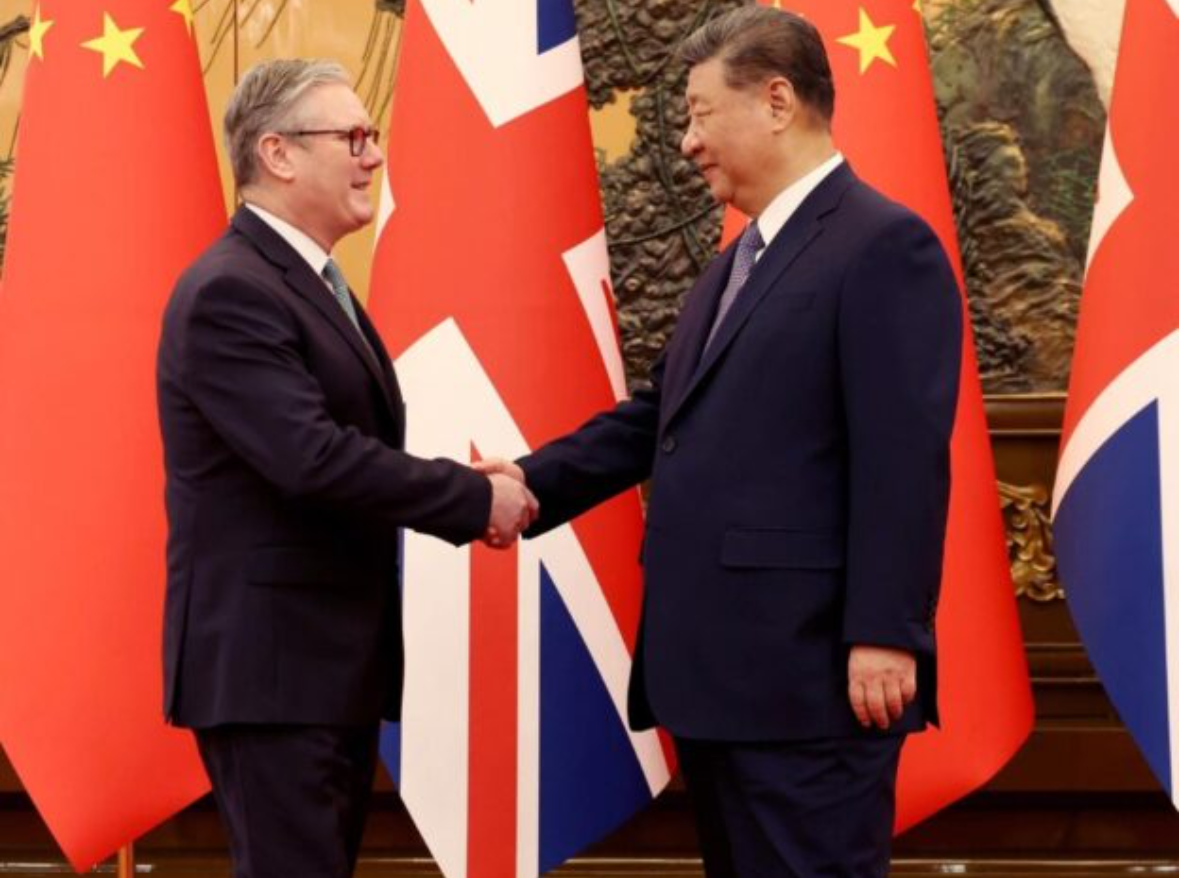
British Prime Minister Kei Starmer shakes hands with Chinese President Xi Jinping during their summit meeting in Beijing, China, Jan. 29, 2026.
British Prime Minister Keir Starmer’s visit to China this week brought the next round of pragmatic cooperation between the more than 50 leading British companies accompanying him and China. More than that, it also signified the end of Western attempts to decouple from China. January 2026 is thus destined to be written into history books as a turning point in global geopolitics.
This is the first visit to China by a British prime minister in eight years. Two weeks ago, Canadian Prime Minister Mark Carney also visited China – the first such trip in nine years. In 2018, Canada, at the behest of the United States, detained Huawei executive Meng Wanzhou at the airport, plunging Sino-Canadian relations into a deep freeze. A few months later, then-British Prime Minister Theresa May ended her term, and Sino-British relations ended their “golden age” and plunged into an “ice age.”
For the next eight years, Canada and the United Kingdom – the two most loyal allies of the United States – closely followed Washington’s competitive strategy against China on many issues such as trade, technology, and human rights. The effort went beyond these three partners to include the European Union, Australia, Japan, and South Korea. The West was attempting to construct a system of blockade against China, or even a new Cold War.
The narrative of a potential new Cold War has persisted in Western media ever since – until January 2026. This underscores the significant meaning of Starmer’s visit to China.
Starmer’s arrival in Beijing was not merely about pragmatic bilateral cooperation driven by commercial interests. It signified a structural shift in Western policy toward China – and the end of a strategic narrative of containment.
Of course, the rigid demands of economic interests have long rendered the containment strategy a self-inflicted wound. Since his election in 2024, Starmer has prioritized improving relations with China, with his core objective being to leverage the Chinese market to fulfill his campaign promise of “improving people’s livelihoods.” Behind this choice lies a community of shared interests built upon $103.7 billion in bilateral trade in goods and nearly $68 billion in two-way investment. China, as the United Kingdom’s fourth-largest trading partner, provides a crucial engine for the struggling British economy.
The latest consensus in Western business circles is that “decoupling” from China is impossible. Instead, the focus has turned to best promote trade. This consensus forms the underlying logic for the collapse of the Western blockade.
This reshaping of the geopolitical landscape is eroding the Western bloc’s previous united front against China. Starmer’s statement to the media on the eve of his visit to China that “Britain will not simply choose between great powers” is clear evidence of the widening rift in Western policy toward China.
Clearly, Starmer’s visit to China highlights a significant shift in British foreign policy. London is reassessing its global partnerships in light of geopolitical changes, and this shift is not unique to the United Kingdom.
Starmer’s actions demonstrate a new trend for middle powers to defend their interests through diversified partnerships. The series of visits to China by leaders of U.S. allies since December 2025 – including French President Emmanuel Macron, South Korean President Lee Jae-myung, Canadian Prime Minister Mark Carney, Irish Prime Minister Micheál Martin, and Finnish Prime Minister Petteri Orpo – outlines a collective alienation from the U.S.-dominated alliance order.
Against the backdrop of the Trump administration’s frequent threats of tariffs against allies, Britain’s renewed cooperation with China is essentially a strategic choice to hedge against U.S. uncertainty. This autonomous decision based on the U.K.’s own interests is a fundamental rejection of the logic of containment and signifies the end of the strategic imagination of a “new Cold War.”
The practical needs of global governance are a key reason why the containment strategy has lost its legitimacy. China and the U.K. share similar positions on global issues such as artificial intelligence, climate change, and public health, and cooperation in these areas is precisely the key to ending the containment strategy.
Starmer reiterated the narrative that all U.S. allies repeat when visiting China: China will bring “significant opportunities” to their companies, opportunities that lie precisely in collaborative solutions to global problems.
China has continuously consolidated its core global position in areas such as rare earths, biotechnology, and supply chains. Many international observers acknowledge that the West needs China more than China needs the West, a judgment that reveals the fatal flaw of the containment strategy. Faced with global challenges, any exclusive isolation policy is destined to fail.
From this perspective, Starmer’s visit to China marks not only a restart of Sino-British bilateral relations but also a return to the concept of “win-win cooperation” in global governance. The trajectory of Britain’s China policy – from a “golden age” to an “ice age” and now the current pragmatic return of “firmness and maturity” – is a microcosm of the Western containment strategy’s rise and fall.
The heated discussions in Western media sparked by Starmer’s visit are essentially an ideological clash about the future of the global order. More and more Western observers are beginning to recognize, as Starmer has, the necessity of establishing a “serious and pragmatic” relationship with China. When the triple logic of commercial interests, geopolitical autonomy, and global governance all point to cooperation rather than confrontation, the Western strategy of containing China collapses quickly.
That’s why Chinese leaders have been very busy in January 2026 hosting a succession of U.S. allies in Beijing.
In today’s world, where economic globalization is irreversible and global challenges are increasingly severe, a clear signal is emerging: the Western world is moving away from the illusion of bloc confrontation. A new era centered on pragmatic cooperation and pluralistic coexistence has arrived.
Key Words: China, UK, Visit





















































































 京公网安备 11010802037854号


