Commentaries
Your Present Location: Teacher_Home> Vijay Prashad> CommentariesSenegal on the Edge of Collapse
Senegal on the Edge of Collapse
Burdened by decades of neocolonialism and corruption, Senegal faces an all-too-familiar dilemma faced by countries across the Global South: how to pursue sovereign development under the weight of debt.
Source: Sri Lanka Guardian
Update: Mar 27th, 2026
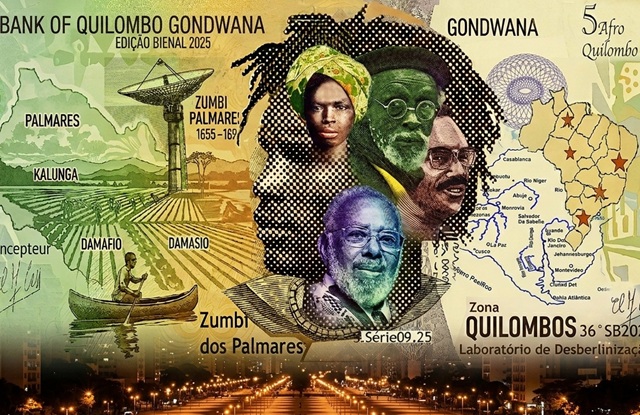
Illustration based on the images from Senegalese artist Mansour Ciss Kanakassy’s (born 1957) 2025 project Gondwana la fabrique du futur
Senegal entered 2026 in the grip of a growing debt crisis that seems insurmountable. After the government of President Bassirou Diomaye Faye took power in April 2024, it became clear that his predecessor, Macky Sall (who held office from 2012 to 2024), had concealed enormous liabilities – including hidden loans equivalent to 25.3 percent of GDP – from the Senegalese people and the International Monetary Fund (IMF). These liabilities expose a structural contradiction: a development model subordinated to external finance has clear limits.
Senegal can no longer continue along this path.
President Faye now confronts a stark choice: whether to deepen Senegal’s dependence through IMF-led adjustment or attempt to chart a more sovereign development path under extreme constraints. Senegal’s public debt has surged beyond 130% of GDP, while IMF support remains suspended and access to private credit markets is increasingly difficult. The options are narrow: austerity combined with refinancing, or restructuring through the G20 Common Framework, a mechanism for coordinated debt treatment by official creditors that still depends on an IMF-backed reform programme. Yet neither path resolves the central dilemma of restoring state capacity while under the weight of debt.
If President Faye remains on the IMF path, he will have to strengthen revenue collection through regressive taxes and strictly curtail government expenditure. The IMF has insisted on these measures to restore macroeconomic stability and regain ‘market confidence’. Examples of this policy prescription resulting in durable stability are few and far between. Instead, it reproduces a debt-austerity cycle in which creditors take precedence over the development of debtor nations and the basic needs of the people.
Across the Global South, rising debt service burdens have crowded out public investment, constrained industrial policy, and weakened state capacity. Senegal is no exception: the more resources it devotes to servicing debt, the less it can invest in energy systems, agro-industrial transformation, and social infrastructure – the material foundations of long-term macroeconomic stability.
The IMF framework treats development as a consequence of a balanced government budget rather than its precondition. It assumes that stability will generate growth even as the mechanisms of adjustment suppress the very investments required for structural transformation. Far from guaranteeing repayment, IMF-led stabilisation programmes often shrink the economy and lock countries into a logic of permanent debt rollover.
Senegal’s reliance on external financing has made it vulnerable to shocks and dependent on volatile capital flows. The promise of future revenues – particularly from hydrocarbon exports – encouraged borrowing that deepened the country’s exposure to global financial turbulence. When those conditions tightened and hidden liabilities surfaced, the fragility of the model became evident. The result was not simply a fiscal crisis but a loss of policy and political autonomy, as economic strategy became constrained by creditor expectations, credit ratings, and IMF conditionality. This is the unfinished problem of decolonisation in economic form: political independence without economic sovereignty.
Senegal now faces an immediate financing shortfall that could escalate into default. But the deeper danger lies in the long-term consequences of how the crisis is resolved. An IMF-led adjustment may stabilise short-term indicators but at the cost of prolonged austerity and weakened state capacity. A poorly managed restructuring could destabilise domestic financial institutions and limit future access to credit.
If Senegal is to escape the debt-austerity regime, it must consider options that move beyond the narrow spectrum defined by the IMF and Global North financial markets. These alternatives are not without risk and would be institutionally difficult because Senegal’s membership in the CFA franc zone and the West African Economic and Monetary Union limits its monetary and fiscal policy autonomy. The following are eight possible alternatives to the IMF-led debt-austerity regime:
Option 1: A temporary debt moratorium and public audit. Senegal must change the terms of the negotiations by declaring a temporary suspension of external debt repayments and conducting a comprehensive and transparent public audit of its debt stock, including the hidden liabilities. In 2007–2008, the government of Rafael Correa in Ecuador established a commission to audit all public debts and found major portions to be illegitimate; Correa then declared a moratorium on parts of Ecuador’s external debt, allowing his government to eventually restructure the debt with a 70% reduction. A moratorium would provide fiscal breathing space and strengthen Senegal’s negotiating position in any subsequent restructuring. In fact, the high interest rates on African bonds have already compensated investors for the risk of default, often allowing them to profit even before full repayment. Bondholders should therefore accept significant ‘haircuts’ since many have already recovered their initial investment.
Option 2: A South-South debt settlement framework. Rather than enter negotiations controlled by the IMF, Senegal could push for a debt conference that involves its principal bilateral creditors alongside private bondholders – which account for a large share of the country’s commercial debt. The presence of China and France, which together account for a large share of Senegal’s bilateral debt, would shift the discussion away from private-creditor-dominated negotiations and force a meaningful resolution. Senegal should seek maturity extensions, interest reductions, and partial write-downs in a unified framework that is not subordinated to IMF conditionality. Senegal must negotiate while keeping its development needs first.
Option 3: African financial solidarity. Senegal’s crisis has implications for the entire region of West Africa. Institutions such as Afreximbank and the African Development Fund, as well as the sovereign funds in the region (such as the Nigeria Sovereign Investment Authority and Morocco’s Caisse de Dépôt et de Gestion) can provide alternative sources of credit. These could help finance essential imports, support key sectors, and avoid the worst effects of fiscal contraction. But the strategic use of regional financing should not be limited to ensuring continued debt service. Instead, it should function as a buffer that allows Senegal to prioritise domestic economic activity while restructuring its external obligations.
Option 4: Engagement with Global South development banks. Senegal should seek to join the New Development Bank, the multilateral development bank established by the BRICS countries; currently, only three of its nine members are African countries: Algeria, Egypt, and South Africa. Such banks offer possibilities for financing infrastructure and industrial projects without World Bank-type conditionality. Senegal should begin to engage with such institutions as a longer-term strategy to diversify sources of finance. This option is not about immediate relief, but about participating in the construction of a new Global South financial architecture.
Option 5: Convert debt into productive investment. Senegal owes Chinese creditors about $5 billion of its roughly $30 billion public debt, most of which was incurred to finance infrastructure projects, not through Eurobond borrowing. Senegal could negotiate to convert some of its repayments to China into direct investment so that, instead of cash repayments, the debt service would be redirected back into projects that expand the country’s productive capacity (for example, energy infrastructure, transportation networks, and agro-processing). This approach transforms debt into a lever for development and aligns long-term creditor interests with Senegal’s own structural transformation.
Option 6: Capital management and economic prioritisation. President Faye and Prime Minister Ousmane Sonko came to politics as tax officials frustrated by the state’s failure to collect taxes and scrutinise the accounting practices of transnational corporations. Now they have the chance to tighten control over capital flows, prioritise essential imports (fuel, medicine, intermediate goods), and protect strategic sectors of the economy. Such measures would allow Senegal to ‘delink’ from the worst aspects of globalisation by refusing to subordinate domestic priorities to external pressures.
Option 7: Sovereign use of hydrocarbon revenues. In mid-March, Alioune Gueye, CEO of Senegal’s state energy company Petrosen Holding, revealed that the government was receiving only a fraction of the revenues generated by from the Sangomar oil project, Senegal’s first offshore oil development. Petrosen received only $600 million out of the $4 billion in revenues – half of that amount went to debt repayment and only about $200 million went to the Senegalese government. ‘The contract was a complete failure’, said Gueye, who is trained as a financial auditor. The IMF framework treats these revenues as collateral for debt repayment when they should be set aside for long-term development. Hydrocarbon revenues should instead be used for the creation of a sovereign wealth fund. There should be strong public control and strategic planning to ensure that the wealth is channelled into diversification, industrialisation, and social investment rather than into the cycle of debt repayment.
Option 8: Building an African anti-debt bloc. African countries have repeatedly articulated a collective critique of the international financial system, from the Lagos Plan of Action (1980), the Organization of African Unity’s call for African development based on collective self-reliance and regional integration, to recent African Union calls for reform. But they have never consolidated this critique into a durable anti-debt bloc because of the structural power of the global financial system. The IMF, which anchors this system, isolates debtor countries and forces them into bilateral negotiations, preventing the emergence of a collective front capable of challenging the debt-austerity regime. An anti-debt bloc would include collective support for moratoria, regional refinancing mechanisms, and a shared principle of prioritising productive investment over external debt obligations.
Ultimately, Senegal’s debt crisis is not simply about numbers on a balance sheet. It is about the direction of development itself. The IMF offers a path of adjustment that promises stability and yet results in perpetual stagnation. The alternatives outlined here are more uncertain, more politically demanding, and more confrontational. But they open the possibility of a different trajectory: one in which development, rather than debt repayment, becomes the organising principle of economic policy.
In 1955, as twenty-nine African and Asian countries met in Bandung, Indonesia, the Senegalese poet David Diop (1927–1960) wrote the beautiful elegy ‘Afrique, mon Afrique’ (Africa, My Africa), which he published in the journal Présence Africaine. The poem should be recited each year on Red Books Day in the squares of every Senegalese town:
Africa, my Africa.
Africa of proud warriors in ancestral savannahs.
Africa that my grandmother sang to me.
By the banks of her distant river,
I have never known you.
But my gaze is filled with your blood.
Your beautiful black blood spread across the fields.
The blood of your sweat.
The sweat of your labour.
The labour of slavery.
The slavery of your children.
Africa, tell me, Africa:
Is it your back that bends,
And lies down under the weight of humiliation,
This trembling back striped with red scars,
that says yes to the whip on the midday roads?
Then, solemnly, a voice answered me:
Impetuous son, that strong and youthful tree,
That tree over there,
Splendidly alone, among white and faded flowers –
It is Africa, your Africa,
Growing again, patiently, obstinately,
And whose fruits have, little by little,
The bitter taste of freedom.
Key Words: Senegal, Edge of Collapse, Africa






























 京公网安备 11010802037854号


