Focus
Your Present Location: HOME> Focus-

Wang Yiwei: Tax cooperation can help B&R achieve aspiration
Tax cooperation related to the Belt and Road (B&R) initiative has entered a new era. A conference related to B&R tax cooperation, recently held in Astana, capital of Kazakhstan, created a framework for establishing long-term mechanisms for tax cooperation. This will have a positive impact on the construction of a global economic governance system.
2018-05-29 -

How to keep a stable G20 framework
So the G20 framework should include it in promoting free and multinational trade. Only with the launch of such a common goal can the new globalization go smoothly, rather than worsening the imbalance and intensifying the conflict. The G20 also needs to achieve greater coherence in future governance. In other words, its policy-making ought to start from the development of global economy instead of a specific area or problem.
2018-05-25 -

Ding Gang: A way out in Sino-US standoff needed
For most of the four decades of China`s reform and opening up, the United States has been the "foreign nation" that has had the most significant impact on China. This influence has seeped into all aspects of Chinese society and life.
2018-05-24 -

Liu Zhiqin: US must amend its currency policy to ease deficit
Some experts have explained the deficit on the basis of trade volume. But the real culprit is the monopoly of the US dollar in the global market. It is very important to clarify the relationship between the trade deficit and the current US policy.
2018-05-24 -

Chen Xiaochen: Make BRICS a Bridge for American Businesses
On May 17th, organized by the Eurasia Center of America and the Embassy of South Africa, a conference themed “Doing Business with the BRICS”was held in Washington, DC. Chen Xiaochen, director of the International Studies Department of Chongyang Institute for Financial Studies at Renmin University of China (RDCY), was invited to attend the meeting and gave a keynote speech.
2018-05-23 -

John Ross: Liu He’s Washington visit leads to `win-win’ outcome
The negotiations in Washington between the special envoy of President Xi Jinping and China`s vice premier Liu He, and a US economic team including treasury secretary Steven Mnuchin, showed the extremely responsible attitude of China towards trade talks with the US. China sought to ensure the development of the prosperity of its people while securing, not merely in words but in reality, a `win-win’ outcome for both itself and the US - while strengthening the global framework for world trade.
2018-05-22 -

Liu Zongyi: A long road ahead for India–China relations
On 27–28 April 2018, Chinese President Xi Jinping held an informal meeting with Indian Prime Minister Narendra Modi. The meeting, which took place just over a month before the Shanghai Cooperation Organization summit that Modi has decided to attend, reflects India’s urgent desire to boost relations with China. The informal meeting also shows that China is willing to receive Modi with extraordinary treatment and that it respects India as a major power.
2018-05-21 -

Liu Zhiqin: Sino-US trade talks -- A textbook for all
Recently two dramas are being presented on the global stage. One is the trade talk between China and the US; the other is the filing by the EU to the WTO on US tariffs against EU countries.
2018-05-21 -

Belt and Road Initiative: Creating a smoother path
2018 marks the fifth anniversary of the creation of the Belt and Road Initiative. The experience over the past five years has shown that the initiative is not necessarily smooth sailing, nor is it something that can be built overnight. How we overcome the challenges in the future will greatly test the strength and stamina of China’s foreign strategy.
2018-05-21 -

Liu Zhiqin: Despite global mess, there is no Cold War II
Some international scholars believe the world is in the midst of "Cold War II" when they assess the global vicissitudes of the decade and especially what the Donald Trump administration has done in the past year. In their writings, they create an illusion that the Cold War is back and call on people to stay vigilant.
2018-05-18 -

Ding Gang: The `software` gap between China and Japan
The gap between the two countries can be measured in terms of hard indicators such as GDP, and can also be assessed through attitudes to work, life, and the environment. Although the latter are difficult to measure accurately, they deserve attention.
2018-05-17 -
Hua Liming: Iran deal pullout brews trouble
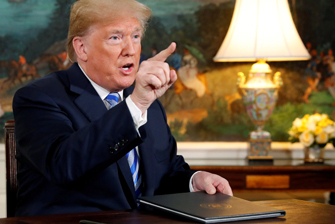
US President Donald Trump pulled the United States out of the Iran nuclear deal and reimposed sanctions on the Middle East country on Tuesday. The deal, formally known as the Joint Comprehensive Plan of Action, was signed by the five permanent members of the UN Security Council (the US, Russia, China, Britain and France), Germany and Iran in Vienna on July 14, 2015, after 18 months of negotiations, and immediately approved by the Security Council.
2018-05-16 -
Chen Dingding: The Case of ZTE and US-China Relations
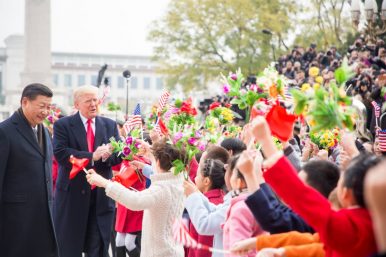
For almost 40 years, since China’s well-known”reform and opening” movement beginning in the late 1970s, the economic relationship has been the solid bedrock of a stable and largely cooperative U.S.-China relationship. Despite the recent complaints about being treated unfairly in each other’s markets, there is no denying that both Washington and Beijing have benefited tremendously from their economic interdependence.
2018-05-15 -

John Ross: US data shows no underlying economic acceleration under Trump
Given President Trump`s tax cuts, and his claim that he will strongly accelerate the U.S. long term annual average growth rate to 4 percent, or even higher, considerable attention is necessarily focusing on the latest U.S. GDP figures. Almost simultaneously the IMF published its new five-year prediction for U.S. economic growth. Taking these together therefore provides a significant opportunity to assess whether President Trump`s policies have succeeded in changing the growth path of the U.S. ec
2018-05-14 -
Bian Yongzu: Visa restrictions would hurt US more than China
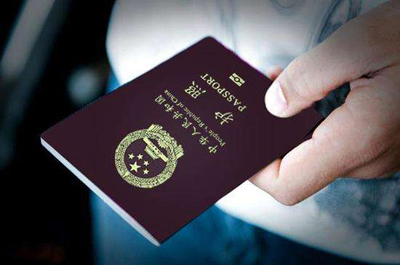
On April 30, the New York Times reported something that could be bad news for China. It said that the White House is considering adjusting the US visa policy for Chinese citizens, with more limitations and checks to be conducted on Chinese academic researchers and employees of high-tech companies.
2018-05-09 -
Liu Zhiqin: Vigilance needed as US shows true face of its capitalism
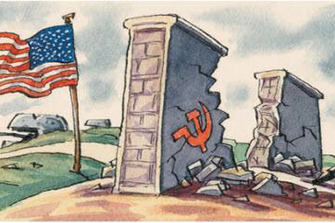
There were two meetings that took place in Beijing on May 4, 2018. One was a meeting to celebrate the 200th anniversary of the birthday of Karl Marx. The other was a smaller meeting held by a delegation of high-ranking US trade officials with their Chinese counterparts.
2018-05-09 -
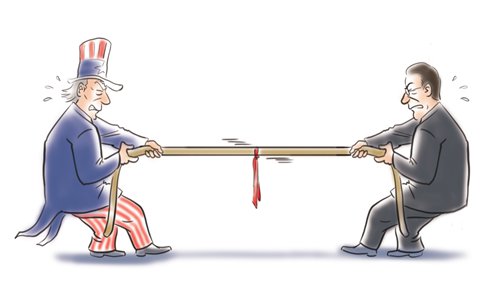
Zhao Minghao: Resolving China-US trade row a hard fight
The latest round of trade talks between China and the US has come to an end. Although the two countries didn`t sign any agreements, they exchanged ideas on issues including expanding US exports to China, bilateral services trade, two-way investment and protecting intellectual property. The two countries agreed to stay in close communication on relevant issues and establish a corresponding work mechanism.
2018-05-08 -
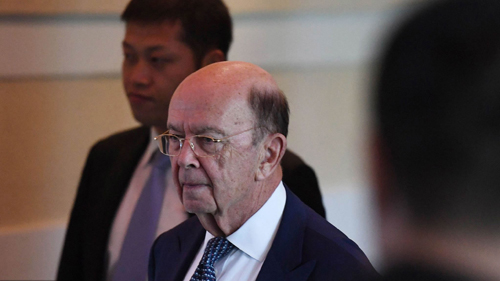
US-China trade dispute: Where there is no vision, the people perish
The recent trade dispute between China and the United States and the threat of the US sanctions on Chinese goods has fueled speculation of a trade war between the two most important economic powers in the world. While most experts are in agreement that such a trade war would be absolutely devastating for both countries, with no up-sides whatsoever, if a solution is not forthcoming at the present round of meetings between the two delegations in Beijing, the danger of such a trade war could be imm
2018-05-07 -
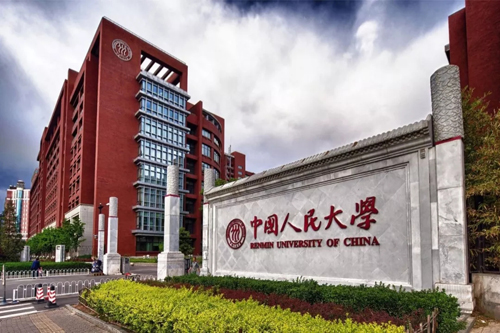
RUC`s Silk Road School MCCS Program 2018 Application Opens
The Master of Contemporary Chinese Studies (MCCS) is a key measure by Renmin University of China (RUC) to actively support the Belt and Road Initiative (BRI) in education. Following several years of preparation, the program leverages RUC’s educational platform, international operational experience and high-level think-tank resources to train future elite leaders for countries along the BRI that have a passion for Chinese culture, understand profoundly the path, model and experience of China’s de
2018-05-07 -

Liu Zhiqin: China must persuade US to abandon unfair 301 probe at talks
The trade delegation sent by the US government is set to arrive in Beijing on Thursday. Judging from the high-level organizational lineup, the US government is attaching tremendous importance to economic relations with China.
2018-05-03
























































 京公网安备 11010802037854号


