Ambassador Forum - RDCY Forum for Area Studies
Your Present Location: Trending> Ambassador Forum - RDCY Forum for Area StudiesTo develop Vietnam-China relations in an increasingly stable, profound, and substantive manner, especially in key and ongoing areas.
To develop Vietnam-China relations in an increasingly stable, profound, and substantive manner, especially in key and ongoing areas.
On the occasion of the 17th Session of the Vietnam-China Bilateral Cooperation Steering Committee and the First Meeting of the Vietnam-China Ministerial-level Strategic Dialogue on Foreign Affairs, Defense, and Public Security, held in Hanoi (March 15-17), Vietnamese Ambassador to China Pham Thanh Binh shared with TG&VN the significance and key focuses of the session.
Source: vietnam.vn
Update: Mar 15th, 2026
Ambassador, could you please explain the significance and key contents of the 17th Session of the Vietnam-China Bilateral Cooperation Steering Committee in the effort to implement the common understandings between the leaders of the two Parties and two countries?
The Vietnam-China Bilateral Cooperation Steering Committee is the highest-level coordination mechanism between the two governments , playing a crucial role in implementing and concretizing the common understandings reached between the high-level leaders of the two Parties and two countries.
Over the past 16 sessions, this mechanism has effectively played its role as the central coordinating body for all areas of bilateral cooperation; reviewing and urging ministries, sectors, and localities on both sides to effectively implement cooperation agreements in various fields.
Against the backdrop of Vietnam having just successfully held its 14th National Congress of the Communist Party of Vietnam, China embarking on its 15th Five-Year Plan after the 2026 session of the Two Sessions, and amidst complex and volatile international and regional situations, the organization of the 17th Session of the Bilateral Cooperation Steering Committee is of even greater importance.
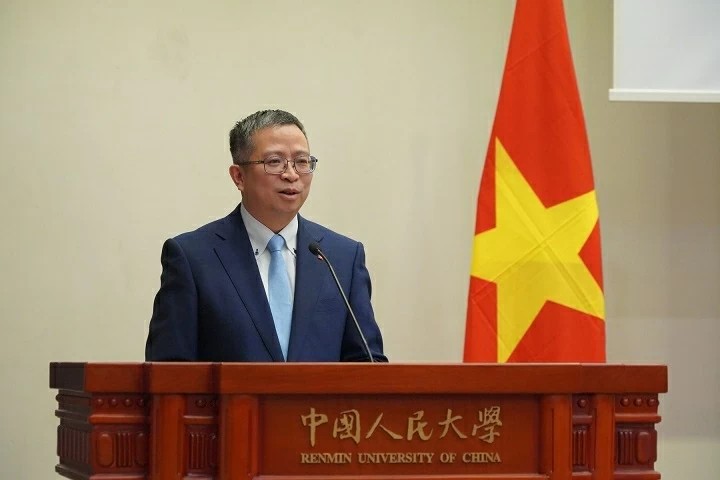
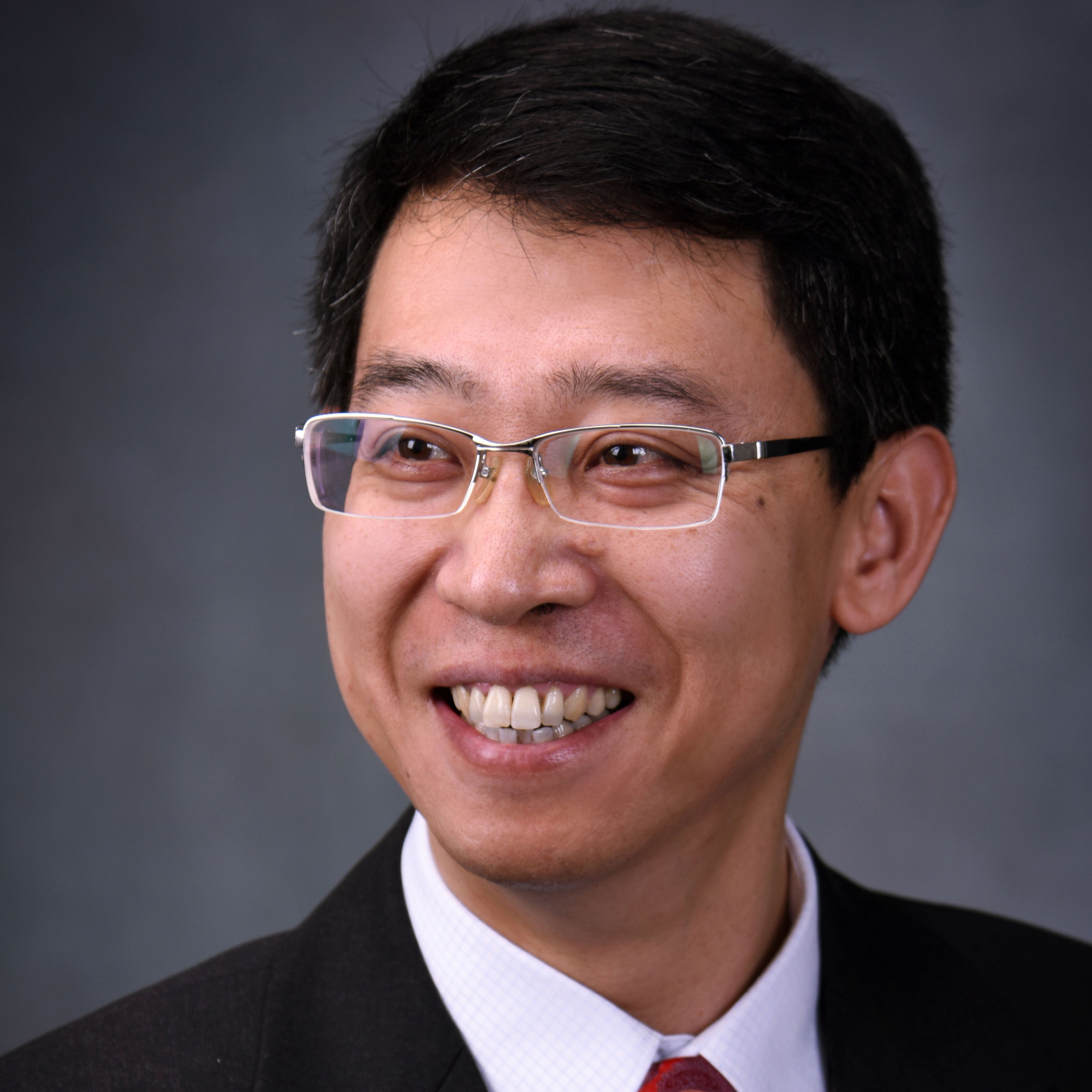
Vietnamese Ambassador to China Pham Thanh Binh. (Source: Vietnamese Embassy in China)
The meeting provided an opportunity for both sides to comprehensively review the cooperation situation since the previous meeting; and to further concretize and effectively implement the high-level common understanding.
As a practical step in implementing the foreign policy guidelines of the 14th Party Congress – “independence, self-reliance, self-strength, peace , friendship, cooperation and development, multilateralization and diversification of foreign relations” – and to promote bilateral relations and cooperation in the new situation according to the “six more” orientation, this session is expected to promote cooperation in politics, defense, security, justice, substantive cooperation areas, people-to-people exchanges, local cooperation, and cooperation within multilateral mechanisms between Vietnam and China.
At the same time, both sides will dedicate time to frank and substantive discussions aimed at resolving remaining obstacles in bilateral cooperation in a spirit of friendship and mutual respect, in line with the common understanding of the high-level leaders of the two countries.
It can be said that maintaining and effectively promoting the mechanism of the Bilateral Cooperation Steering Committee continues to demonstrate the importance both countries place on bilateral relations, promoting the effective implementation of the common understanding between the high-level leaders of the two Parties and two countries, contributing to strengthening political trust, and bringing Vietnam-China relations to increasingly stable, profound, and substantive development, especially in key and regular areas.
The first meeting of the Vietnam-China Ministerial-level Strategic Dialogue on Foreign Affairs, Defense, and Public Security will also be held on this occasion. Could the Ambassador highlight the role and key aspects of the meeting?
The 3+3 Dialogue Mechanism (Diplomacy, Defense, Public Security) is an important inter-sectoral cooperation mechanism between Vietnam and China. This is the first 3+3 inter-sectoral dialogue mechanism established by each side with a foreign partner. In fact, this dialogue mechanism was implemented at the Vice-Ministerial level in 2024 during the 16th Session of the Bilateral Cooperation Steering Committee, achieving positive results.
The agreement by the top leaders of the two parties and two countries to upgrade this mechanism to the ministerial level demonstrates the increasing level of political trust between the two countries and shows that both sides highly value the role of inter-sectoral cooperation and the strengthening of strategic exchanges in key and crucial areas.
Through this 3+3 Dialogue Ministerial Conference, the foreign, defense, and police agencies of both countries have the opportunity to strengthen strategic exchanges, contributing to elevating strategic coordination to a new level, in line with the new positioning of the relationship between the two countries.
The conference is expected to highlight the pivotal, ongoing, and crucial role of the Ministries of Foreign Affairs, Defense, and Public Security in maintaining and promoting the stable development of bilateral relations, preserving a peaceful environment for the successful achievement of development goals. Both sides will share information and assessments on the global and regional situation, as well as exchange views on measures to cooperate in responding to common security challenges.
For two countries sharing a long border like Vietnam and China, inter-agency cooperation mechanisms are crucial in border management, crime prevention, and responding to non-traditional security challenges.

Ambassador Pham Thanh Binh attended and participated in a thematic discussion at the academic seminar "The Ambassador's Story," jointly organized by the Chongyang Institute for Financial Studies and the Global Leadership Academy of Renmin University of China on March 12. (Source: Vietnamese Embassy in China)
The recent 14th National Congress of the Communist Party of Vietnam has set out development directions for Vietnam in the new period. The Chinese National People's Congress and the Chinese People's Political Consultative Conference have also just concluded, shaping the country's new growth drivers. Based on these foundations, how does the Ambassador assess the potential for cooperation between the two countries in this new context?
The 14th National Congress of the Communist Party of Vietnam and the 2026 Sessions of the Two Sessions of China have outlined strategies, directions, and measures for the socio-economic development of each country during the 2026-2030 period.
It can be seen that the strategies of the two sides complement and are similar in many areas such as science and technology-based development, innovation, digital transformation, green transformation, and openness and international integration.
In this context, I believe that the potential and room for cooperation between the two sides are still very great to realize the common understandings of the high-level leaders of the two Parties and two countries, contributing to the development of the comprehensive strategic partnership and building a strategically significant Vietnam-China community with a shared future.
Regarding strategic connectivity, both sides will accelerate infrastructure connections between the two countries, prioritizing railways, expressways, and border infrastructure. This includes the effective and timely implementation of standard-gauge railway lines such as Lao Cai – Hanoi – Hai Phong, Lang Son – Hanoi, and Mong Cai – Ha Long – Hai Phong. Simultaneously, they will strengthen connections between regional development strategies, supply chains, and economic and logistics corridors.
In terms of economics and trade, effectively utilizing free trade agreements such as ACFTA 3.0 and RCEP, improving the business environment, strengthening institutional, standard, and procedural linkages will create favorable conditions for balanced and sustainable bilateral trade development, directly contributing to the goals of industrial upgrading and high-level opening up of both countries.
Regarding investment, Vietnam encourages Chinese businesses to expand investment in priority sectors such as processing and high-tech manufacturing, strategic infrastructure, digital economy, green economy, renewable energy, and smart cities.
In the current complex international context, Ambassador, how can the two countries promote cooperation at both bilateral and multilateral levels to contribute to building peace and stability in the region and the world?
In the context of profound, complex, and unpredictable changes in the world and the region, it is increasingly important for countries to strengthen cooperation, promote dialogue, and work together to maintain a peaceful and stable environment.
At the bilateral level, Vietnam and China need to continue strengthening political trust and effectively utilizing existing cooperation mechanisms to maintain strategic exchanges through Party, State, Government, and Parliament channels; and promote substantive cooperation in the fields of economics, trade, investment, infrastructure connectivity, science and technology, and people-to-people exchanges. Properly addressing outstanding issues in a spirit of mutual respect and in accordance with international law is also crucial for maintaining a peaceful and stable environment for the development of each country.
At the multilateral level, the two countries can continue to strengthen coordination within regional and international mechanisms and forums such as the United Nations, ASEAN, APEC, regional cooperation frameworks, and cooperation initiatives at the global, regional, and sub-regional levels; jointly and persistently promote multilateralism, respect international law, resolve disputes peacefully, and enhance mutually beneficial cooperation.
With a foundation of traditional friendly neighborliness and broad common interests, as a comprehensive strategic cooperative partnership and a strategically significant community of shared future, Vietnam and China have every reason and condition to continue to coordinate even more closely, jointly contributing positively to the peace, stability, and common prosperity of the region and the world.
Thank you very much, Ambassador!
Key Words: Vietnam-China, Bilateral, Ambassador Forum














































 京公网安备 11010802037854号


