Commentaries
Your Present Location: Teacher_Home> Wang Wen> CommentariesChina and the US Pursuing Strategic Stability, as in US-China-Russia Relations
China and the US Pursuing Strategic Stability, as in US-China-Russia Relations
Source: Valdai Club
Update: May 20th, 2026
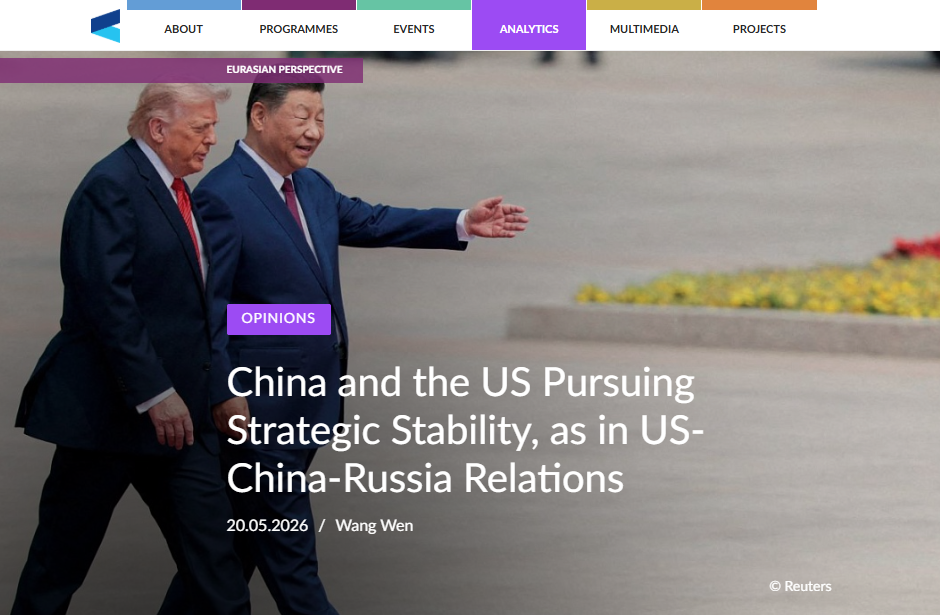
China, the US, and Russia—the three most important global powers—are altering the paradigm of major power interaction with remarkable strategic foresight, and are reshaping the global political landscape, Wang Wen writes.
Trump’s visit to China after nine years to meet with Chinese President Xi Jinping on May 14, 2026 was a historic landmark event. The biggest achievement was the establishment of a “constructive strategic and stable relationship,” characterised by cooperation as its primary focus, orderly competition, controllable differences, and the promise of a peaceful future.
This new positioning has helped to prevent the further deterioration of US-China relations, stabilising them and potentially allowing for a gradual warming. This is no easy feat.
Since 2018, the US has positioned China as its “greatest strategic competitor,” launching trade wars, technology wars, and even a new Cold War against Beijing. US-China relations have continuously deteriorated, even potentially spiralling out of control in some respects. A war between the two countries would undoubtedly be a global catastrophe. Therefore, for the past nine years, China has been committed to “stabilising the situation”: demonstrating its counter-measures to the US through confrontation while simultaneously reshaping US-China relations with the utmost patience and perseverance.
Now, the future establishment of a strategic and stable relationship between the US and China signifies more institutionalised high-level dialogues and sends a signal of stability and cooperation among the major powers of the world.
While I believe that many structural contradictions and competitive relationships will still persist between China and the United States, these tensions will not spiral out of control.
More importantly, China-US stability is a global public good. A stable relationship between the two countries will spare other countries the dilemma of choosing sides and will allow cooperation to return to the mainstream of the international community—both of which are highly beneficial to the world.
Of course, given Trump’s volatile personality, tensions between the two countries may remain for some time. However, China has ample experience in dealing with such situations.
Going forward, the most sensitive and risky issue between China and the US will remain Taiwan. Following his visit, Trump stated in a media interview, “I don’t want to see anyone (Taiwan) trying to go towards independence,” and added, “we have to fly 9,500 miles to fight a war, and that’s not what I want.” This statement has been widely interpreted as a signal that the US is adopting a more cautious and pragmatic stance on the Taiwan issue.
China’s position on the Taiwan issue has remained unchanged: it is at the core of China’s interests. China has consistently warned the US to be cautious and vigilant regarding Taiwan. Trump’s visit to China may have been aimed at securing China-US economic and trade cooperation and stabilising bilateral relations. The US chose to reduce its interference with regards to Taiwan and acknowledge China’s core interests, a key consensus reached at the meeting between the two leaders.
With the possibility of US support for Taiwanese independence eliminated, China has become more confident that it will ultimately achieve national reunification. In this process, China will continue to guard against Taiwan’s independence and separatist forces.
Taiwanese independence would lead to reunification through military force. However, China maintains maximum patience in promoting peaceful reunification. Beijing has also stated its hope that the US will support its peaceful reunification.
Besides the Taiwan issue, following Trump’s visit, China and the US announced the establishment of a trade council and an investment council to resolve economic and trade issues with a mutually beneficial approach. Furthermore, the friendly gestures between the two leaders in their protocol and conversations confirm that China and the US are indeed striving to ensure that their relationship moves on to a new phase.
Five days after Trump’s visit, Russian President Putin visited Beijing. This can be seen as another significant stability signal of new interactions among China, the US and Russia, after China-US relations returned to strategic stability.
In fact, on February 4, 2026, also known as the first day of the Chinese Lunar Spring (Lichun), Chinese President Xi Jinping held a video conference with Russian President Vladimir Putin and a phone call with US President Donald Trump. This was already a carefully planned arrangement for the upcoming interactions between the three major powers.
The following interactions deserve close attention. In September 2026, Chinese President Xi Jinping will pay a state visit to the United States. In November 2026, China will host the APEC summit in Shenzhen, where President Putin and President Trump will both be present. A meeting among the three leaders is highly likely.
Following this, the G20 summit will be held in Florida, USA. The US has extended an invitation to President Putin, and the Russian president will attend the G20 summit for the first time in five years. A second meeting between the three leaders may be expected.
From the simultaneous phone calls between the Chinese president and the presidents of Russia and the US on the same day (February 4), to the simultaneous visits to Beijing by the US and Russian presidents in May, and then the highly probable two trilateral meetings between the Chinese, US, and Russian leaders at the APEC and G20 summits, we may conclude that China, the US, and Russia—the three most important global powers—are altering the paradigm of major power interaction with remarkable strategic foresight, and are reshaping the global political landscape.
For China, deepening relations with Russia is based on strategic cooperation rooted in mutual respect; maintaining stable relations with the United States means adhering to equal dialogue and managing differences.
China and Russia have shared goals, and China and the US are seeking common ground while reserving their differences. Beijing’s objective remains consistent: to promote the building of a new type of international relations. This is precisely China’s grand ambition.
China hopes that international competition will reverse its current downturn. In China’s philosophical view, relations between major powers are never a black-and-white confrontation, but rather can be strengthened through communication; misunderstandings may be resolved, and win-win outcomes achieved through cooperation.
Over the past four decades, unlike any other major economy in the world, China has never participated in, initiated, or been involved in any military conflict. For China, both high-quality domestic development and deep participation in global governance require a stable, cooperative international environment.
Currently, a strategically stable relationship between China and the US is being built, while the strategically stable relationship between China and Russia is unbreakable. On this basis, if the three major powers continue to interact positively, it will certainly be the greatest guarantee for world peace and development.
Key Words: China, US, Russia














































































 京公网安备 11010802037854号


