Commentaries
Your Present Location: Teacher_Home> Wang Wen> CommentariesChina thinks America is declining but still uniquely dangerous
China thinks America is declining but still uniquely dangerous
It sees Donald Trump as both symptom and accelerant of the decline
Source: The Economist
Update: May 4th, 2026
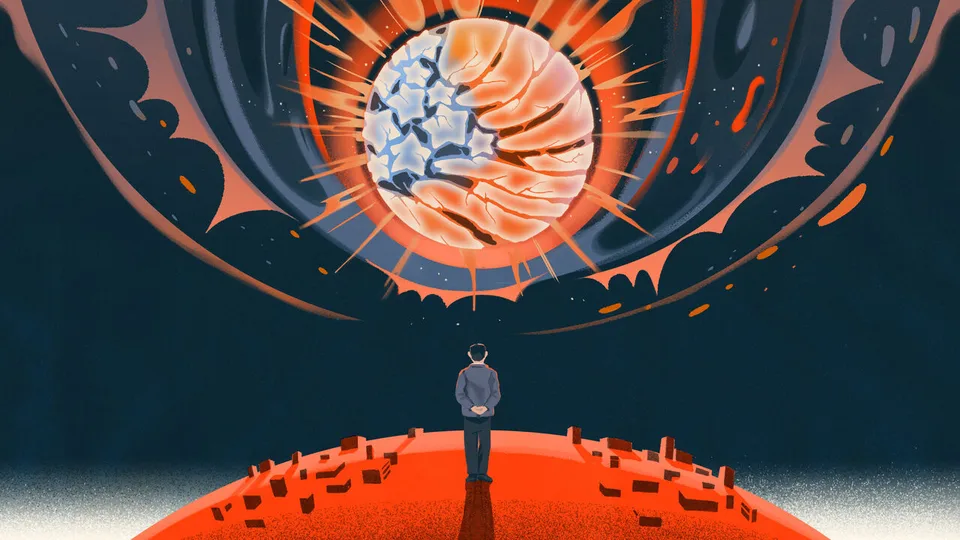
Illustration: Cornelia Li
In late January, as Donald Trump completed his first year back in the White House, a group of scholars in Beijing penned a report thanking the American president. Their gratitude was sarcastic, not an endorsement of Trumpian policy. But the sentiment behind it was genuine. Thank you, they wrote, to President Trump for driving away America’s traditional allies. Thank you for showing the world that China is more trustworthy and stable. Thank you for putting economic pressure on China and thus pushing it to innovate. And thank you, most of all, for illustrating that America is in its “imperial twilight”, a decaying and hypocritical power.
This report by Wang Wen and his colleagues at the Chongyang Institute for Financial Studies at Renmin University was at the strident end of Chinese discussions about America. Mr Wang, a cheerful nationalist, is known for his punchy language. But he is not an outlier. Many of China’s leading intellectuals and officials believe that American power is terminally on the wane. This has been expressed most authoritatively in Xi Jinping’s dictum that “the East is rising and the West is declining”. (He has been diplomatic enough not to say explicitly it is China versus America.)
State media have long loved shining a harsh light on America’s failings, an unsubtle way of telling Chinese people they have it better. Yet it would be a mistake to doubt the sincerity of China’s verdict that America’s best days are past it. This worldview, partly rooted in Marxist suspicion of capitalism, gained ascendancy in China after the global financial crisis of 2008. Donald Trump’s two election victories have only hardened this conviction, taken as evidence that American democracy is malfunctioning, too, in producing an agent of chaos as president.
In a recent paper, Jonathan Czin and Allie Matthias of the Brookings Institution, a think-tank, tabulate how often phrases describing American decline appear in Chinese writing. Their conclusion is that such analysis has been a consistent fixture of Chinese discourse for nearly two decades. But since Mr Trump’s return to power there has been an upswell: he is seen as both a symptom and an accelerant of American decline.
A few ideas come up repeatedly in Chinese thinking about what ails America. First, there are economic problems: the financialisation of America, the hollowing out of its manufacturing capacity and soaring public debts. Next, there are military woes: the burden, and impossibility, of being the world’s policeman. Finally, and underpinning all of this, there are political defects: an ultra-polarised system, unable to sustain consensus, that is now gravitating towards self-defeating populism.
The question is how China responds to its own assessment of a diminished America. One possibility is that leaders might opt to behave more aggressively, seeing more space opening up as America shrinks. There is some evidence of this, notably in China’s occasional economic bullying of American allies, from Japan to Canada, and in its more aggressive military posture around Taiwan and in the South China Sea. Yet its actions often take place in grey areas, and are not nearly as bold as Russia’s territorial grabs. So the more important observation is that China is relatively cautious for now, despite its diagnosis.
The concept of “hegemonic anxiety”, a touchstone for many Chinese scholars, helps to explain such caution. They see America as a diminished hegemon that is extremely anxious about its loss of clout and so prone to lash out violently on the way down. Scholars use this as a framework for understanding Mr Trump’s decision to snatch Venezuelan President Nicolás Maduro, to bomb Iran and to scorn allies. America, from this vantage, is hellbent on creating crises and throwing its weight around in a desperate bid to maintain its primacy. The upshot for China is that it must be careful. As Zhong Sheng, a pen-name for the party’s official views on foreign policy, wrote in a commentary in the People’s Daily on April 23rd: “America is accelerating its degeneration into a world where might makes right.”
Another element to the Chinese perception of American decline argues for caution. In a positional sense, all of this is real: America’s share of the global economy has plateaued over the past few decades, at the same time as China’s has rapidly expanded. But China’s most sober thinkers note that this relative shift does not constitute absolute loss. As Da Wei of Tsinghua University has put it, hegemony is different from power. America’s leadership of international institutions has disintegrated, not least because America has consciously undermined them. Even so, there is little question that America remains the world’s strongest country in economic and military reach.
Wang Jisi of Peking University has also urged humility. For all of America’s evident political woes, these have not constrained its economic or technological developments. Moreover, he has noted that political polarisation tends not to last in America; the country has a record of recovering its equilibrium.
Whether China sees America as a shrinking but unpredictable hegemon or as a weakened power that still has great capacity to inflict harm and, with artificial intelligence, to make new gains, the conclusion is the same: China should not do reckless things that might antagonise it. If American decline is close to a consensus opinion in Beijing, so is that feeling of caution. It is a reassuring place for China to end up, since such prudence ought to help minimise the risk of a superpower conflict. But make no mistake. When Mr Xi meets Mr Trump in Beijing in mid-May, he will not be awed by the grandeur of his office or impressed by his flexing of America’s military muscle. Instead, he will see Mr Trump as the leader of a faded power, full of danger yet destined to decline.
Key Words: RDCY reports, China, Wang Wen



















































 京公网安备 11010802037854号


