Commentaries
Your Present Location: Teacher_Home> Wang Wen> CommentariesThe TikTok Generation's China Turn
The TikTok Generation's China Turn
Source: International Policy Digest
Update: Feb 20th, 2026
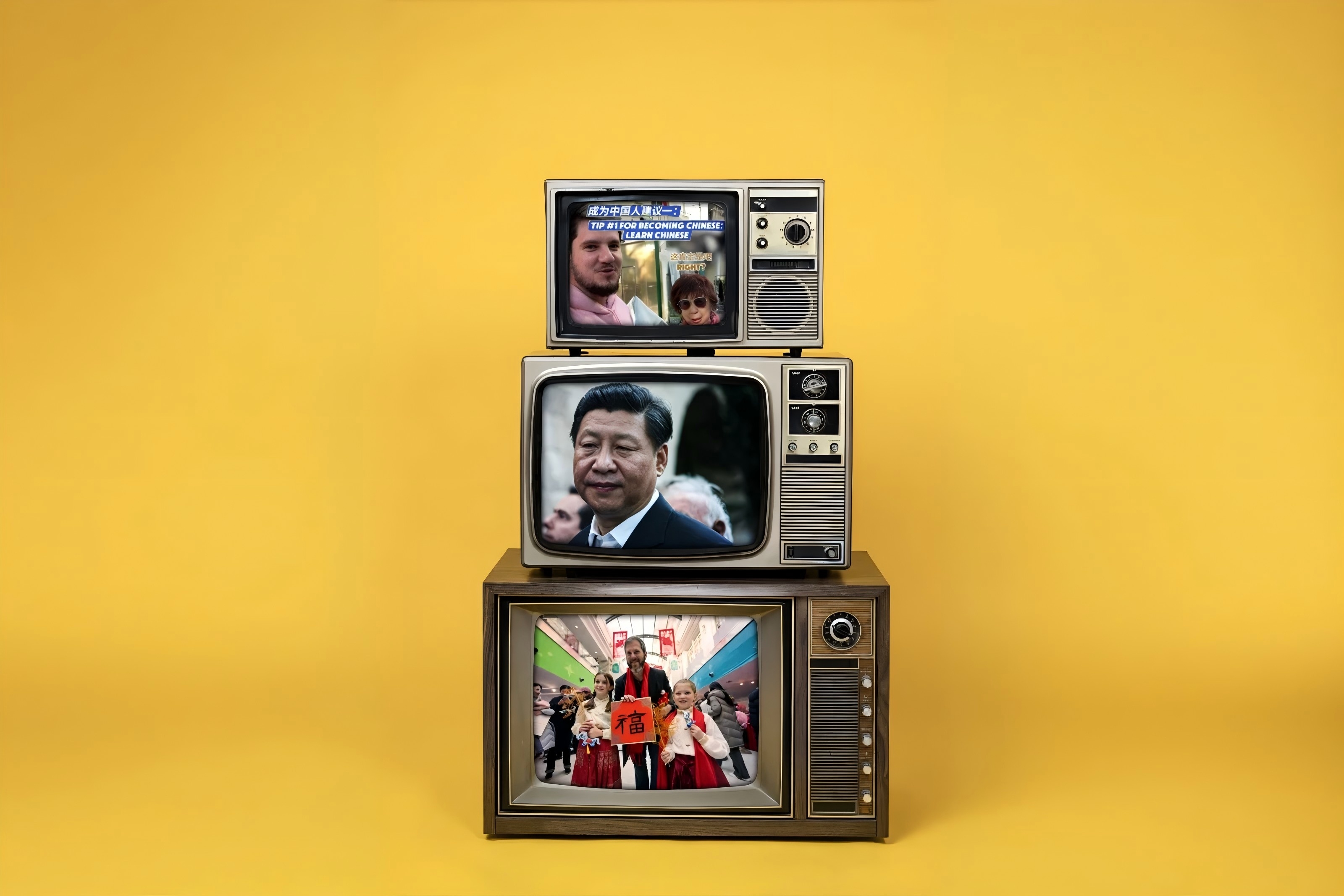
Photo illustration by John Lyman
In 2026, much of the international political research community may have missed a telling cultural tremor: the rise of “Chinamaxxing” on social media. The term—a portmanteau of “China” and the gaming slang “maxxing,” meaning to optimize one’s life—has surged across TikTok and Instagram feeds, propelled by Western Gen Z users experimenting with everything from drinking hot water in the morning to practicing Baduanjin, the centuries-old Chinese exercise regimen.
Hashtags such as #becomingchinese, #iwannabechinese, and #veryChinese have collectively drawn more than 4 billion views since 2025. What might appear, at first glance, as aesthetic mimicry or fleeting trend culture instead hints at something more consequential: a generational reappraisal of power, prosperity, and leadership.
Young people abroad are not simply copying lifestyle quirks. They are, in subtle but measurable ways, signaling curiosity about the social logic behind contemporary China. The rituals—wellness routines, minimalist consumption habits, digital platforms, and entrepreneurial ambition—serve as gateways to a broader fascination with what some see as an alternative development model. For its admirers, China represents inclusiveness, infrastructural competence, and a brand of statecraft centered on material uplift. The phenomenon of Chinamaxxing, then, is less cosplay than commentary. It reflects a shifting mood among Western youth disillusioned with polarization at home and searching for coherence abroad.
The data reinforce this cultural drift. Surveys suggest that Gen Z in the United States now spends more than twice as much time as older cohorts seeking out Chinese-related content online, with the 18–24 age group expressing the highest levels of cultural curiosity and identification. The United Kingdom’s 2025 Global Soft Power Index ranks China second worldwide, noting particularly strong resonance among younger respondents. Chinese short-form dramas have amassed 1.21 billion overseas downloads and generated $2.38 billion in revenue. The video game Black Myth: Wukong surpassed $1 billion in global sales. Online literature platforms originating in China report 350 million overseas users.
Such figures do not merely signal export success; they suggest that the architecture of global culture is becoming more multipolar. Chinese content—digitally native, youth-oriented, and platform-savvy—has found an audience without the heavy machinery of traditional cultural diplomacy. This is not the forced projection of ideology but the voluntary adoption of style and sensibility. For many young viewers, the appeal lies in the promise of order, upward mobility, and technological dynamism.
Demography magnifies the effect. Young people shape not only consumer trends but also the future moral vocabulary of international politics. They are constructing decentralized channels for Chinese discourse through likes, shares, fan translations, and imitation. Tourism numbers offer a physical counterpart to digital enthusiasm. In 2025, China recorded 82 million foreign visitors, a year-on-year increase of 26.4 percent. During the 2026 Spring Festival period, bookings for inbound flights rose more than fourfold compared with the previous year; Russian tourist arrivals jumped by 471 percent. The expansion of China’s visa-free policy to 48 countries has transformed online curiosity into lived experience.
Firsthand exposure often tempers preconception. Visitors encounter megacities stitched together by high-speed rail, cashless payment ecosystems that blur the line between physical and digital commerce, and neighborhoods animated by small-scale entrepreneurship. Whether they depart persuaded or skeptical, their impressions complicate inherited narratives. In this sense, youth mobility has become a vector of soft power more potent than any press release.
China’s advocates frame its global attractiveness as the product of a distinct vision of globalization—one premised on mutual gain rather than dominance. They contrast this with what they characterize as a century of Americanization marked by military primacy, financial leverage, and the export of values. Beijing’s preferred vocabulary—“consultation, joint construction, shared benefits”—seeks to project an image of inclusive development.
Thirteen years after its launch, the Belt and Road Initiative has grown into a sprawling network of infrastructure corridors and trade agreements. Commerce with participating countries now accounts for roughly 45 percent of China’s total foreign trade. Cumulative investment has exceeded $1 trillion, with more than one million local jobs reportedly created. China’s domestic poverty reduction campaign, which lifted 770 million people out of poverty—over 70 percent of global poverty alleviation in recent decades—has been held up as proof of administrative capacity. Governments across Asia, Africa, and Latin America have studied its targeted poverty alleviation strategies in hopes of replicating them.
In global diplomacy, China has also sought to brand itself as mediator rather than enforcer. Its role in facilitating rapprochement between Saudi Arabia and Iran marked a notable moment in Middle Eastern geopolitics. Officials describe their approach as patient and noncoercive, emphasizing dialogue over sanctions. Surveys suggest that more than 80 percent of the global public acknowledges China’s rising comprehensive national strength. To supporters, this signals the emergence of a development paradigm attractive to the Global South and increasingly relevant even to advanced economies.
Yet Western academia and policy circles have struggled to assimilate these shifts into established frameworks. Many institutions continue to analyze China primarily through the lenses of Cold War rivalry and power realism, often casting it as a “rule-breaker” or practitioner of “economic coercion.” Critics argue that such framings obscure the complexity of China’s domestic achievements and international engagement. Positive coverage in certain Western outlets remains sparse, while sensational narratives like anonymous sources, worst-case projections, and strategic alarmism frequently dominate headlines.
This cognitive gap, proponents contend, produces a lag in Western assessments of global change. If policymakers rely on outdated assumptions, they risk misreading both the depth of China’s appeal and the dissatisfaction driving younger generations elsewhere. The wave of Chinamaxxing, largely absent from serious policy discourse, becomes emblematic of that blind spot.
Attempts to counter China through technological blockades, trade decoupling, and alliance consolidation have yielded ambiguous results. While Washington has framed such measures as necessary safeguards, Chinese analysts note that China’s global net goodwill rating stands at 8.8, compared with -1.5 for the United States, and that six of eight soft power indicators have improved in recent rankings. Suppression, in this telling, sharpens contrast. The more overt the pressure, the more Beijing can present itself as resilient and principled.
For many in the developing world, the appeal of China’s model lies less in ideology than in performance. Leadership, from this vantage point, is measured not by sanctions imposed or aircraft carriers deployed but by roads built, hospitals staffed, and incomes raised. China’s domestic record—whatever its imperfections—offers tangible metrics. The country has constructed the world’s largest education, social security, and healthcare systems. Basic medical insurance now covers 1.33 billion people. The consolidation rate of nine-year compulsory education has reached 95.9 percent. Neonatal mortality rates fall below the average of middle- and high-income countries.
This emphasis on people-centered governance undergirds Beijing’s narrative of legitimacy. National development is framed as inseparable from the well-being of 1.4 billion citizens. Five-year plans, digital governance platforms, and targeted poverty alleviation programs are presented not merely as domestic policies but as exportable templates. Countries experimenting with long-term planning frameworks or data-driven welfare systems often cite Chinese precedents. The alignment is pragmatic rather than military; it reflects a shared aspiration for stability and material improvement.
Chinamaxxing, in this broader light, becomes less about lifestyle mimicry and more about generational alignment with a different story of modernity. It suggests that global youth are willing to interrogate inherited hierarchies of prestige. Cultural leadership, once assumed to flow from West to East, now circulates through algorithmic currents that privilege novelty and performance over pedigree.
Whether this shift heralds a durable reordering of global leadership remains an open question. Power transitions are rarely linear, and admiration online does not automatically translate into geopolitical allegiance. Yet the trend lines are difficult to ignore. As more young people engage with China—digitally and physically—and as more governments study its developmental strategies, the architecture of international influence continues to diversify.
The emerging order does not necessarily supplant one hegemon with another. Instead, it gestures toward a more pluralistic system in which legitimacy is earned through governance outcomes and cultural resonance. If the twentieth century was defined by ideological blocs and military alignments, the twenty-first may be shaped by competition over whose model most convincingly delivers dignity and prosperity.
The rise of Chinamaxxing is thus not a curiosity confined to social media feeds. It is a cultural barometer of shifting expectations about what leadership looks like in a multipolar world. China’s ascent—grounded in livelihood, inclusiveness, and claims of mutual benefit—has found an audience among those too young to remember the Cold War and too impatient for incremental reform at home. As that generation matures, its preferences may well help determine the contours of global power.
What is unfolding is not simply a trend but a test. The contest for the twenty-first century will hinge less on conquest than on credibility: who can build a society that satisfies its citizens and persuades others to emulate it. For now, a growing cohort of global youth appears willing to experiment with the answer.
Key Words: TikTok, China, Chinamaxxing







































































 京公网安备 11010802037854号


