Commentaries
Your Present Location: Teacher_Home> Wang Wen> CommentariesChina Outlines Vision for Global Governance
China Outlines Vision for Global Governance
Global Governance Forum 2026 emphasizes multilateralism and reform of global institutions.
Source: Global Economic Indicator
Update: Feb 27, 2026

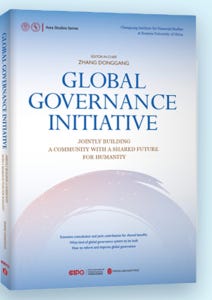
On January 24, 2026, GEI was invited to attend the 2026 Global Governance Forum and book launch at Renmin University of China, bringing together senior academics, diplomats, and policy experts to discuss how the Global Governance Initiative (GGI) can be translated into concrete international cooperation amid growing geopolitical fragmentation. The event accompanied the launch of a new book “Global Governance Initiative: Jointly Building a Community with a Shared Future for Humanity.”
The event opened with welcoming remarks by Zhang Donggang, Secretary of the CPC Committee of Renmin University of China, and Yu Yingfu, Deputy Director-General of the China International Communications Group. Zheng Xinye, Vice President of Renmin University of China, served as host and emphasized the university’s longstanding commitment to global governance research and international academic exchange.
A key highlight of the forum was the launch of the multilingual publication Global Governance Initiative: Jointly Building a Community with a Shared Future for Humanity, introduced by Ma Rujun, President of Foreign Languages Press. The book, published in nine languages, aims to provide a systematic academic explanation of the Global Governance Initiative and was officially donated to major libraries worldwide. The forum also marked the inaugural ceremony of the Global Governance Initiative International Research Network, designed to foster open, inclusive collaboration among global universities and think tanks.
Emphasizing Reform, Multilateralism, and Shared Responsibility
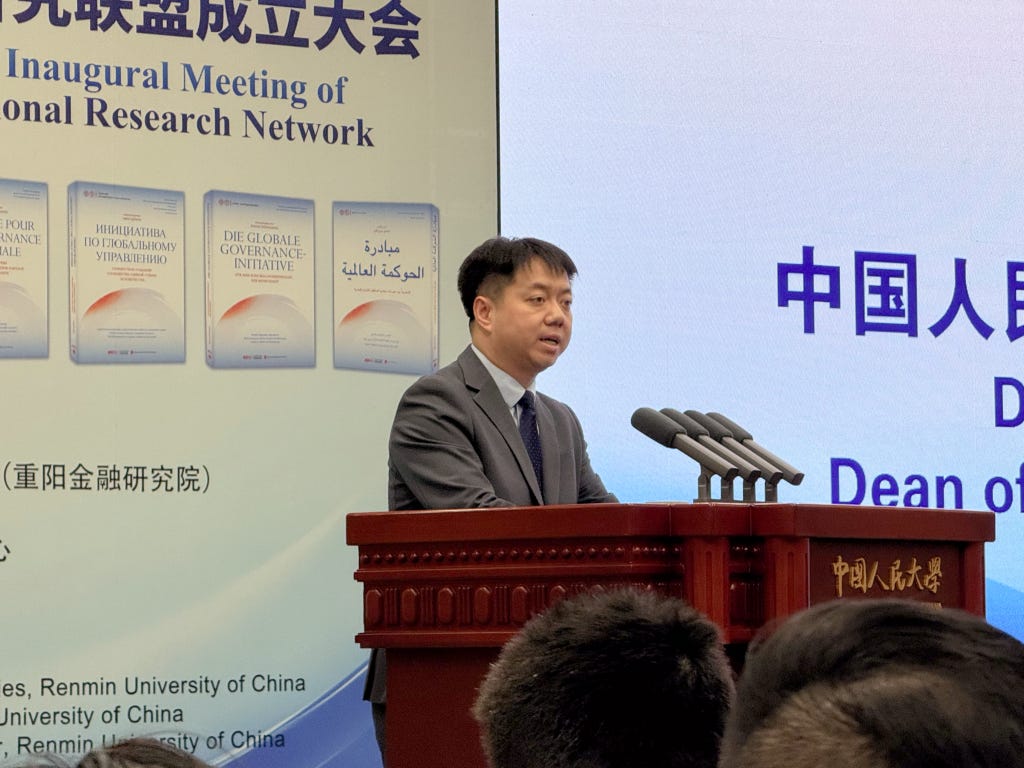
In his keynote address, Wu Hailong, President of the China Public Diplomacy Association, stressed that global governance has become “more urgent and necessary than ever” in the face of rising unilateralism, geopolitical tensions, and global challenges such as climate change and artificial intelligence governance. He underscored the importance of upholding international law, defending the United Nations-centered multilateral system, and strengthening collective action to prevent a return to “power-based” international relations.
Wu argued that global challenges cannot be addressed through unilateral approaches and called for renewed commitment to multilateral cooperation, particularly in areas such as climate action, technological governance, public health, and poverty reduction. He emphasized that emerging technologies, including artificial intelligence, should be treated as global public goods and governed through inclusive international frameworks.
China’s Role and the Evolution of Global Governance
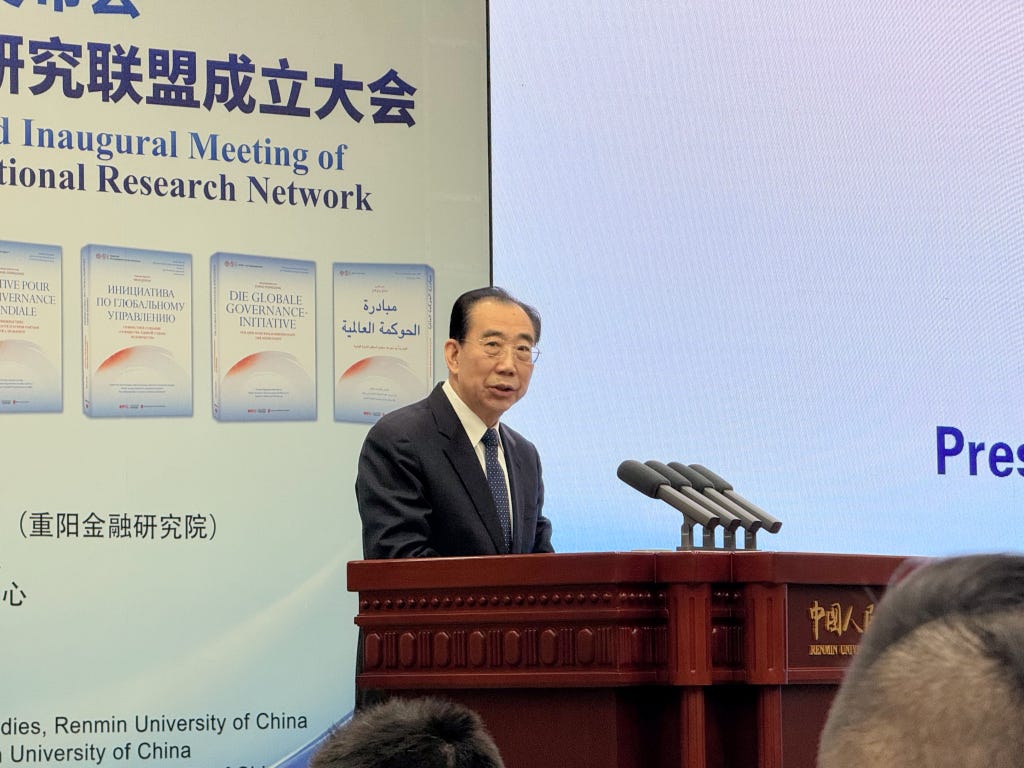
Gao Fei, President of the China Foreign Affairs University, traced the evolution of global governance since World War II, highlighting the role of platforms such as the G20 in bridging divides between developed and developing countries. He noted that recent shifts in global politics have exposed growing “governance gaps” and “responsibility vacuums,” particularly in emerging policy areas where international rules remain underdeveloped.
Gao emphasized that the Global Governance Initiative responds to these challenges by reaffirming five core principles: sovereign equality, international rule of law, multilateralism, a people-centered approach, and action-oriented cooperation. He also highlighted China’s expanding contribution to the international system, including its growing role in UN funding and peacekeeping operations, describing China as a stabilizing force committed to reform rather than disruption of the existing international order.
From Concept to Practice
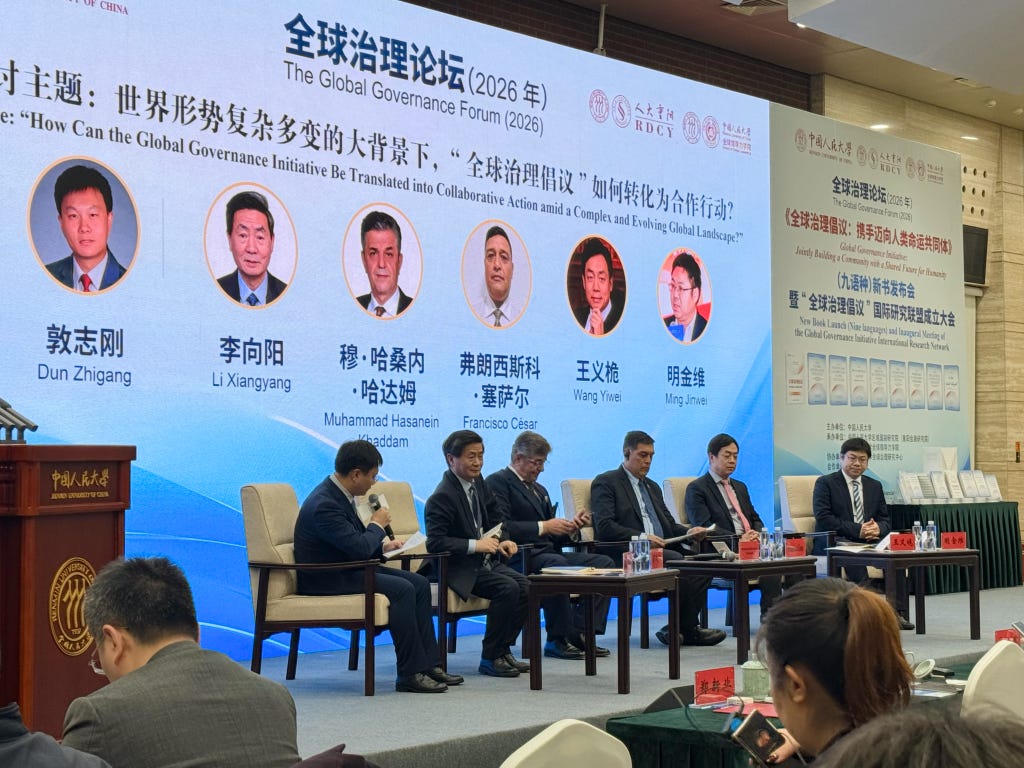
A panel discussion titled “How Can the Global Governance Initiative Be Translated into Collaborative Action amid a Complex and Evolving Global Landscape?” featured contributions from scholars and diplomats, including representatives from the Chinese Academy of Social Sciences, the embassies of Syria and Venezuela in China, and Renmin University’s Academy of Xi Jinping Thought on Socialism with Chinese Characteristics for a New Era.
Speakers emphasized the importance of aligning academic research, policy dialogue, and practical cooperation to address shared global challenges, particularly from the perspective of developing countries and the Global South.
Building a Global Academic Network
In closing remarks, Renmin University reaffirmed its commitment to advancing global governance research, cultivating internationally minded talent, and strengthening cross-border academic collaboration. The newly established Global Governance Initiative International Research Network is expected to serve as a platform for joint research, policy dialogue, and knowledge exchange aimed at promoting a more equitable, inclusive, and effective global governance system.
The forum concluded with a call for sustained international cooperation to reform and strengthen global governance mechanisms in support of peace, development, and a shared future for humanity.









































 京公网安备 11010802037854号


