Commentaries
Your Present Location: Teacher_Home> Wang Wen> CommentariesWhat trap? US-China relations show conflict is far from inevitable
What trap? US-China relations show conflict is far from inevitable
The Thucydides Trap that has dominated debate for a decade is a poor fit for reality. Beijing and Washington are both showing they can share the stage without drifting into war
Source: SCMP
Update: Sep 29th, 2026 8:30 PM
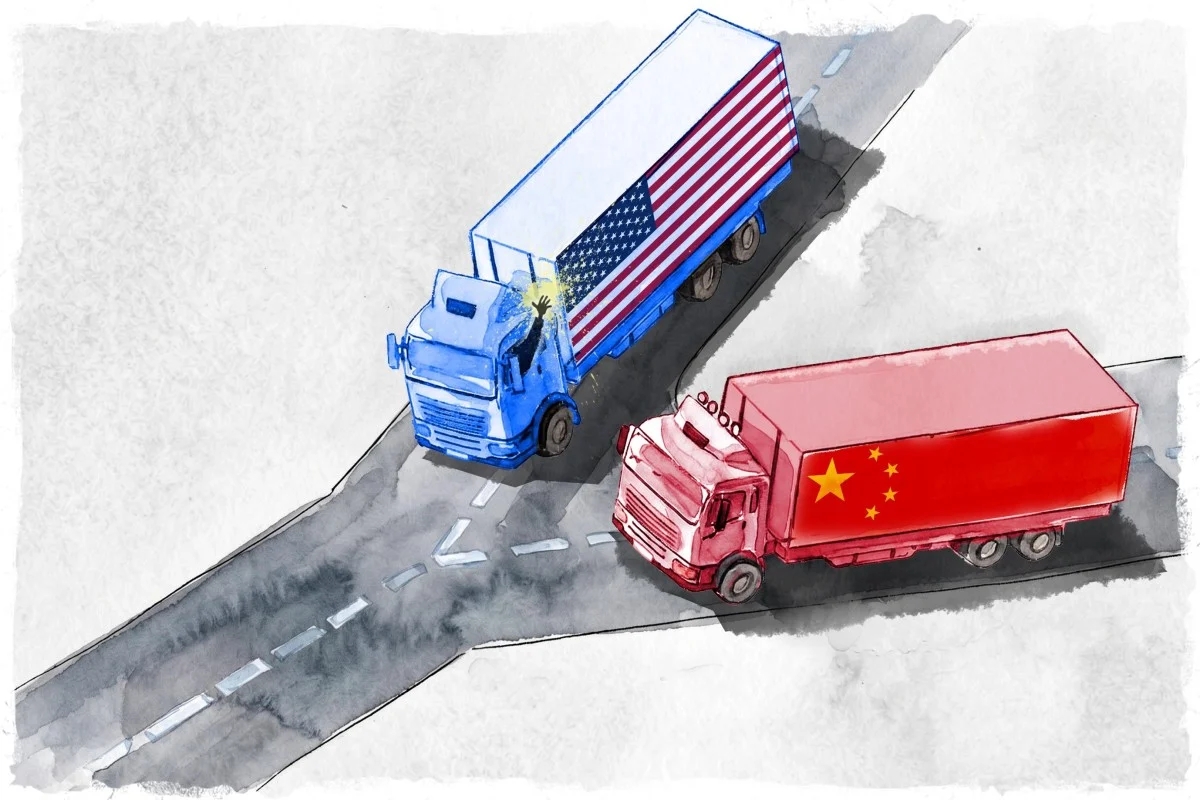
Illustration: Henry Wong
For a decade, foreign policy circles have treated war between the United States and China as something close to destiny. The theory has a fancy, fashionable name borrowed from ancient Greece: the “Thucydides Trap” – the idea that a rising power and an established one are fated to collide, the way two articulated lorries merging into a single lane rarely ends well.
The term is widely used in commentaries on US-China relations. Frictions get written off as “inevitable” regardless of what actually happened. But a closer look at how the two governments behave, not just how pundits describe them, tells a different story. Both sides are, for now, choosing the diplomatic equivalent of indicating before they change lanes.
Any analysis about power transition has to start with power itself, so here is where the two superpowers stand at the moment. By market exchange rates, the US economy was worth about US$30.6 trillion in 2025 against China’s US$19.4 trillion, putting China’s economy at roughly 63 per cent of the size of the US.
China has led the world in manufacturing value added for 16 straight years, hitting 34.7 trillion yuan (US$5.2 trillion) in 2025, an industrial base that the US would struggle to replicate even if it wanted to. China’s research and development spending passed 3.9 trillion yuan in 2025, with strengths in renewable energy, artificial intelligence, electric vehicles and robotics.
For its part, the US still holds the cards in several areas that China cannot easily match: the US dollar’s reserve currency status, deep basic science, a global network of allies and the ability to project military power anywhere on Earth.
This is not a story of one power overtaking the other. This is two heavyweights circling each other, neither able to land a knockout blow.
There are three reasons the US-China rivalry might not end in war and tragedy. First, the guard rails still hold. Nuclear deterrence, tangled global supply chains and shared problems such as climate change and public health form a kind of ballast keeping both ships upright. Regular summits between the two countries’ leaders are not mere photo ops. They are how great powers check their assumptions before a small miscalculation turns into a large one.
Second, Washington’s bark might be worse than its bite. US policy on China often looks less like grand strategy and more like a barroom argument that resets every election cycle. Extreme partisanship, congressional gridlock and the tussle between state and federal power all make it hard for the US to sustain one consistent approach to China for longer than one electoral term.
Taking a hard line on China might play well on the campaign trail. However, a slogan is not a strategy, and slogans rarely survive contact with a change of administration.
Third, the US-China relationship is far from the only source of global friction. Under US President Donald Trump, Washington has often been at loggerheads with its own allies. Some of these disagreements have been every bit as bitter as anything between the US and China.
As it turns out, friction is simply what happens when large economies with different interests share a planet. It does not herald a war on its own.
Perhaps the more significant shift is that China has stopped merely responding to the moves the US makes and started trying to shape the global agenda itself. That shift rests on three foundations.
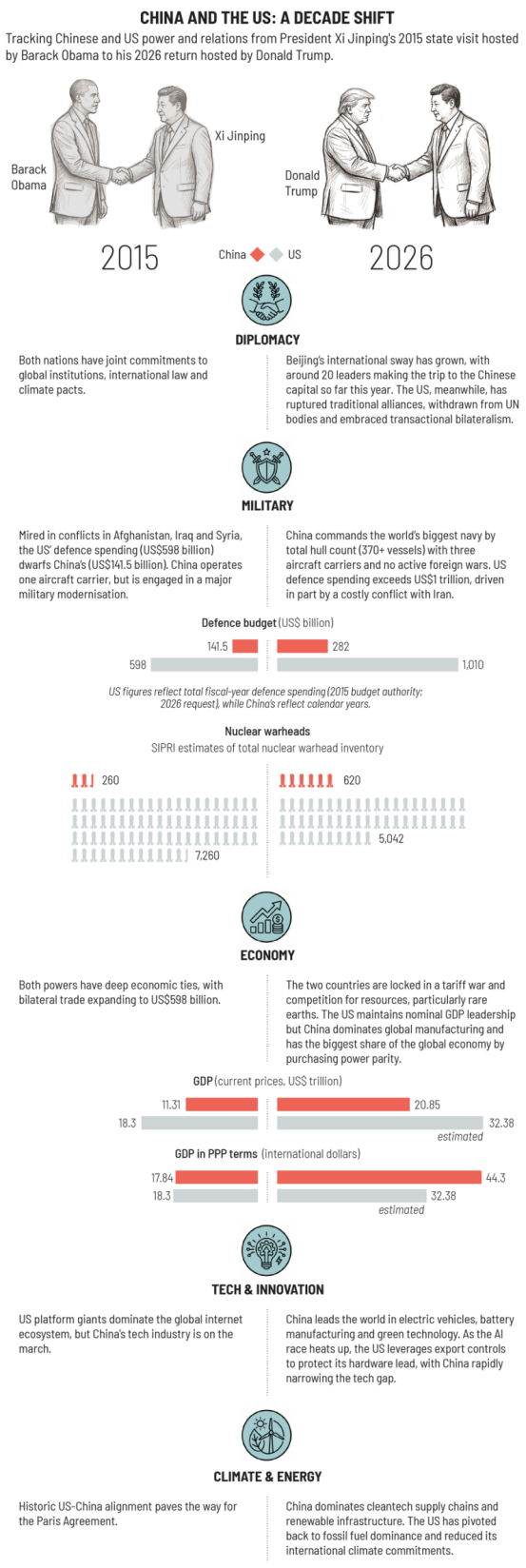
Sources: IMF, General Administration of Customs of the People’s Republic of China, SIPRI
The first is economic gravity. China runs the world’s most complete industrial supply chain. More than US$600 billion in annual bilateral goods trade gives both sides real reasons to avoid a clean break, however tempting decoupling might sound in a campaign speech. China remains the largest trading partner the US has outside North America.
The second is a consistent playbook: no compromise on sovereignty, open competition on technology and industry, and practical cooperation on shared problems such as climate change and food security. That tiered approach stops the relationship collapsing into a zero-sum fight every time a new dispute appears.
The third is a wider stage. With the Brics bloc of developing economies expanding, the Shanghai Cooperation Organisation deepening and Global South ties growing, the US-China relationship is no longer just a two-player game. Much of the rest of the world would rather not be forced to choose a side, and that reluctance is itself a brake on both Beijing and Washington.
None of this means the danger has passed. The hard edge of US-China policy shows no sign of softening soon. A single incident in the Taiwan Strait or the South China Sea could still upend the relationship overnight.
Escaping the Thucydides Trap was never going to mean the end of competition. It means building rules sturdy enough to keep that competition within a peaceful lane and keeping military conflict off the table altogether.
Sparta and Athens never had to worry about nuclear weapons, global supply chains or a shared climate crisis. Borrowing their story to predict the 21st century is like using a horse-drawn buggy manual to help fix a Tesla. It might contain a grain of wisdom, but it will not get you very far.
Whether China and the US can build a genuine peaceful coexistence is not a private matter between two capitals. It will help decide the shape of global stability for decades. Power does not have to change hands at the point of a sword. In an interdependent world, two great powers can still work out how to share the stage.
Key Words: China, US, Thucydides Trap
























































































 京公网安备 11010802037854号


