Commentaries
Your Present Location: Teacher_Home> Wang Wen> CommentariesVietnam - China: Friendly and stable neighbors for long-term development
Vietnam - China: Friendly and stable neighbors for long-term development
On April 14th, General Secretary and President To Lam and his wife, along with a high-level Vietnamese delegation, arrived in Beijing, beginning a state visit from April 14th to 17th at the invitation of General Secretary and President of China Xi Jinping and his wife.
Source: Vietnam.VN
Update: Apr 15th, 2026
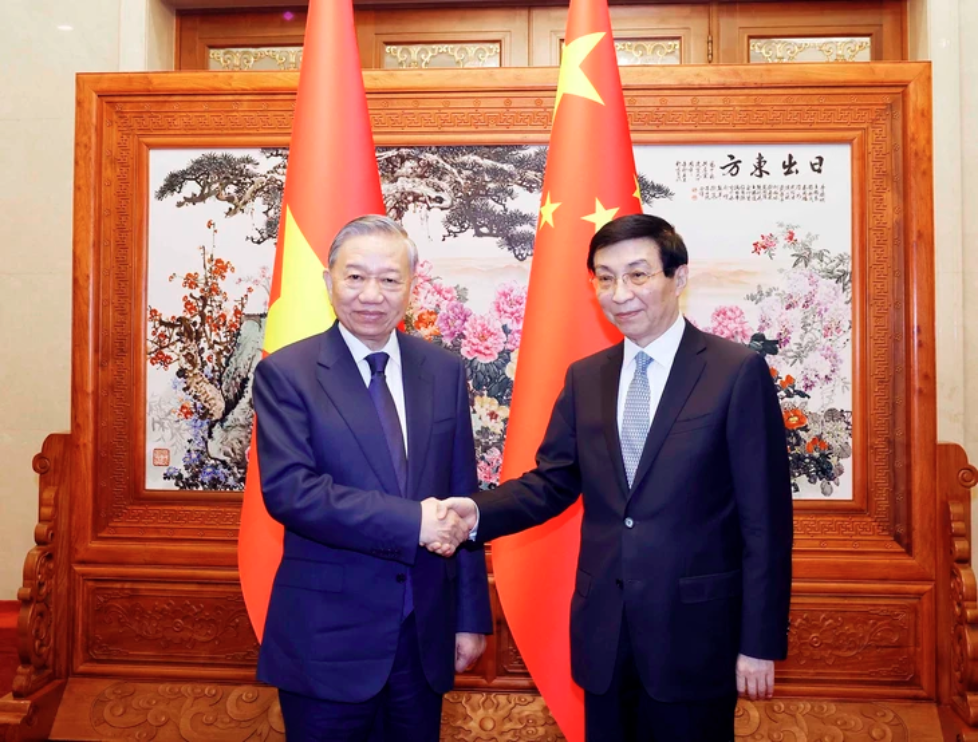
General Secretary and President To Lam met with Chairman of the National Committee of the Chinese People's Political Consultative Conference Wang Huning - Photo: VNA
"The fact that General Secretary and President To Lam chose China as his first destination on his overseas trip after taking office shows that the China-Vietnam relationship is becoming more important than ever for Vietnam."
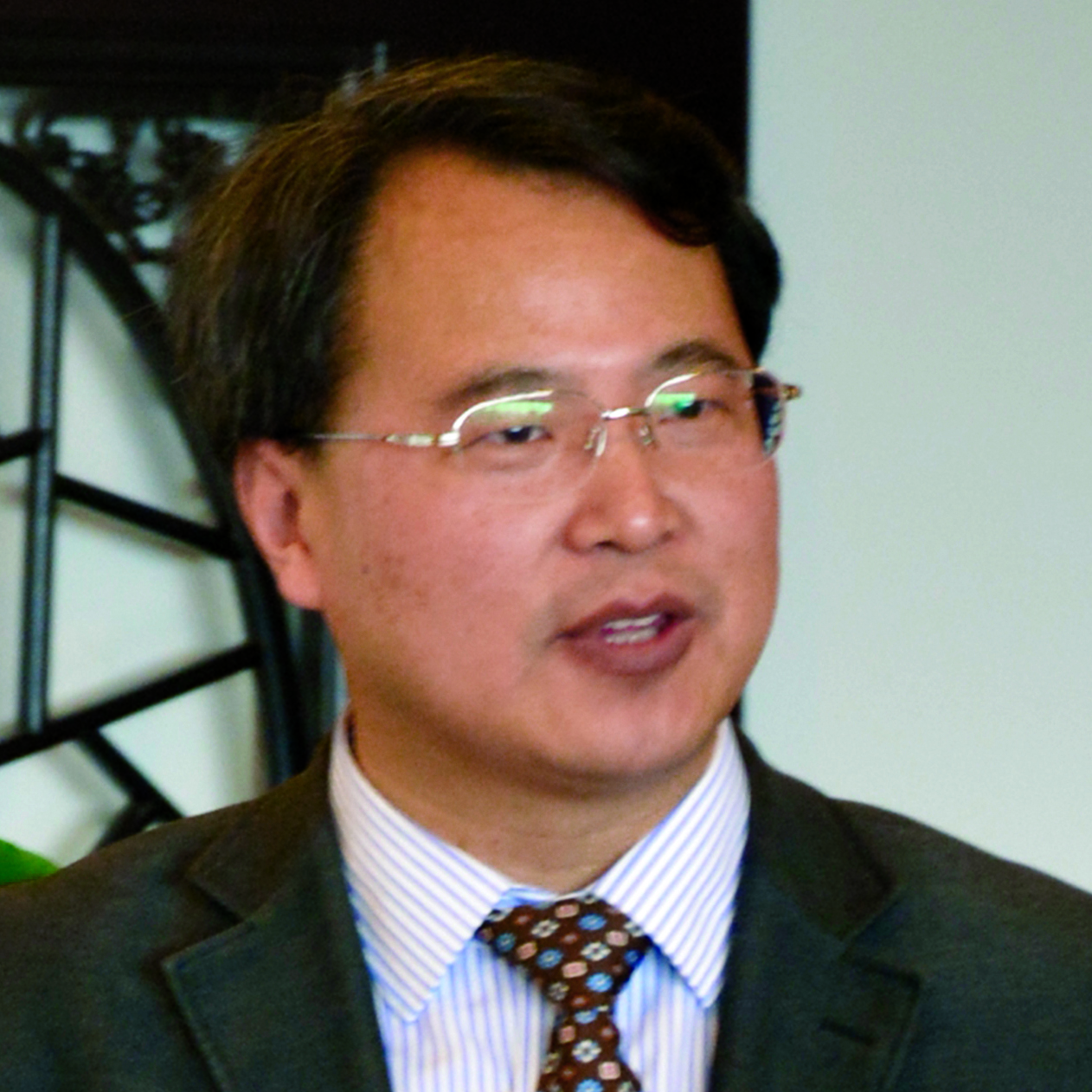
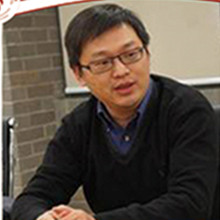
"And for China, the China-Vietnam relationship continues to be a priority, holding a top position in Beijing's foreign policy towards its neighbors," Professor Wang Wen of Renmin University of Beijing (China) told Tuoi Tre newspaper .
The warmest, most wonderful phase.
Besides the timing, observers are also paying attention to the composition of the delegation accompanying General Secretary and President To Lam to China this time.
With 10 Politburo members (including the General Secretary and President), 8 ministers, and leaders from various ministries, departments, and localities, this trip marks one of the largest high-level delegations ever, reflecting the importance placed on and the expectation of further promoting comprehensive, in-depth, and substantive Vietnam-China relations.
In his overall assessment of recent relations between Vietnam and China, Professor Wang pointed out that political relations are a crucial factor, with numerous high-level visits, meetings, and contacts between the two countries in a short period of time. This strong political foundation has fostered the development of economic, trade, and investment relations between the two countries, further strengthening their strategic relationship.
"From China's perspective, Sino-Vietnamese relations are currently in their warmest and best phase in the modern history of bilateral relations. People on both sides are full of expectations for an even better relationship in the future," Mr. Wang shared with Tuoi Tre newspaper .
According to Wang, one characteristic of the China-Vietnam relationship is the clear manifestation of the leading and guiding role played by the heads of the Party and State on each side.
The strategic guidance of the top leaders of the two parties and two countries can be seen as the greatest advantage and the most important political guarantee for the development of China-Vietnam relations.
This visit by General Secretary and President To Lam takes place exactly one year after the visit to Vietnam by General Secretary and President Xi Jinping (from April 14 to 15, 2025).
This also marks the third time in less than two years that the top leaders of the two parties and two countries have paid a bilateral visit.
"The personal relationship between the leaders of the two countries will strongly promote the continued warming of bilateral relations and build trust and mutual understanding in social relations," Wang stated.
Wang's remarks can be found in an article by General Secretary and President To Lam published in the People's Daily – the official newspaper of the Communist Party of China – before the visit.
In the message, the Vietnamese leader shared that the Party, State, and people of Vietnam deeply appreciate the friendly sentiments and dedication of General Secretary and President Xi Jinping to the development of Vietnam-China relations over the past years.
Neighborly diplomacy and Vietnam's two centenary goals.
Also in the article in the People's Daily, General Secretary and President To Lam recalled the history of friendship between the two countries. He placed the Vietnam-China relationship within the larger picture of Vietnam's foreign policy of "independence, self-reliance, self-strengthening, multilateralism, and diversification."
He emphasized that in relations between neighboring countries, the most sustainable thing is "knowing how to view the relationship from a strategic perspective with a long-term vision," and "knowing how to put the fundamental, long-term interests of the people above all else."
According to the General Secretary and President, developing relations with China is identified by Vietnam as a "consistent policy," a "strategic choice," and a "top priority." Conversely, China also identifies Vietnam as a priority in its neighborly diplomacy.
According to observers, this way of expressing it emphasizes the objectivity of the development of relations between Vietnam and China: it is both a continuation of history and a possible answer to the need to maintain a peaceful and stable environment for development in the new era.
When placed in the context of the ongoing visit, it also conveys a consistent message: Vietnam wants to proactively shape the space for cooperation with China in a stable, long-term direction, based on the political and social foundations built over history, rather than viewing the relationship only through short-term perspectives.
Looking towards the future, General Secretary and President To Lam emphasized in his article: "We understand that to achieve rapid and sustainable development, we must maintain a peaceful environment; to successfully achieve the goals for 2030 and 2045, we must maximize our internal strengths while expanding effective international cooperation on the basis of independence and self-reliance."
Judging from the above statement, the trip is not simply an activity to "promote traditional friendship," but also an effort to bring bilateral relations onto a trajectory that directly serves the requirements of quality, sustainable, and self-reliant growth.
Against the backdrop of profound global transformations, creating both opportunities and challenges, Vietnam and China are in a period of unprecedented historical opportunity. As Deputy Minister of Foreign Affairs Nguyen Minh Vu stated, the visit marks "a new beginning" in bilateral relations as both countries enter a new phase of development.
Domestically, Vietnam is entering the phase of implementing the resolutions of the 14th National Congress with two strategic goals for the next 100 years, in which Resolution No. 57 of the Politburo identifies science and technology, innovation, and digital transformation as "top priority breakthroughs".
On the other side of the border, China began implementing its 15th Five-Year Plan with a focus on high-quality development, scientific and technological self-reliance, green transformation, and higher levels of opening up.
According to observers, these two "tracks" of development form the basis for the two countries to find common ground through "strategic connectivity" rather than just pure trade growth.
General Secretary and President To Lam's vision for Vietnam-China relations extends beyond trade and infrastructure connectivity. During his visit to Tsinghua University (China) on the afternoon of April 14th, he emphasized his desire for stronger cooperation between Vietnam and China, not only in trade and investment, but also in knowledge, technology, innovation, and future-building capabilities.
The Vietnamese leader stated that Vietnam is entering a new period of development, in which science and technology, innovation, and digital transformation are identified as the main drivers for achieving strategic goals by 2030 and 2045.
Vietnam attaches particular importance to cooperation with China in areas where the two sides can complement each other and develop together, especially artificial intelligence, big data, cloud computing, semiconductors, automation, robotics, green technology, biotechnology, new materials, clean energy, and other strategic technologies.
According to a researcher on Vietnam-China relations, the state visit to China by General Secretary and President To Lam can be summarized in three key phrases: inheriting friendship, elevating strategic connectivity, and opening up a new vision for development in the new era.
Viewed through the lens of how Vietnam is realizing its most recent development goal by 2030, this visit is positioned as a step to both leverage cooperation for breakthroughs in infrastructure, supply chains, science and technology, and digital transformation, while maintaining a peaceful and stable environment during this new development phase.
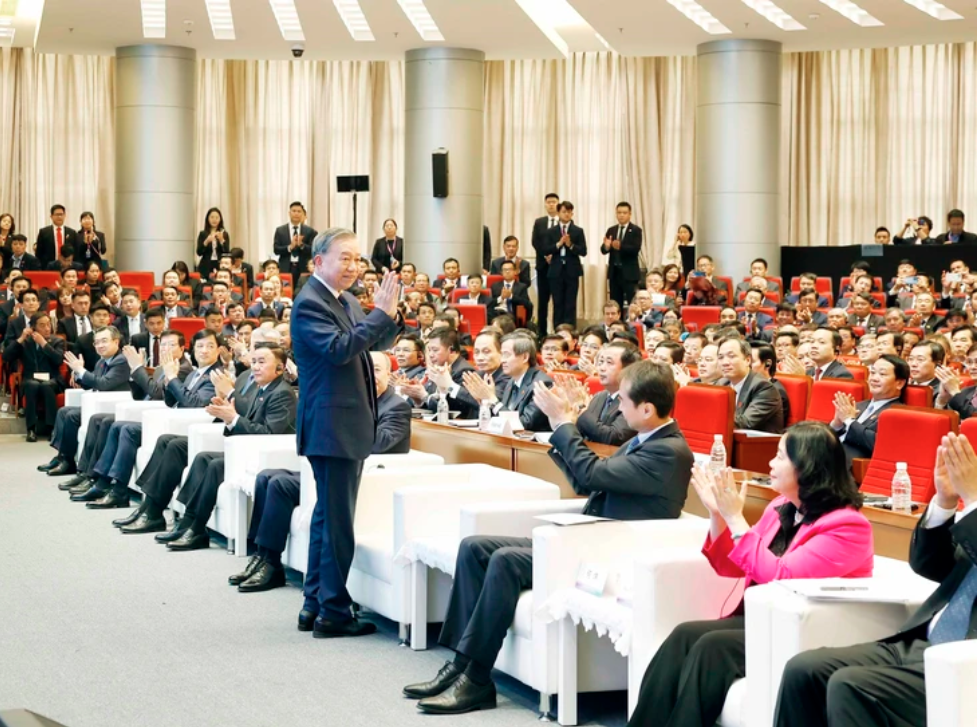
General Secretary and President To Lam visits and delivers a policy speech at Tsinghua University - Photo: VNA
Realizing cooperation in infrastructure, technology, and energy.
Dr. Dang Thi Thuy Ha, Deputy Director of the Center for China Studies at the Asia-Pacific Institute, shared that the visit of General Secretary and President To Lam to China, following the completion of the Party and State leadership positions, affirmed that developing relations with China is a strategic choice and a top priority for Vietnam through direct exchanges at the highest level between the two Parties and States. This sends a signal of solidarity between the two countries in a world with many unpredictable changes.
To realize the commitments made by high-level leaders of both sides and achieve more substantive cooperation, effective coordination and cooperation between ministries, departments, and localities of both countries are necessary. For example, practical surveys could be organized for ministries, departments, and localities to visit new urban areas in China or new facilities to learn from their experiences.
We need to translate these agreements into concrete projects. Prioritize connecting both hard and soft infrastructure.
For example, hard infrastructure includes promoting standard-gauge railway projects to ensure timely completion, accelerating the planning of other routes, and speeding up hard infrastructure connectivity by implementing smart border crossing models and a one-stop-at-two-country system to improve customs clearance efficiency and reduce logistics costs.
Connecting soft infrastructure involves promoting cross-border electronic payment platforms, thereby facilitating trade and tourism.
Furthermore, both sides are very interested in cooperation in new technologies and the economy. We also need to leverage China's strengths in green energy transition, solar power, and electric vehicle batteries to meet Vietnam's energy transition needs.
Both sides also need to promote cooperation to transform traditional processing exports into higher value-added industries in order to bring sustainable and tangible benefits to businesses and people in both countries.
It is necessary to strengthen cooperation in the field of people-to-people exchanges to consolidate the social and media foundation, emphasizing the role of the younger generation (organizing "Red Journey" tours) and timely and accurate information and communication on issues in the bilateral relations between the two countries.
Promoting three connections: ideals and beliefs, development interests, and culture and people's will.
During the visit, on April 14, General Secretary and President To Lam met with Chairman of the National Committee of the Chinese People's Political Consultative Conference Wang Huning.
At the meeting, the General Secretary and President affirmed that Vietnam hopes that through this visit, it will further deepen political trust, establish a new level of bilateral cooperation with more comprehensive and in-depth connections, and together realize the development goals of each country.
To achieve this goal, he hopes that both sides will promote three key connections: shared ideals and beliefs, shared development interests, and cultural values and public sentiment.
Also on April 14th, General Secretary and President To Lam visited and inspected the Hung An New Area – an important project with historical significance for China; delivered a policy speech at Tsinghua University; and visited and met with staff of the Vietnamese Embassy in China and representatives of the Vietnamese diaspora.
Many areas still have room for further improvement.
China's Global Times noted that there are many areas of cooperation where Vietnam and China can still further develop, for example, Vietnam's economic development is currently hampered by incomplete infrastructure, but China is well-positioned to provide significant support in this area.
Vietnam and China are promoting three standard-gauge railway lines connecting the two countries, with construction of the first phase of the Lao Cai - Hanoi - Hai Phong railway line scheduled to begin in late December 2025.
Through a standard-gauge railway system, both sides can improve cross-border logistics efficiency, and when combined with infrastructure cooperation such as 5G, it can promote digital economic integration, jointly turning the "hard connection" between the two countries into a growth pole for common development.
Key Words: Vietnam, China, Friendly
























 京公网安备 11010802037854号


