Commentaries
Your Present Location: Teacher_Home> Liu Ying> CommentariesMiddle East Conflict Drives Up Global Energy and Travel Costs; Trump's Tweets Become New Oil Price "Bellwether"
Middle East Conflict Drives Up Global Energy and Travel Costs; Trump's Tweets Become New Oil Price "Bellwether"
Source: BigGo Finance
Update: Apr 23rd, 2026, 8:12 AM
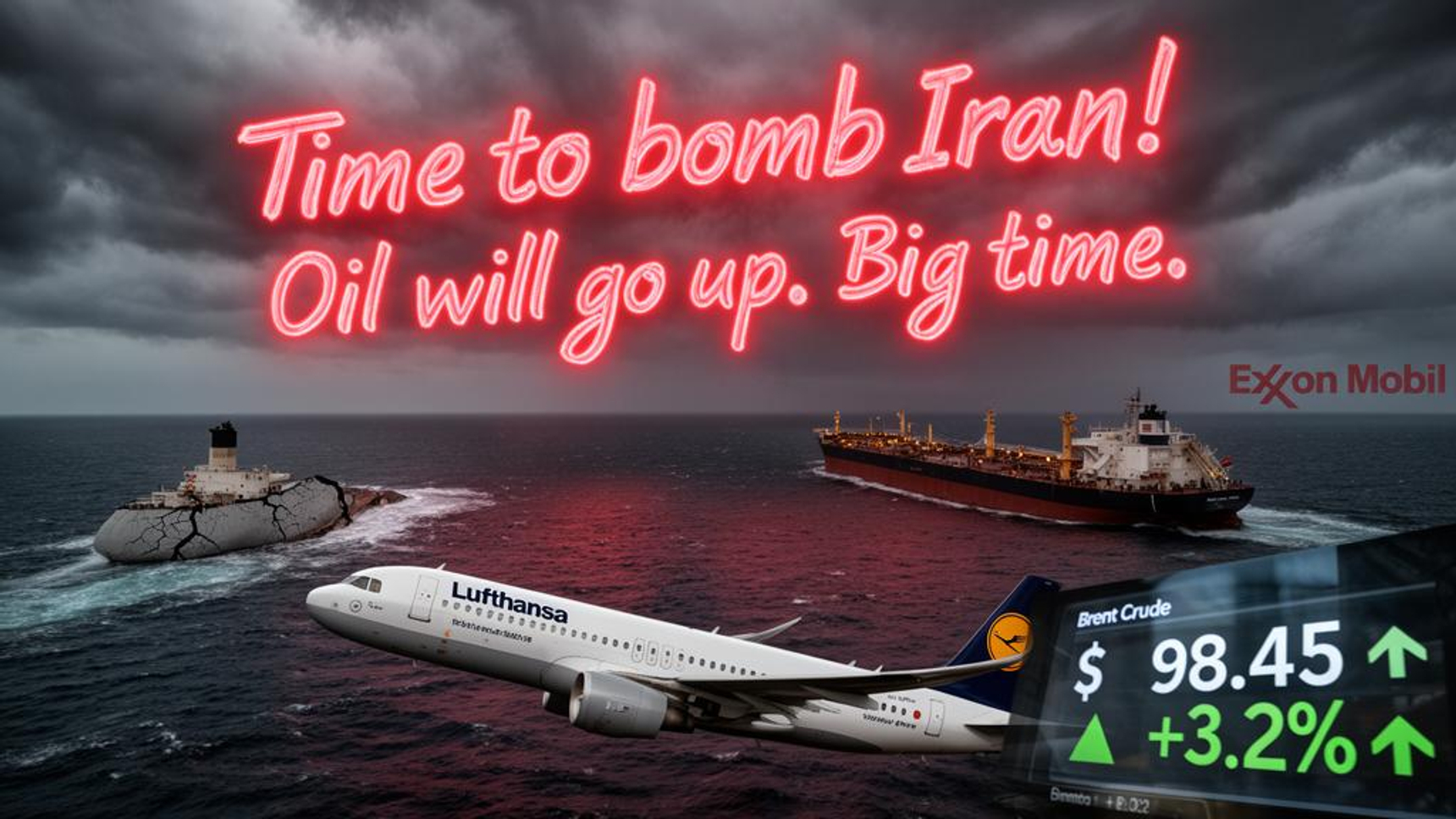
A military conflict far away in the Middle East involving the U.S., Israel, and Iran is transmitting shockwaves to the bills and travel plans of ordinary consumers worldwide through surging energy and transportation costs. From Europe's aviation fuel emergency and skyrocketing international airfares to fertilizer raw material prices doubling in Southeast Asia, geopolitical risks have evolved into a compound economic shock.
Simultaneously, global oil traders are finding the market increasingly swayed by U.S. President Donald Trump's social media commentary, with an unprecedented tight correlation between oil price movements and geopolitical news. Analysis indicates that, in the short term, oil prices have detached from supply-demand fundamentals, leaving the market in a state of high sensitivity.
Airfare Prices "Take Off," Europe's Jet Fuel Reserves Sound Alarm
Ms. Gao, a Beijing resident planning a trip to Europe during the May Day holiday, has felt this impact firsthand. She told the Southern Metropolis Daily that round-trip tickets via Middle Eastern hubs like Dubai or Doha previously cost around 5,000 yuan (approximately $733). However, after the conflict erupted, she had to abandon those options for safety reasons. Alternatives via South Korea or Turkey not only took longer but also doubled the ticket price. She ultimately chose a route via Turkey to Nice, France, though rumors of "Iranian missiles entering Turkish airspace" still left her uneasy.
Ms. Gao's experience is not unique. International Energy Agency (IEA) Executive Director Fatih Birol recently warned that Europe's aviation fuel reserves "may only last about six weeks." If the Middle East situation continues to disrupt oil supplies, many flights could be canceled "soon."
Cost pressures are already forcing European airlines to act. On April 16, Germany's Lufthansa announced measures including grounding older aircraft and reducing routes to save costs. On the same day, KLM Royal Dutch Airlines announced it would cancel dozens of European round-trip flights. These moves are expected to further push up airfares.
Liu Ying, a researcher at the Chongyang Institute for Financial Studies at Renmin University of China, analyzed that the severity of the oil price shock varies by region, depending on resource endowment, oil import dependence, and economic resilience. Europe's jet fuel shortage is a concentrated manifestation of its fragile energy supply chain, potentially triggering a chain reaction from transportation paralysis to runaway manufacturing costs.
Mass Flight Cancellations in Southeast Asia, Agricultural Costs Spike
The shockwave has also swept through Southeast Asia. As the May Day holiday approaches, many travelers with tickets to Bangkok, Phuket, Vientiane, and other destinations have faced sudden flight cancellations. Mr. Liu from Guangzhou, who planned a trip to Malaysia, received a notification in early April that his ticket was reclaimed by the airline. Rebooking prices were 500 to 2,000 yuan (approximately $73 to approximately $293) higher, with cheaper options often being "red-eye flights."
Passengers report that this wave of flight adjustments mainly targets routes to Southeast Asia, involving low-cost carriers like AirAsia and VietJet, as well as some major Chinese airlines.
A more profound impact is felt in agricultural production. As an energy-related product, fertilizer prices have surged alongside energy costs. The Malaysia Fruit Farmers Association noted that fertilizer raw material prices have risen 100% to 150% in just two weeks, with some suppliers even suspending orders, raising the risk of "having money but no fertilizer to buy."
In Malaysia's Port Klang area, some manufacturers face delays in key raw material arrivals, with a few small and medium-sized enterprises experiencing "temporary production halts due to material shortages." Liu Ying points out that the shock is evolving from cost escalation to potential supply chain disruptions, creating multiple pressures on the real economy in Southeast Asia.
Trump's Tweets Become Market Barometer, Oil Prices Swing Wildly
While ordinary people fret over rising costs, global oil traders are fixated on another screen—Donald Trump's social media account. Reports indicate that Sebastian Barrack, head of commodities at U.S.-based Citadel, has a dedicated screen in his office monitoring Trump's posts.
Since the U.S.-Iran ceasefire announcement on April 8, Brent crude prices have seen significant fluctuations, each highly correlated with major conflict developments and Trump's statements.
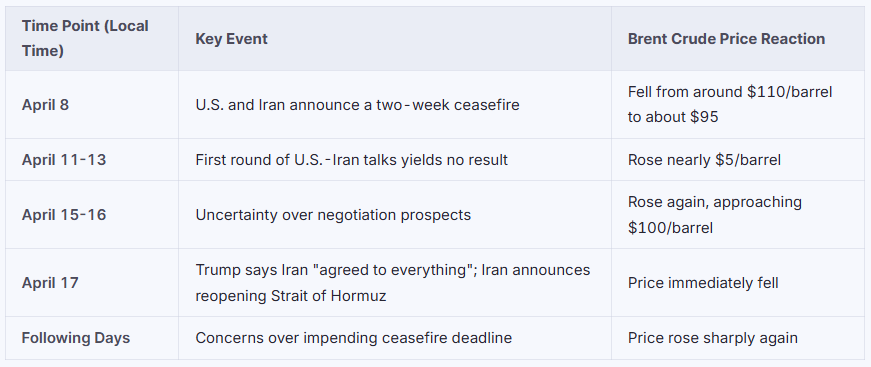
"In the short term, oil prices have detached from supply-demand fundamentals, essentially driven by geopolitical news. The market is in a state of high sensitivity," Liu Ying stated. "Any negative news regarding the Strait of Hormuz reopening or talks breaking down will be amplified, leading to significant price volatility."
Ceasefire Indefinitely Extended, Supply Crisis Persists
According to The Motley Fool, Trump unexpectedly announced on Tuesday, April 21, an indefinite extension of the ceasefire with Iran to allow the "deeply divided" Iranian government to submit a "unified proposal." This move means the global oil supply shortage shows no sign of ending soon.
Although Iran's foreign minister announced the reopening of the Strait of Hormuz last Friday, the decision was quickly retracted citing the U.S. Navy's blockade of Iran-linked vessels. This critical waterway remains closed. Before the war, 20% of global oil and liquefied natural gas (LNG) supplies passed through it daily.
Data analytics firm Kpler estimates that since the war began, the global cumulative loss of oil supply has reached 500 million barrels (worth approximately $50 billion), equivalent to more than a month of European demand. Countries are depleting emergency reserves to fill the gap.
The indefinite extension of the ceasefire means there is no clear timeline for the resumption of oil flows from the Persian Gulf. Even if the Strait reopens, restarting shut-in wells will take months, making the path to market normalization a long one.
Following the announcement, oil prices rose. On the morning of April 22, the global benchmark Brent crude rose 3%, surpassing $101 per barrel; U.S. West Texas Intermediate (WTI) crude rose over 2%, to $92 per barrel.
Market Impact and Investment Strategy Adjustments
Analysis suggests that whether the ceasefire is extended or fighting resumes, oil prices may remain elevated for a longer period. An extended ceasefire means supply recovery is distant; renewed conflict could invite further Iranian strikes on Persian Gulf energy infrastructure, potentially even threatening the Bab el-Mandeb Strait, a key Red Sea chokepoint.
The Motley Fool article suggests investors consider adjusting their portfolios for the possibility of "long-term high oil prices." For example, evaluating whether to reduce holdings in oil-sensitive stocks like airlines. Meanwhile, impending fuel shortages may begin to impact economic growth, making it a time to consider reducing exposure to cyclical stocks.
On the other hand, investing in some oil stocks could be an option. For instance, ExxonMobil (XOM) is investing in its lowest-cost, highest-margin assets while working to reduce costs, making it more profitable when oil prices are low and also able to benefit when they rise. However, if war resumes, the company's facilities in the Middle East remain at risk; two of its LNG facilities were damaged in previous attacks.
Zhao Jun, an associate professor at the Middle East Studies Institute of Shanghai International Studies University, told the Southern Metropolis Daily that Iran is dragging negotiations to the last minute to test whether the U.S. seeks a "surrender-style negotiation" or a "transactional negotiation," while also serving domestic and foreign political narratives. The Trump side continues to apply deadline pressure, indicating a reluctance to extend the ceasefire, with a stance of resuming strikes if talks fail.
The outcome of this博弈 (game) will directly determine how long the global energy market and supply chains must bear the "Middle East premium." Liu Ying concludes that the impact of the U.S.-Israel-Iran conflict has formed a compound shock, whose transmission chain will profoundly reshape global industrial chains, supply chains, financial markets, and even technological development paths.
Key Words: Mid-East, Oil price, global energy





















































































 京公网安备 11010802037854号


