Commentaries
Your Present Location: Teacher_Home> Dong Shaopeng> CommentariesNingbo Zhoushan Port tops 40m containers in calendar year for first time
Ningbo Zhoushan Port tops 40m containers in calendar year for first time
Milestone showcases vitality, resilience of China’s foreign trade: experts
Source: Global Times
Update: Dec 2nd, 2025, 11:34AM
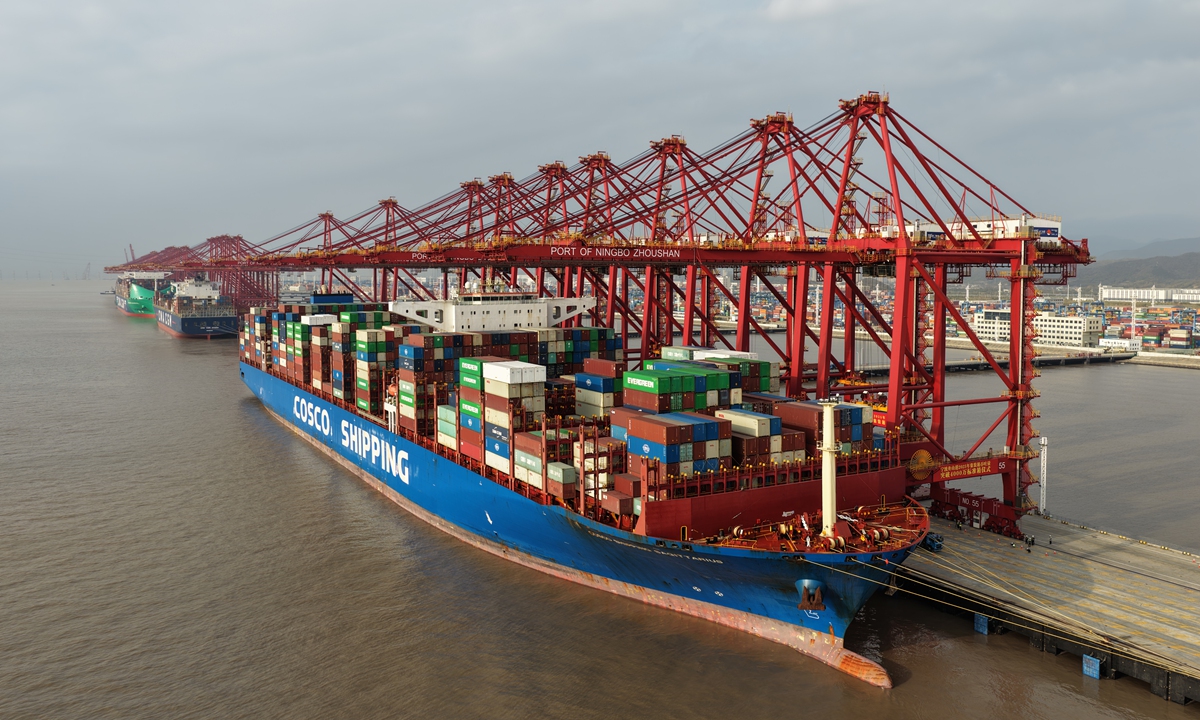
A glimpse of Ningbo Zhoushan Port Photo: Courtesy of Ningbo Zhoushan Port
Ningbo Zhoushan Port in East China's Zhejiang Province handled its 40 millionth container of the year on Tuesday at the Meishan port area, marking the first time the port has surpassed the threshold of 40 million standard containers in a calendar year, the Global Times learned from the port authority. Analysts said that the milestone underlines the continued resilience of China's economy and foreign trade despite a turbulent global environment.
Container throughput is a key indicator of port capacity and international trade activity. In recent years, Ningbo Zhoushan Port has posted notable growth, rising from 30 million to 40 million 20-foot equivalent units (TEUs) in just four years. It was the fastest-growing major port among the world's top five in terms of annual throughput over the past decade, per the statement.
The achievement makes Ningbo Zhoushan the third port in the world to join the "40-million club," reflecting the port's accelerated efforts to build a world-class hub capable of supporting China's "dual-circulation" development strategy as global uncertainties intensify, according to a statement provided to the Global Times.
"The port started relatively late in container operations, but it has developed very rapidly," Tao Chengbo, chairman of Ningbo Zhoushan Port Co, said in the statement. He said that the latest breakthrough underscores the port's growing capacity to support national strategies, drive regional development and serve global clients, marking a vivid shift in China's evolution from a major port nation to a strong one.
Ningbo Zhoushan, a modern deepwater port that integrates river, estuary and sea operations, handled 1.38 billion tons of cargo in 2024, up 4 percent year-on-year. According to the Ningbo municipal government, the port has remained the world's busiest by cargo throughput for the 16th straight year.
In the first 10 months of 2025, mechanical and electrical products continued to lead exports at Ningbo's ports under customs supervision, reaching 913.42 billion yuan ($129 billion) and accounting for 54 percent of total outbound shipments, according to Wang Yu, deputy director of the supervision department at Ningbo Customs.
Wang added that to ensure the smooth flow of Chinese manufacturing overseas, Ningbo Customs and the port have jointly promoted "smart customs" systems that integrate data-sharing and coordinated operations with port and shipping companies, significantly improving logistics efficiency and reducing corporate costs.
"The huge throughput at Ningbo Port reflects active trade flows, which in turn highlight the resilience and steady momentum of China's foreign trade, even amid the pressures of de-globalization from certain countries," Dong Shaopeng, a senior research fellow at the Chongyang Institute for Financial Studies at Renmin University of China, told the Global Times on Tuesday.
According to Dong, Ningbo Port's rapid growth has been driven in part by improved service levels. Measures such as the "One-Port-Pass" digital clearance system have boosted efficiency, shortened clearance times and strengthened businesses' willingness to use the port, demonstrating major progress in digital port management, he added.
Situated where China's eastern coastal economic belt meets the Yangtze River Economic Belt and facing major Pacific shipping routes, Ningbo Zhoushan Port is a key hub for the Belt and Road initiative (BRI), the development of the Yangtze River Economic Belt and the Yangtze River Delta integration strategy, the Xinhua News Agency reported.
Given Ningbo Port's broad reach across the Yangtze River Delta and its extension across supply and industrial chains throughout the area, the latest breakthrough will inject fresh vitality into regional and national economic growth, Dong said.
With extensive ocean routes linking major partners in Southeast Asia, the Middle East and Africa, the port helps deepen industrial chain cooperation and bolsters supply chain resilience with BRI partner countries. "Its efficient clearance systems and strong operational capacity further provide greater convenience for Chinese and international companies expanding cross-border business," Dong added.
Ningbo Zhoushan Port has more than 210 berths for ships of 10,000 tons and above, including more than 135 berths capable of handling vessels of 50,000 tons or more, one of the highest concentrations of large deepwater berths globally, according to official data.
As a key symbol of China's opening-up, the port is accelerating its outward reach. In September, the China-Europe Arctic Express made its inaugural voyage, cutting travel time from Ningbo Zhoushan to the UK's Felixstowe Port to just 20 days — about 20 days faster than traditional routes — while halving single-trip carbon emissions, CCTV.com reported.
The new route means the port now connects major navigable oceans worldwide, from the Pacific and Atlantic to the Indian and Arctic oceans.
Ningbo Port's prosperity is lifting the industrial upgrading and open-economy development of its vast hinterland, Dong said, adding that "this linkage of domestic and international circulation is a core feature of China's high-quality regional development and Belt and Road connectivity, aligning the country's manufacturing strengths and market potential with global networks and ensuring resilient foreign trade amid global shifts."
Key Words: Ships, Foreign trade, China























































































 京公网安备 11010802037854号


