Commentaries
Your Present Location: Teacher_Home> Ding Gang> CommentariesChinese people embrace AI as a companion in the country's story
Chinese people embrace AI as a companion in the country's story
Source: Global Times
Update: Mar 11th, 2026, 10:39 PM
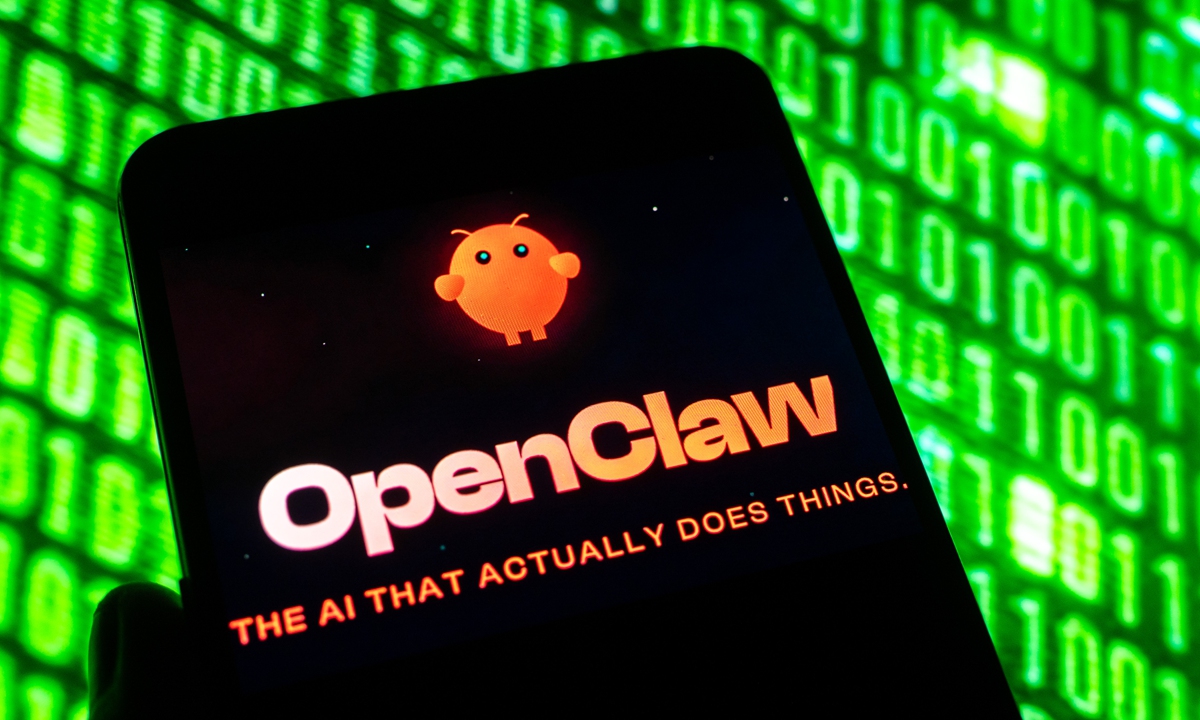
Photo: VCG
Last week, at the foot of the Tencent skyscraper in Shenzhen, citizens clutching their laptops formed long lines, patiently waiting to participate in a free installation event for OpenClaw - an AI agent affectionately dubbed the "crayfish." Across the Chinese internet, downloading and mastering OpenClaw has evolved into a nationwide obsession.
How did an open-source program, written by an Austrian developer during his weekends, morph from an obscure GitHub project into a national phenomenon in China in just a matter of weeks?
The answer is the story of an era.
OpenClaw's Western discourse remained mostly within academia and the tech industry. In China, it rapidly went mainstream, moving from developers to entrepreneurs, businesses and the general public. The speed of adoption was driven more by the environment than by the software itself.
China boasts one of the world's largest software developer ecosystems. According to the Ministry of Industry and Information Technology, the country is home to over 9.4 million software developers, more than 2.2 million active open-source contributors and nearly 18 million GitHub contributors - about the same as the population of Shenzhen, or two Austrias.
Most of them can write code, understand new technology, and have a natural sensitivity to innovative applications.
This massive developer base, coupled with China's unique hyper-competitive culture, has generated a drive for learning that is unparalleled globally.
In China, the anxiety of falling behind the technological curve is palpable and deeply personal. Once an AI tool proves it can boost efficiency and help secure economic opportunities, news of it spreads like a spark in dry tinder - it doesn't slowly burn; it detonates.
OpenClaw is practical to some extent. It can take action, genuinely operate a computer and execute tasks. A large user base enables fast deployment, data collection, and feedback.
Of course, when problems arise - improper installation and use of the OpenClaw agent have already led to several cases involving serious security risks - authorities step in. The National Computer Network Emergency Response Technical Team/Coordination Center of China on Tuesday issued a risk alert regarding the safe use of OpenClaw.
What binds all these elements together and elevates them to a higher plane is state power.
The 15th Five-Year Plan (2026-30) draft outline has already explicitly incorporated "information and communication networks" into the nation's new infrastructure projects. It represents a strategic chessboard of staggering scale.
The State Grid has announced a fixed-asset investment of 4 trillion yuan (roughly $550 billion) over the 15th Five-Year Plan period, averaging 800 billion yuan annually. One of its primary objectives is to build a dedicated power supply system to support AI data centers.
AI's energy demands are massive. Data centers rival cities in electricity consumption, making computing power a race for electrical power. China leads the world in electricity consumption (over 10 trillion kWh) and renewable power generation (two-thirds of the world total).
Crucially, China's industrial electricity rates are approximately half those of the US. This means running AI data centers in China offers a massive structural cost advantage.
This isn't a sudden miracle; it is the concentrated realization, in the AI era, of national dividends accumulated over decades of relentless infrastructure build-out.
China has prepared for this moment: a colossal developer army, ferocious market demand, visionary infrastructure planning and a clear-eyed national strategy.
Finally, there is a hard truth that might make some people uncomfortable, but it must be said. For years, the US has imposed sweeping high-tech blockades and sanctions on China - chips, equipment, software, wave after wave. The premise was to widen the technological gap and install a permanent glass ceiling.
But Chinese developers never stopped coding. That is why, when an Austrian programmer released an open-source tool, the Chinese transformed it into a national phenomenon at breakneck speed. Furthermore, when problems occur, solutions emerge. This in itself provides support for the next stage of AI tool development. Every user question and every piece of feedback from society helps China understand how to achieve harmonious coexistence between AI and human society.
The Chinese people embrace AI not as a cold machine, but as a companion in the country's story. China aims to stay at the forefront of global technology and create new opportunities for its people.
Key Words: Embrace AI, OpenClaw, China





















































































 京公网安备 11010802037854号


