Commentaries
Your Present Location: Teacher_Home> Cai Tongjuan> CommentariesBRI moves from concrete and cargo to standard setting
BRI moves from concrete and cargo to standard setting
Source: China Daily
Update: Mar 19th, 2026, 7:52 AM
WANG XIAOYING/CHINA DAILY
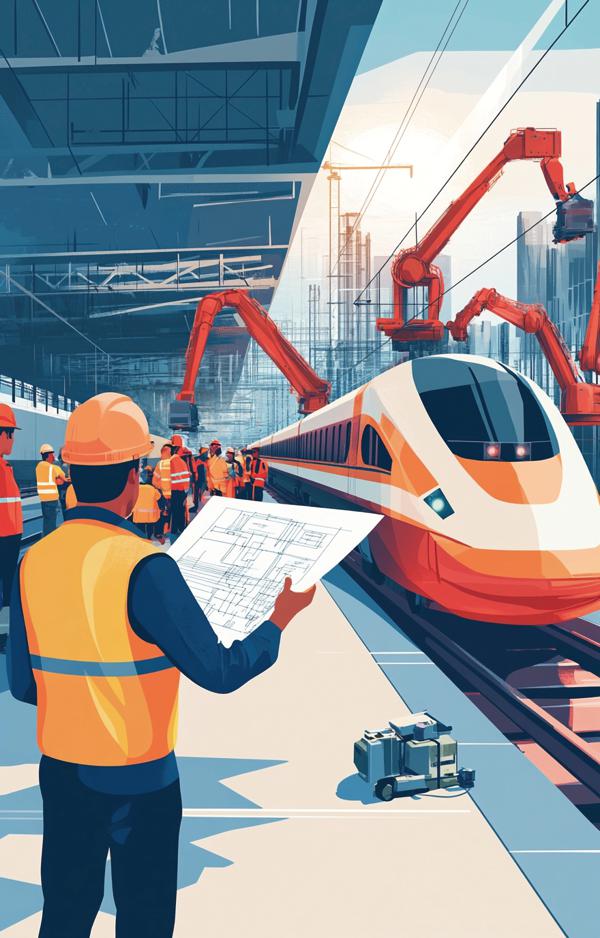
For much of its first decade, the Belt and Road Initiative was measured in steel and stone. Freight trains rumbling across Eurasia, ports expanding and bridges rising. The map filled in. Today, the more consequential shift is harder to photograph. From artificial intelligence governance to green finance, from cross-border data flows to sustainable supply chains, China has become increasingly active in international rule-making conversations. These are not isolated diplomatic gestures. They point to a deeper strategic recalibration. The emphasis of high-quality BRI cooperation is moving beyond the "hard connectivity" of railways, highways and ports toward the "soft connectivity" involving rules, standards and institutional alignment. The initiative is evolving from building projects to shaping frameworks.
The distinction matters. Physical infrastructure can move goods. But without compatible legal, financial and digital systems, those goods move inefficiently — and sometimes not at all.
Consider the China-Europe freight trains. They have become emblematic of Eurasian connectivity. Yet railway waybills in international trade often lack full property-right status.
Meanwhile, divergent data regulations mean cargo information may need to be declared multiple times as it crosses jurisdictions.
The lesson is clear. Steel tracks alone do not guarantee economic dividends. Connectivity without regulatory interoperability risks becoming a bottleneck. This is why "high-quality cooperation" has become the operative phrase for the next stage of the BRI. The metric is no longer how many trains depart or how many kilometers of track are laid. It is whether participating countries can build a cooperative ecosystem with mutual recognition of standards, industrial integration, shared risk management and equitable distribution of benefits.
China's role within that ecosystem is subtly changing. In the early years, it was primarily a financier and builder of international public goods. Increasingly, it seeks to act as a co-designer of rules and a provider of governance solutions.
Some of this shift is already visible in technical pilot projects. Efforts to digitize and securitize cross-border railway waybills using blockchain technology aim to transform them into divisible, pledgeable electronic instruments. If successful, such instruments could serve as collateral for small and medium-sized enterprises along BRI corridors, expanding access to trade finance.
Parallel explorations are underway in areas such as mutual recognition of digital customs procedures, harmonization of environmental, social and governance disclosure standards, and the establishment of arbitration mechanisms tailored to BRI projects.
Crucially, this emerging model is not framed as a one-way export of Chinese standards. Its viability depends on compatibility. In cross-border data governance, for example, pilot mechanisms aim to facilitate efficient customs clearance while preserving policy space for national data localization requirements. The design logic is modular rather than monolithic — standards that can be "plugged in" and adapted to diverse regulatory environments.
That approach reflects a broader geopolitical reality. The global trading system is under strain. Reform of the World Trade Organization has stalled. The United States and the European Union are accelerating club-based regulatory frameworks in areas such as digital trade and green subsidies, often leaving developing economies on the margins of standard-setting processes.
Against this backdrop, the BRI offers China a platform to convene rule-based dialogues in emerging domains — digital governance, green finance, supply chain resilience — that emphasize inclusivity and developmental pragmatism. For many countries in the Global South, participation in standard-setting is not a theoretical exercise. It shapes their access to markets, technology and capital.
Of course, rule-building is inherently more complex than bridge-building. Technical standards can become arenas of strategic competition. Legal systems differ. Geopolitical tensions intrude. The risk of being perceived as pursuing institutional expansion rather than mutual benefit is real.
Yet the early signs suggest that solution-oriented cooperation retains appeal. In areas such as artificial intelligence governance and green standards, recent international engagements indicate that many countries prefer incremental, problem-driven frameworks over ideological polarization.
The coming five years will test whether the BRI can successfully transition from corridor economics to a symbiotic governance ecosystem. Its sustainability will hinge on its ability to reduce transaction costs, improve regulatory certainty and generate broadly shared gains.
A new experiment in global governance is taking shape — one that suggests connectivity in the 21st century is defined as much by code and contract as by concrete and cargo.
Cai Tongjuan is the deputy dean of Chongyang Institute for Financial Studies at Renmin University of China, and Gan Wenjing is the vice-president and chairman of Xinjiang Catering Culture Professional Committee of the Malaysia Chinese Restaurant Association.
Key Words: BRI, Standard setting, Infrastructure






















































































 京公网安备 11010802037854号


