LATEST INSIGHTS
Your Present Location: LATEST INSIGHTS-
Zhao Minghao: UK aiming for win-win cooperation with China
President Xi Jinping`s forthcoming state visit to the UK heralds a "golden era" in ties between China and Britain. During his trip to China in September, UK Chancellor of the Exchequer George Osborne stated China will become the center of the global economy and Britain not only welcomes the rise of China, but ought to be China`s best partner in the West.
2015-10-19 -
Jia Jinjing: China’s Great Game: Road to a new empire
If this approach does not work, China will be faced with some grim alternatives — either turn tail and leave, or risk getting bogged down in security commitments and local politics. It has made clear that it does not want to replace the US in Afghanistan nor does it see itself as a regional policeman. “China will not fall into the same mistakes,” says Jia Jinjing, a specialist on south Asia at Beijing’s Renmin University.
2015-10-19 -
John Ross: UK correct to ignore US concerns about building closer cooperation with China
Xi Jinping`s visit to Britain from October 19 to 23 represents a triumph of China`s diplomacy - a demonstration of how firmness on principles together with willingness to meet any positive openings halfway can yield big benefits for China and other countries.
2015-10-19 -
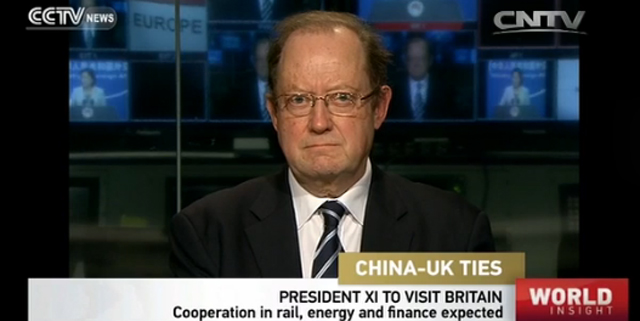
John Ross accepts an interview on Xi `s visit to Britain
John Ross accepts an interview by CCTV on President Xi Jinping`s visit to Britain.
2015-10-19 -
John Ross: Britain & China`s `win-win` with Xi Jinping`s visit
Britain was once the world`s largest economy and most powerful state, but this position has been taken by the US and increasingly by China. Thanks to Britain`s long period of development it retains a standard of living China is still growing towards.
2015-10-16 -
Liu Zhiqin: Conclusion of TPP marks start of post-China era
The conclusion of Trans-Pacific Partnership (TPP) negotiations has touched a global nerve. Does the formation of the TPP foreshadow the end of China`s era?
2015-10-16 -
Wang Yanhang: Heavy engagement in derivatives a risk to economy
Deutsche Bank, the largest bank in Germany, recently said it will probably post a third-quarter loss of 6.2 billion euros ($7.1 billion), causing wide concern among the international banking community. One reason for the huge loss lies in the bank`s risk management strategy. For instance, by the end of 2013, the bank`s derivative exposure was more than 54.6 trillion euros ($75 trillion at the time), which was 100 times larger than its 522 billion euros in deposits, 20 times larger than Germany`s
2015-10-15 -
Rakesh Gupta: China must reduce interventions in commodities markets
Following the continued success of market models in China - especially the stock markets and, more recently, the commodities markets - President Xi Jinping announced the introduction of an emissions trading scheme during his visit to the US last month. This trading system will be based on a cap and trade mechanism, which is widely regarded as the best mechanism for reducing emissions.
2015-10-14 -
Liu Zongyi: Economic reform best response to TPP
News that the US, Japan and other 10 Pacific Rim countries finalized the Trans-Pacific Partnership (TPP) Agreement early this month has caused a stir among both domestic and foreign media. Barbed remarks such as "China has suffered a setback in competing for predominance in formulating new rules for global trade" and "China has been thoroughly isolated" have been common.
2015-10-14 -
Hu Yuwei: Will TPP really have a detrimental impact on China?
Once the pact comes into effect, taxes and tariffs on most goods and services produced within the trade zone formed by the agreement would drop and ultimately fall to zero. Therefore, the biggest impact on China would be a possible decline in Chinese exports, as Chinese exports to TPP countries such as Japan and the US could be substituted with similar competitive products made in other TPP countries like Malaysia and Vietnam. Such potentially negative effects are largely hypothetical, however,
2015-10-12 -
Zhao Minghao: Agreement centered on protectionism, not free trade
Apparently, news that the US, Japan and 10 other Pacific Rim nations have finalized the Trans-Pacific Partnership (TPP) agreement has made many Chinese over-upset and many Americans over-thrilling. It`s a pity that people tend to seek as simple as possible answers when the global affairs become increasingly complicated. Just as China has realized the establishment of the Asian Infrastructure Investment Bank is a major test instead of a smashing victory, the TPP is no panacea for the US economic
2015-10-09 -
Zhao Minghao: Replenishing a new type of Sino-US ties
Chinese President Xi Jinping has successfully concluded his first state visit to the United States and reached a bilateral consensus on some 50 agreements involving economic relations, internet security, climate change, cultural and educational exchanges, in order to build a new model of major country relations.
2015-10-08 -
Zhao Minghao: The US needs to reciprocate China’s goodwill
Chinese President Xi Jinping`s first state visit to the US sent two impressive messages. First, he reiterated both in Seattle and Washington that China will never stop reforms or close its doors to the outside world, and China made a strategic decision to firmly adhere to the path of peaceful development. Second, China will prioritize a new type of major power relationship with the US despite the ups and downs.
2015-09-27 -
He Weiwen: No Hard Landing in Chinese Economy
Since the start of August, the stock-market plunge, RMB moderate devaluation to the dollar and the recent weak economic data have led to mounting pessimism about the Chinese economy in the world. Some experts and media ascribed the global market’s panic selling to the Chinese stock-market plunge, and the continuous deprecation in many emerging-market currencies to RMB devaluation. A prevailing saying goes that “When China sneezes, the world catches cold”. An article in the Financial Times in lat
2015-09-25 -
US needs a BIT with China to safeguard its overseas investments
As Chinese President Xi Jinping begins his first State visit to the US on Tuesday, hopes are high for another breakthrough in the bilateral investment treaty (BIT) negotiation, which analysts say will help both countries safeguard their overseas investments and boost the US manufacturing industry.
2015-09-23 -
Climate change high on agenda of Chinese President Xi`s visit to US
Mr Xi’s visit comes almost two years after he became the president, at a time when Chinese investments in the US remain at an all-time high. Analysts say the visit will strengthen ties between the two sides.
2015-09-23 -
China, US should not risk alienating each other
During Chinese President Xi Jinping`s State visit to the US, economic issues will no doubt be high on the agenda of his meetings with US President Barack Obama. Economic exchanges have been an anchor for China-US relations during the past three decades. But many observers are now concerned that China and the US are alienating one another over economic issues, even though bilateral trade exceeded $550 billion in 2014.
2015-09-23 -
Business elite will lead Washington onto right path with Beijing
Prior to Chinese President Xi Jinping`s US tour, I visited over 10 US think tanks. They, enveloped by the influence of interest groups, were talking of trivial matters - for instance, China`s cyber theft, the South China Sea issue and the deteriorating Chinese business environment. They argued that those concrete problems should be put on the agenda of Xi`s trip.
2015-09-23 -
Beijing and Washington need to be common defenders of global stability
Prior to Chinese President Xi Jinping`s US visit, China and the US reached an important consensus on the cyber security issue during a visit by Xi`s special envoy Meng Jianzhu, a member of the Political Bureau of the Central Committee of the Communist Party of China. This sends a positive signal that the two countries have confidence in dealing with new challenges in the 21st century such as cyber security with cooperative approach and that more such deliverables will enrich the new type of majo
2015-09-22 -
China seeks partnerships with world
"Do you still uphold the idea of `G2?`"I asked Fred Bergsten, director of the Peterson Institute for International Economics, in Washington recently. Bergsten raised the idea of China and the US developing a "G2" partnership in 2008. He talked a lot to me, with the clear message that he still believes in the idea now.
2015-09-22





























































 京公网安备 11010802037854号


