LATEST INSIGHTS
Your Present Location: LATEST INSIGHTS-

Liu Zongyi: Lack of authoritative leadership hinders India’s reform
Why is India having trouble promoting economic reform? It may be due to the political ecology of this country. India lacks a centralized authority similar to that of China, led by the Communist Party of China (CPC), which is the driving force of the nation`s rapid economic development.
2017-11-01 -
Chen Dingding: China Has a New Grand Strategy and the West Should Be Ready
For a long time scholars and pundits have debating whether or not China has a clear grand strategy. Most believe the answer is “No,” mainly because the Chinese government has never clearly articulated a coherent version of grand strategic thinking in front of the world. Now that has changed.
2017-10-31 -

The great SOE turnaround
Last week, the 19th National Congress of the Communist Party of China learnt that since the last congress in 2012, as many as 34 central State-owned enterprises, or SOEs, have been restructured, with their overall number falling to 98 from 117.
2017-10-30 -

Zhao Minghao: China, America can be great together
US President Donald Trump will start his official visit to China on November 8, just days after the Communist Party of China (CPC) concluded its 19th National Congress. In his report to the Congress, Xi Jinping announced that his government will build a "great modern socialist country" by the middle of the 21st century while Trump is making efforts to "Make America Great Again." At the moment, the relationship between China and the US needs to be redefined to make the two countries become great
2017-10-30 -
Chen Xiaochen: Sino-US innovation cooperation promising for world
US President Donald Trump Wednesday congratulated Chinese President Xi Jinping on being re-elected general secretary of the Central Committee of the Communist Party of China. This set a harmonious tone for Trump`s visit to China in November.
2017-10-30 -
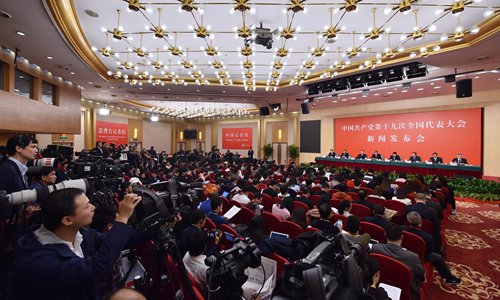
China shifts to quality growth
China`s focus has shifted to higher-quality growth and will no longer target doubling the country`s GDP in its two-stage development plan from 2020-2050, a senior official said on Thursday.
2017-10-27 -
How China can avoid middle income trap in a new era
The middle-income trap is what happens when economic stability becomes economic stagnation. The World Bank estimated in 2012 that of 101 middle-income economies in the 1960s, only 13 became high-income ones in 2008.
2017-10-27 -
Partnership between China, South Asian nations can make better Asia: Experts
Connectivity of China with South Asia under the Belt and Road Initiative can only make a better Asia, experts said in Kavre, Nepal on Tuesday.
2017-10-27 -

Ding Gang: Trump won’t withdraw US from Asia-Pacific
US Secretary of Defense James Mattis is paying an eight-day visit to Asia in a bid to "reaffirm the enduring US commitment to the Asia-Pacific region." It`s seen as preparation for US President Donald Trump`s upcoming trip to Asia in November.
2017-10-26 -

China set to steer clear of significant slowdown in new era
The Chinese economy will be able to steer clear of rapid declines in GDP growth during the new development era, a prominent economist has said, while ruling out the possibility of an immediate rebound.
2017-10-26 -
Indian official misrepresented Chinese scholar’s statement
Chinese experts Wednesday slammed an Indian official`s remarks that China has been culturally controlled by India, saying the official is trying to boost the country`s national pride.
2017-10-26 -

What does modernizing China`s economy really mean?
A modern economy is an urgent requirement for a smooth economic transition and a strategic goal, according to Xi`s report delivered at the opening of the congress. It will be achieved through supply-side structural reform, innovation, a socialist market system and opening up.
2017-10-25 -

Liu Zhiqin: The greatest revolutionary practice: Dreaming of prosperity
Xi realized that the mission to fight against poverty must be carefully planned to avoid any possible mistakes. That is why he asked the government at all levels to take "targeted efforts" to alleviate poverty. There are so many measures and guidelines to guide the whole society in order to facilitate the process of poverty alleviation.
2017-10-25 -
Zhao Minghao: US can woo, but India must cherish its independent diplomacy
Many contradictions still remain in India-US relations. Modi won`t satisfy all Trump`s demands in trade and market openness because of his "India First" thought mode and Washington and New Delhi hold different opinions about global climate change and the green economy.
2017-10-24 -
Xi`s report reflects grand vision
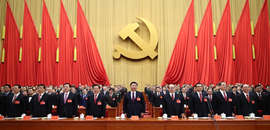
Xi`s report shows China is at the intersection of continuity and change. At the core of Xi`s report was a firm dedication to the central missions of the Party: national unity, prosperity and modernization.
2017-10-24 -
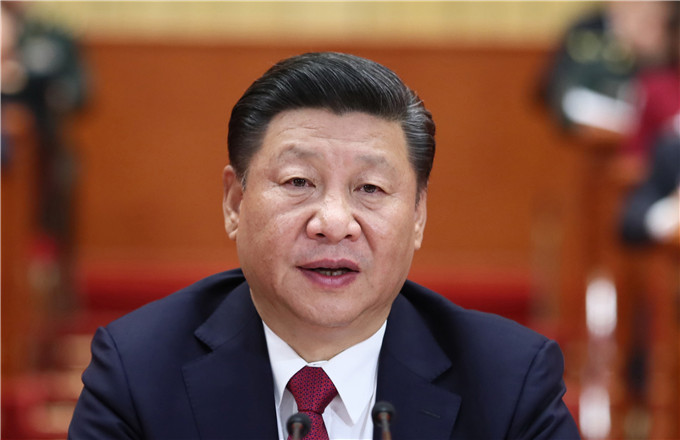
Liu Zhiqin: Xi’s report: manifesto of CPC in a new era
Xi`s report to the 19th CPC National Congress proves to the world that more than one path is available for countries striving to pursue socio-economic development and modernization. The development pattern in the West doesn`t fit all nations. China`s development experience shows that one can follow China`s path to head toward the modernization that was achieved in the developed world.
2017-10-24 -
John Ross: Financial crises show superiority of Chinese model
This year marks the 20th anniversary of the Asian financial crisis and the 10th of the start of the global financial crisis. As these anniversaries coincide with the 19th National Congress of the Communist Party of China, it seems an appropriate time to analyze the achievements and trends of China`s economy in the wake of these major crises and of China`s relations with the rest of the world.
2017-10-23 -
Overseas infrastructure expanding
"Infrastructure is the first step, and it will be followed with trade and investment and industrial cooperation. Efforts to facilitate trade and investment also matter and soft infrastructure improvements such as bilateral agreements on boosting customs clearance and newly opened air links have also increased over the past five years," Liu noted.
2017-10-23 -
Han Hua: People’s New Era: Tackling inequality and growth
A new era does not start overnight. When it comes to one of the nation’s most fundamental interests - people’s livelihood and welfare - Xi Jinping and his team have been hard at work on a daily basis for the past 5 years (or even longer.) Hence, the 19th CPC National Congress is just a “comma,” or a “milestone” opportunity to summarize the two key concepts of its mission: “People” and “new era”.
2017-10-23 -
Guan Zhaoyu: Amid continuing scandals, Japan needs a rethink
On October 16, a fleet of Hitachi-built high-speed trains bought by the British Great Western Railway Corporation (GWR) started operation, on a route from Bristol to London, but it wound up as a total failure as severe delays and water leakage interrupted the journey.
2017-10-20

















































 京公网安备 11010802037854号


