LATEST INSIGHTS
Your Present Location: LATEST INSIGHTSChina seeks to cushion AI impact on jobs, build talent strength
China seeks to cushion AI impact on jobs, build talent strength
Source: Khmer Times
Update: Jan 13th 2026
Author: Ding Zhunag
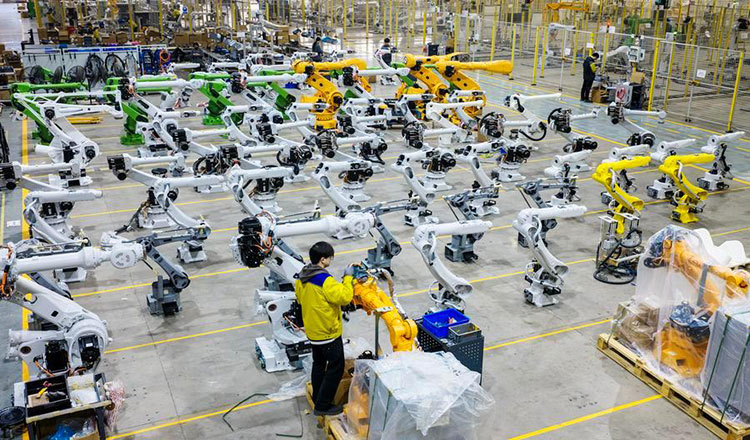
Beijing – From chatbots to autonomous vehicles, artificial intelligence (AI) is reshaping how work gets done in China, boosting efficiency while redrawing industrial boundaries. However, the shift has heightened concerns about job displacement.
Acknowledging short-term disruption, economists believe AI is less the end of jobs than a transformative force that, much like earlier waves of technological revolutions, will restructure the labor market by giving rise to new professions and work models.
China’s policymakers, for their part, are acting to guide AI’s development in an effort to cushion its impact on employment, while also stepping up investment in human capital, aiming to build a workforce better.
Analysts said concerns about technology displacing workers are hardly new. Every major technological leap, from the steam engine to mechanization, has triggered similar fears.
"Even as some traditional roles are gradually fading, AI raises productivity and opens space for new industries, creating new opportunities and redefining employment in the future," said Wu Jie, an analyst of think tank DRCnet.
In August 2025, the State Council rolled out guidelines for the “AI Plus” initiative, calling for broader use of AI to create new jobs and upgrade existing ones, while steering innovation resources toward sectors with strong employment potential.
The World Economic Forum has projected in a report that by 2030, AI and data processing technologies would have created about 11 million jobs worldwide, more than offsetting the roughly 9 million jobs they are expected to displace. Notably, this dynamic is already visible in China.
China's AI core industry is approaching a scale of 600 billion yuan (around 85.58 billion U.S. dollars), according to Ding Zhuang, a research fellow at Chongyang Institute for Financial Studies at the Renmin University of China. “From breakthroughs in large language models and algorithms to the deep integration of AI with manufacturing, services and biotech, demand for talent is surging,” he said.
The Ministry of Human Resources and Social Security has identified 72 new occupations over the past five years, with more than 20 tied directly to AI. Each new occupation is expected to generate jobs for 300,000 to 500,000 people in its early stages.
Autonomous driving offers a telling case study. Rather than simply replacing drivers, companies are creating roles that combine operational experience with digital skills.
Firms behind robotaxi services are hiring ground-safety supervisors, vehicle testers and dispatch algorithm engineers. Many openings give priority to former taxi, bus or ride-hailing drivers, reflecting a push to retrain rather than discard traditional workers.
One such transition is Zhang Chao, a former car leasing manager who is now a remote safety operator for robotaxis in Beijing. He monitors autonomous vehicles in real time and intervenes when necessary, such as rerouting cars in response to road closures.
“The factory floor used to be about assembling, welding and repairing. Now workers are shifting from holding wrenches to managing systems, becoming testers and operators for intelligent connected vehicles,” said Wang Hao, a researcher at the China Center for Information Industry Development.
Key Words: China, AI, Jobs










































































 京公网安备 11010802037854号


