LATEST INSIGHTS
Your Present Location: LATEST INSIGHTSHow China’s sharper tech edge forces South Korea to rethink decades of industrial ties
How China’s sharper tech edge forces South Korea to rethink decades of industrial ties
Scholars urge a pivot to shared AI and EV standards and cooperation, while an upgraded China-South Korea free-trade pact is deemed vital
Source: SCMP
Update: May 8th, 2026 6:30 PM
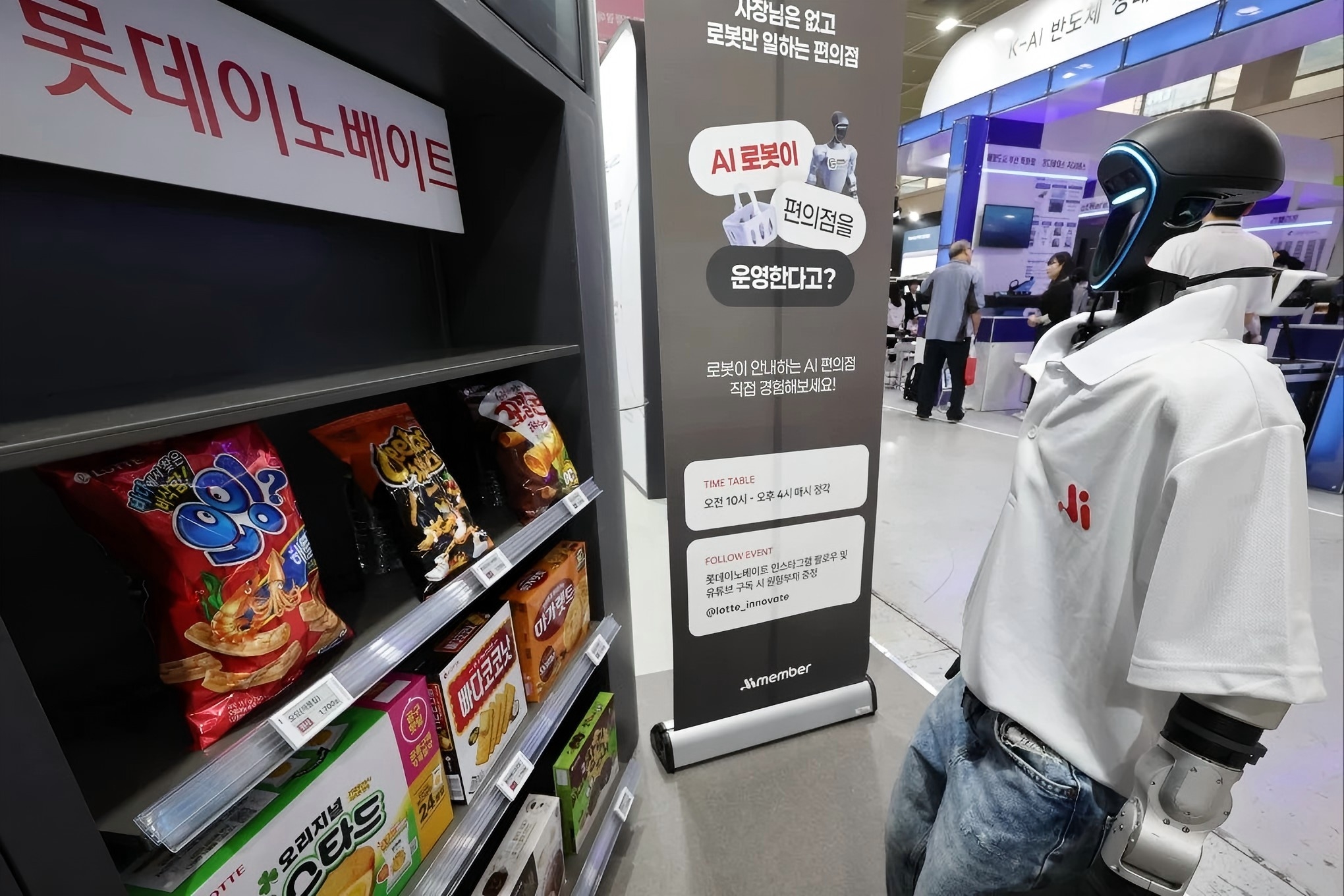
An artificial intelligence-powered robot works at a “convenience store” during the 2026 World IT Show in Seoul. Photo: EPA
China’s rapid technological gains and aggressive pricing are making it increasingly difficult for South Korean firms to find profitable areas of industrial synergy with their Chinese counterparts, according to experts.
Speakers at a recent forum in Beijing urged firms from both countries to pivot towards building more interdependent ecosystems in high-growth sectors such as batteries and artificial intelligence, while also calling for the advancement of negotiations towards an upgraded free-trade agreement.
“Industries in each country must re-evaluate their core strengths to build a synergistic, interdependent global supply chain,” Seo Bong-kyo, head of Samsung Global Research China, said on Thursday during a seminar co-hosted by Renmin University and the South Korean embassy.
Seo argued that both nations should look beyond conventional rivalry, according to an event summary published by the Chinese organiser.
“China’s push to expand domestic demand offers a new opening for South Korean firms to enter high-value markets,” he was quoted as saying.
Economic ties between Beijing and Seoul – a key US ally in East Asia – have slowly recovered from a protracted downturn following the 2017 deployment of an American anti-ballistic missile defence system known as Terminal High Altitude Area Defence (THAAD).
Following a high-profile visit by South Korean President Lee Jae Myung in January, China emerged as South Korea’s top outbound travel destination in the first quarter, according to the Yonhap News Agency.
Despite the diplomatic thaw, trade and tech competition are intensifying, according to Renmin University professor Cheng Xiaohe, who spoke at the same seminar. However, the professor of international studies suggested that the “compete-while-negotiating” dynamic of China-US relations could help ease regional policy tensions.
The pressure on Seoul is quantifiable, with a government report this year finding that China had surpassed South Korea in 11 key sectors between 2022 and 2024, including rechargeable batteries – an area Seoul once dominated.
But Li Dongxin, a professor of international politics and economics at Shandong University, said China-South Korea cooperation is “moving towards horizontal coordination” in manufacturing and new energy. Also speaking at the event, she pointed to power batteries as a key sector for cooperation.
“By joining forces in R&D and standard-setting for EVs and solid-state batteries, the two countries can leverage their respective strengths to generate significant spillover effects across technology, markets and policy,” she was quoted as saying.
Scholars at the seminar also called for faster progress on an upgraded China-South Korea free-trade agreement (FTA).
The second phase of their FTA “should be upgraded into a comprehensive platform covering industries, technology, environmental standards and investment rules”, Nam Eun-young, an assistant professor of global trade at South Korea’s Dongguk University, was quoted as saying.
Nam reportedly called for “selective deepening” in AI cooperation, specifically targeting healthcare, digital education, smart cities and carbon governance.
The push for an upgraded FTA is now a strategic necessity in the face of shifting global alliances, according to Li Xiangyang, director of the National Institute of International Strategy (NIIS), a think tank under the Chinese Academy of Social Sciences.
Li of NIIS reportedly said at the seminar that China and South Korea should accelerate FTA talks to elevate bilateral cooperation to a higher strategic level as a counterweight to the US-led “Pax Silica” initiative.
Last month, China and South Korea concluded their 14th round of so-called FTA 2.0 negotiations, focusing on services, investment and negative-list frameworks, according to the Ministry of Commerce.
Key Words: China, South Korea, Cooperation










































 京公网安备 11010802037854号


